The CAT rating is a safety specification, not a quality grade · review
AstroAI Digital multimeter with ceramic fuses review
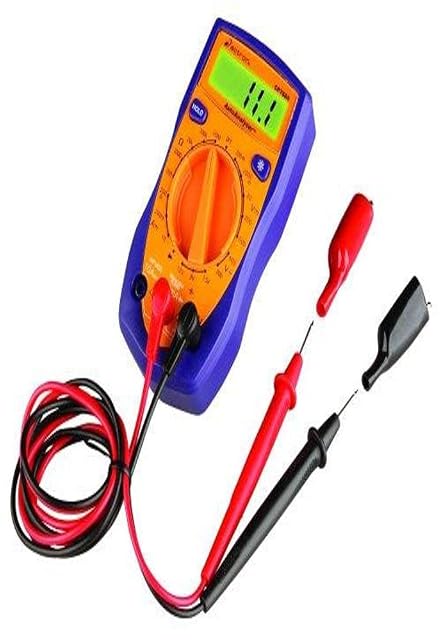
A compact meter whose distinguishing specification is its protection: a double ceramic fuse stated as flame-retardant, plus a silicone sleeve, at fourteen euros.
What the figures leave us with The fusing is the reason to pick this over its neighbors. It is also one of only two meters here that mention their fuses at all — and the other, the KAIWEETS KM100, states double fuses without saying what they are made of.
Fourteen euros, and one of only two listings in this hub that talk about the fuse at all.
What the manufacturer publishes
Accurate measurement of AC and DC voltage, DC current, resistance and diodes. A sampling rate of two measurements per second and a 0.6-inch backlit LCD. A data-hold function, a low-battery indicator and an audible continuity tester. A double ceramic fuse, stated as flame-retardant and protecting against overload, and a silicone sleeve protecting the meter.
The component nobody advertises
Ask what fails dangerously in a multimeter and the answer is the current input. Put the probes across a live supply with the meter set to amps, and the only thing between you and a short circuit is the fuse. Ceramic, sand-filled fuses are specified for that job; glass ones are not. This is the only listing in this hub that names the TYPE. The KAIWEETS KM100 states double fuses and never says what they are.
What is still not stated
No measurement category, no true-RMS, no AC current. The first is a safety specification and its absence is the pattern of this whole hub; the other two are capability limits that put this meter firmly in the household and hobby band.
Availability
Read on the day this page was built: $17 at the American Amazon shop.
Read from Keepa on the day this page was last revised; stock and price both move without notice.
Prices quoted in this text were read on 31 August 2026. The live price is at the top of the page.
What it has, and what it lacks
Strengths
A double ceramic fuse, stated as flame-retardant and protecting against overload — the right fuse type for a meter
A protective silicone sleeve included rather than sold separately
Audible continuity, data hold and a low-battery indicator
A stated sampling rate of two readings per second
On sale across all six markets
Compromises
No measurement category published
A 0.6-inch display, the smallest in this hub
No true-RMS and no AC current range
Specifications
Amazon reference
B01ISAMUA6 (identical on 6 markets)
EAN
0756910381981
Voltage measurement
AC/DC voltage
Current measurement
DC current
Functions
resistance · diode
Fuse
double ceramic fuse
Where this one lands in its group
At $15, it is the 3 cheapest of the 7 models in this category published here.
Cheapest in the group$11
Median$25
Dearest in the group$75
What gets asked here
Why does a ceramic fuse matter?
The fuse in a meter's current input is a safety component. A ceramic sand-filled body is specified where the meter must interrupt a high-energy fault; a glass fuse of the same current rating does not do the same job. AstroAI states double ceramic fusing, which most meters at this price do not mention at all.
What category is it rated to?
The listing does not state one. Follow the manual supplied with the meter, and treat the absence of a published category as a reason to keep it away from anything beyond a socket outlet.
What does two samples per second mean?
The display updates twice a second. On a changing signal that is slow, and it is the normal rate at this price.
Our score
7.8/ 10
The fusing is the reason to pick this over its neighbors. It is also one of only two meters here that mention their fuses at all — and the other, the KAIWEETS KM100, states double fuses without saying what they are made of.
Against the measuring instruments in the same bracket
Same category, nearby prices, between measuring instruments. What remains is the specifications every one publishes — half empty, a column is no use.
AC and DC, stated, at CAT III 600 V. This shelf's buying tip insists the category and the voltage are one specification rather than two, and this is the only listing on this shelf that gives them as one: CAT III AND 600 V, in the same phrase
DC ONLY, and the listing says so outright: "DC current (Can not for AC current)". No ampere figure is published. That is the limit of the instrument and it is stated in a bullet rather than buried — which is more than can be said for a good deal of this shelf
AC and DC voltage, DC current, resistance, continuity and diode measurement, with a DATA HOLD and a backlight. No resistance ceiling is published — the MM325 states 2 MΩ, the MM450 50 MΩ, the published coczow 20 MΩ. A rotary switch sets the range, and the listing asks you to check it is in the right position, so the ranging is manual
AC and DC, stated, with no maximum published. That is the gap on this page: every other meter on this shelf that publishes a voltage states 600 V. Battery tests are called out at 1.5 V, 9 V and 12 V, which is where this meter is meant to live
DC current, stated, with no ampere figure. Three of the four American meters on this shelf read DC current only; the Klein MM450 is the exception
19 RANGES, stated — the only range count published anywhere on this shelf. AC and DC voltage, DC current, resistance; tests for diodes, batteries, FUSES, switches, solenoids and relays. The word "fuses" in that list is the reason this line was relevéd on the multimeter-fuses shelf: it TESTS them. A hold button retains the reading, and there is a low-battery indicator and overload protection
What the models do not share, in measuring instruments
If price decides: Actron Automotive multimeter, 19 ranges, at $11.
This one’s price among measuring instruments
A reference exists on these Amazon stores: France, Germany, Italy, Spain, United Kingdom, United States. Listed is not the same as in stock — availability changes daily.
Details checked on August 31, 2026.
Who should pick this one, among measuring instruments
A first multimeter for household and hobby electronics, chosen for its fusing rather than its features.
Accessories stated to fit this instrument
Listed because the accessory names this instrument itself.
Amazon reports what buyers took in the month before this page was last checked: at least 10,000.
The figure is a floor, rounded by Amazon, and read through Keepa — it says what buyers picked, not what a maker claims.
Sources
Specifications: the manufacturer sheet for measuring instruments and the matching Amazon product page. Prices and availability: Keepa. Every figure on this page names its source.
True RMS · 6000 counts · 600 V · temperature, capacitance and frequency
A true-RMS meter with 6000-count resolution and a wide function list — voltage, current, resistance, temperature, diode, continuity, capacitance and frequency — with probe caps included.
Best for: Household and light installation work where waveforms are not clean and the reading has to be right.
19 RANGES, the only range count published on this shelf · 10 MΩ input impedance, stated for automotive computer circuits · automatic POLARITY sensing · automatic zero on volts, amps and battery tests · battery tests at 1.5, 9 and 12 V · the ONLY meter on this shelf sold WITHOUT its battery · NO measurement category
An automotive meter built around the one specification car electronics actually need — a 10 MΩ input impedance.
Best for: Car and bench electrical diagnosis, where the circuits are 12 V and the sensors must not be loaded by the meter