Skip to content

The best digital calipers for 2026

A caliper display showing 0.01 mm is stating its resolution, not its accuracy — those are different figures, and the manufacturer usually publishes accuracy separately, often at ± 0.02 mm (0.001 in) or ± 0.03 mm (0.001 in) over the range. Reading the first number as the second is the most common mistake in this family. The rest is construction: hardened stainless steel, a beam that does not flex, and an ingress rating if coolant or dust is involved. We compare range, stated accuracy against display resolution, material, IP rating, and inside, outside, step and depth jaws.

The models we recommend

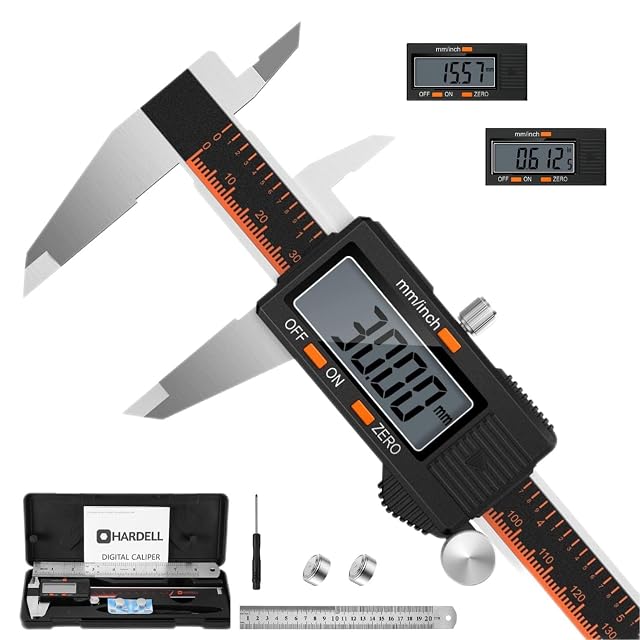
  1. HARDELL Digital caliper, 150 mm (5.91 in)

    150 mm (5.91 in) · ± 0.02 mm (0.001 in) stated · hardened stainless · four modes

    A hardened stainless caliper stating ± 0.02 mm (0.001 in) over 0–150 mm (0 to 5.91 in), splash and dust protected, with the four standard measuring modes and a zero button.

    Best for: The value pick: a published tolerance and hardened jaws, without paying for a named standard.

    7.8/10

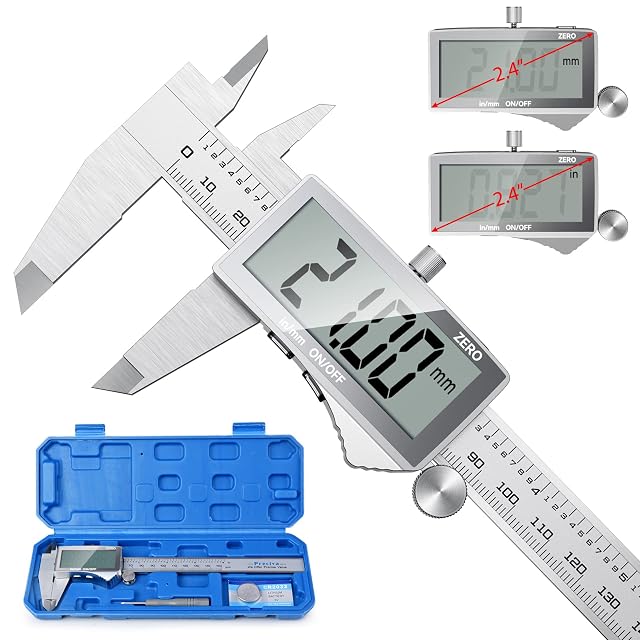
  2. Preciva Digital caliper, 150 mm (5.91 in)

    150 mm (5.91 in) · 0.03 mm (0.001 in) resolution stated · hardened stainless · four methods

    A hardened stainless caliper over 0–150 mm (0 to 5.91 in) with four measuring methods — and a stated resolution of 0.03 mm (0.001 in), which is coarser than the 0.01 mm step these tools normally display.

    Best for: General workshop measuring where hundredths are not the deciding factor.

    7.8/10

Need by need, within digital calipers

Measuring large parts

The measuring capacity is a hard limit: beyond it, the jaws will not open. It decides what you can check.

ORTHLAND de-kachi2

A workshop caliper

A standard capacity covers virtually every part in a home workshop, in a more manageable instrument.

ORTHLAND de-kachi2

Keeping its cell for more than a month

A caliper that never truly switches off drains its coin cell in three weeks in a drawer. The stated auto-off decides the state of the tool when you need it.

MIB Germany 1

Who each family suits, across digital calipers

Machining and metalwork
The caliper is the basic checking instrument. Its repeatability counts for more than its displayed resolution.
Wood
Wood compresses under the jaws and moves with humidity. Measuring to a hundredth makes no sense on that material.
Occasional workshop
A simple digital model is amply enough. The direct reading avoids learning the vernier.

What you gain and what you give up, on digital calipers

Displayed resolution against real trueness
A display to a hundredth does not guarantee trueness to a hundredth. On entry-level instruments the deviation is larger than the last digit.
Digital against vernier
Digital is read with no learning and lives on batteries; the vernier never fails and asks you to know how to read it.
Measuring force against repeatability
Squeezing harder or softer changes the value, above all on soft materials. Consistency of touch makes the repeatability.

Frequent questions on digital calipers

Does a display to a hundredth mean accuracy to a hundredth?

No: resolution is what the screen shows, trueness is something else. On entry-level instruments the real deviation exceeds the last digit.

How do I check a caliper?

With the jaws closed, the display should read zero and keep reading zero as you close it several times. A gauge block allows a more thorough check.

Should I squeeze hard?

No, and above all always the same way. The force applied changes the value, particularly on soft materials.

What do the rear jaws and the depth rod measure?

The rear jaws measure internal dimensions, the depth rod holes and shoulders. A caliper takes four different measurements.

The battery drains fast — is that normal?

Many models draw power even switched off. Removing the battery when it will sit unused avoids the surprise.

Can wood be measured to a hundredth?

Wood compresses under the jaws and varies with humidity. The useful precision there is far coarser.

How do I look after a caliper?

Wipe the beam after use and keep swarf off the rack. An instrument put away dirty goes out of adjustment and wears.

Do digital calipers drift?

They can lose their zero if the jaws are dirty or the cell is weak. Zeroing with the jaws closed before each run is the habit that makes the reading dependable.

What stays with you, on digital calipers

The displayed resolution is not the trueness: at entry level, the real deviation exceeds the last digit. Check the zero with the jaws closed every time, always squeeze the same way — the force changes the value — and wood is never measured to a hundredth.

Summed up: digital calipers

    The full table of digital calipers

    A column is raised only if four instruments in five publish the value. Below that, it would be measuring the silence of the manuals.

    ModelPriceFunctionsMaterialStated dimension or range
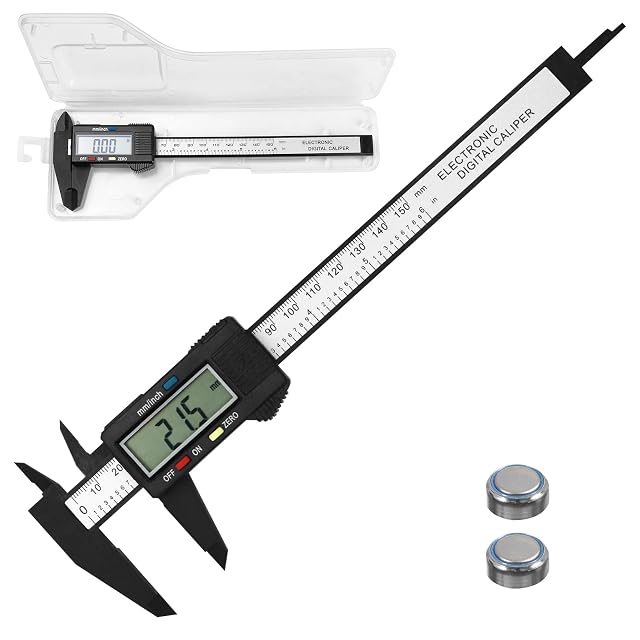
    Gvolatee 1—zero buttoncarbon-fiber composite150 mm (5.91 in)
    MIB Germany 1—four functions——
    HARDELL A41-HDDCKC03-2—four modeshardened stainless150 mm (5.91 in)
    ORTHLAND de-kachi2——hardened stainless body150 mm (5.91 in)
    Preciva CR2032_SML—four methodshardened stainless150 mm (5.91 in)

    Our guides on digital calipers

    Where the figures are read

    Specifications: manufacturer sheets for measuring instruments and the matching Amazon product pages. Prices and availability: Keepa. Every figure in this table names its source.

    Most recent revision in this category: August 31, 2026.

    The method applied to digital calipers