What the figures leave us with A usable caliper with an unpublished tolerance. Fine for hobby work on soft materials; not a measuring reference.
Six euros buys a caliper that displays hundredths and says nothing about whether they are right.
What the manufacturer publishes
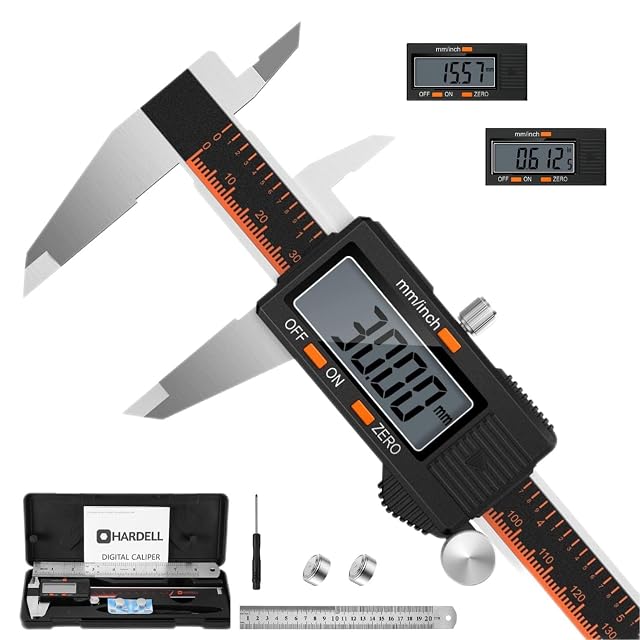
A digital caliper described as having passed the maker’s own testing for accuracy. A ZERO button, stated as suited to home, school, workshop and factory use. A large LCD reading in inches or millimeters. A carbon-fiber composite body, described as lighter and safer to handle than stainless steel.
The figure that is not there
A caliper is bought to answer a question to a hundredth of a millimeter. Two numbers describe whether it can: the resolution, which is the step of the display, and the accuracy, which is how far the reading may be from the truth. This listing publishes neither. It publishes the claim that the maker tested it.
Where composite jaws are the right choice
Carbon-fiber jaws will not scratch a soft workpiece, will not conduct, and weigh little. For measuring 3D-printed parts, plastics, timber and cable, that is a real advantage. Against steel, day after day, the tips round over and the reading drifts — which is why every precision caliper is hardened stainless.
Availability
No such listing: the American Amazon shop answers the reference with a search box rather than a page.
Read from Keepa on the day this page was last revised; stock and price both move without notice.
What it has, and what it lacks
Strengths
A dedicated ZERO button, which is the control you use before every set of measurements
Carbon-fiber composite, lighter than stainless and stated as safer to handle
Large LCD switching between millimeters and inches
The cheapest caliper here by a wide margin
Compromises
No accuracy figure published — not resolution, not tolerance, nothing
Composite jaws wear faster than hardened steel ones against metal parts
No ingress rating stated
Specifications
Amazon reference
B0B82CFP9H (identical on 5 markets)
EAN
0753798658198
Stated dimension or range
150 mm (5.91 in)
Material
carbon-fiber composite
Functions
zero button
Scale
mm and inch
What gets asked here
Does the maker publish an accuracy figure?
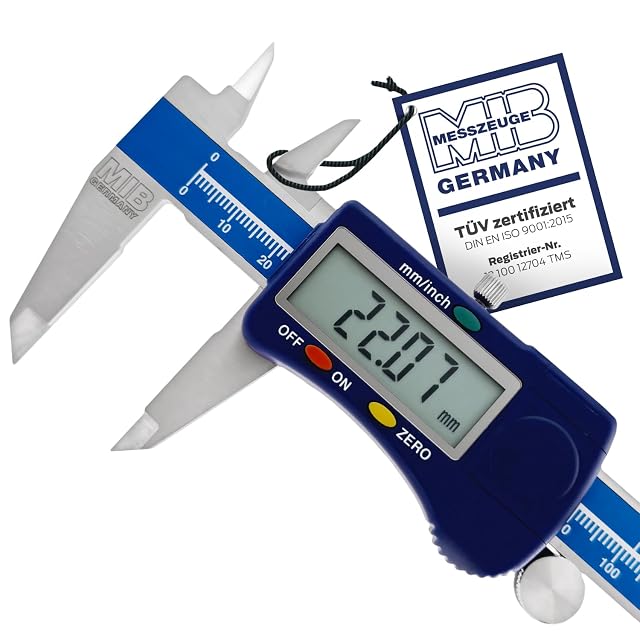
No. The listing states the caliper passed the maker's own tests to ensure more precise accuracy, and gives no number at all. The MIB caliper in this hub states ± 0.02 mm (0.001 in) to DIN 862; this one states nothing.
Is carbon fiber better than stainless?
Lighter and non-conductive, which suits electronics work. Softer at the jaw tips, which does not suit repeatedly measuring steel. It is a trade, not an upgrade.
What is the zero button for?
It sets the display to zero at the current jaw position. Closed fully, that re-establishes the true zero — the check to do before every session. It also lets you measure a difference from any starting point.
Our score
7.2/ 10
A usable caliper with an unpublished tolerance. Fine for hobby work on soft materials; not a measuring reference.
This one’s price among measuring instruments
A reference exists on these Amazon stores: France, Germany, Italy, Spain, United Kingdom. Listed is not the same as in stock — availability changes daily.
Details checked on August 31, 2026.
Who should pick this one, among measuring instruments
Occasional measuring of soft materials — plastic, wood, printed parts — where the jaws will not be abraded.
What buyers actually choose
Amazon reports what buyers took in the month before this page was last checked: at least 400.
The figure is a floor, rounded by Amazon, and read through Keepa — it says what buyers picked, not what a maker claims.
Sources
Specifications: the manufacturer sheet for measuring instruments and the matching Amazon product page. Prices and availability: Keepa. Every figure on this page names its source.
± 0.02 mm (0.001 in) to DIN 862 · 0.01 mm resolution · four functions
The only caliper in this hub that names the standard behind its figure: ± 0.02 mm (0.001 in) to DIN 862, with 0.01 mm resolution and the four standard measuring functions.
Best for: Work where the measurement has to be defensible, and naming the standard is part of that.
150 mm (5.91 in) · ± 0.02 mm (0.001 in) stated · hardened stainless · four modes
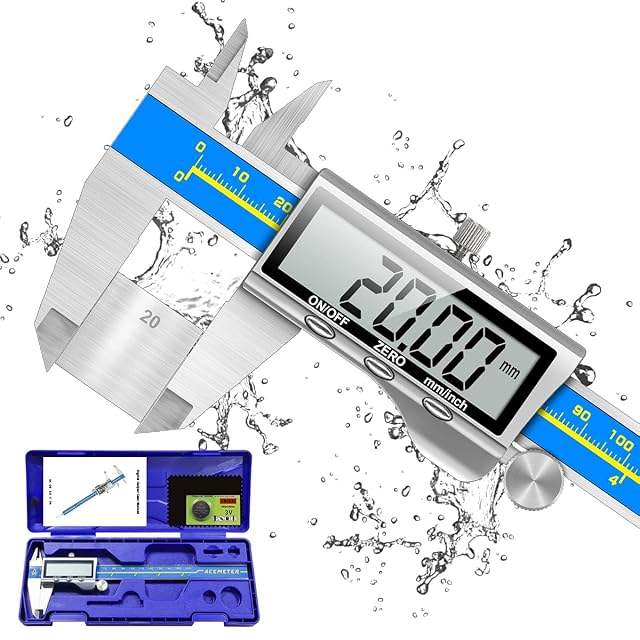
A hardened stainless caliper stating ± 0.02 mm (0.001 in) over 0–150 mm (0 to 5.91 in), splash and dust protected, with the four standard measuring modes and a zero button.
Best for: The value pick: a published tolerance and hardened jaws, without paying for a named standard.
150 mm (5.91 in) · glass grating scale · IP54 · hardened stainless body
A caliper using a glass grating scale rather than the usual capacitive strip, which the maker states resists humidity and magnetism, in an IP54 hardened stainless body.
Best for: A workshop where oil, swarf and damp are normal and a capacitive caliper keeps misbehaving.