Skip to content

The best digital multimeters for 2026

The specification to read first is the measurement category the manufacturer states — CAT II, III or IV, each with a voltage. It describes the transient energy the instrument is built to survive at a given point in an installation, and it is a safety statement rather than a mark of quality. After that: true-RMS, which reads distorted waveforms correctly where an averaging meter does not; the count (2,000, 6,000, 20,000) that sets display resolution; and whether the current inputs are fused. We compare stated category and voltage, true-RMS, counts, auto-ranging, and input protection.

The models we recommend

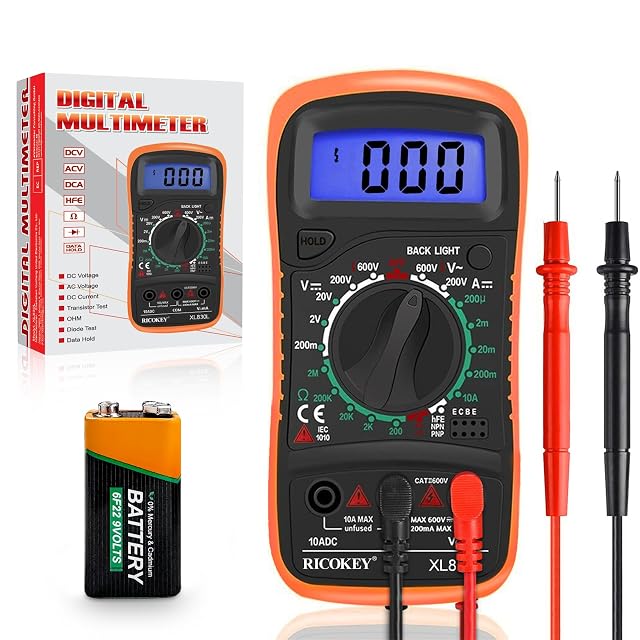
  1. RICOKEY Digital multimeter with stand

    AC/DC voltage · DC current · resistance · continuity · diode and transistor test

    A basic manual-ranging meter covering voltage, DC current, resistance, continuity, battery and diode tests, with a 2.7-inch backlit screen and a fold-out stand.

    Best for: Bench and automotive fault-finding at low voltage, where the reading is a presence check rather than a value.
    7.0/10

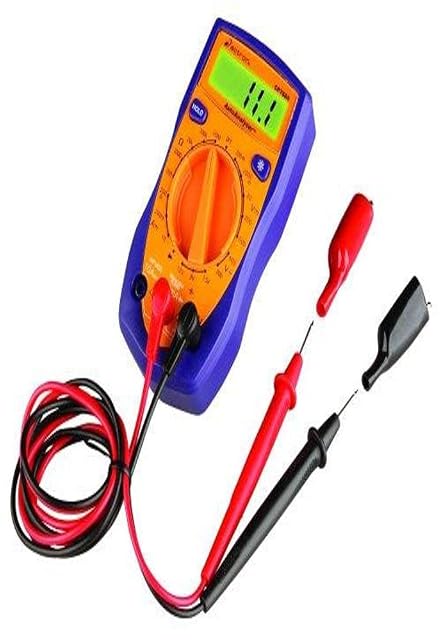
  2. Actron Automotive multimeter, 19 ranges

    19 RANGES, the only range count published on this shelf · 10 MΩ input impedance, stated for automotive computer circuits · automatic POLARITY sensing · automatic zero on volts, amps and battery tests · battery tests at 1.5, 9 and 12 V · the ONLY meter on this shelf sold WITHOUT its battery · NO measurement category

    An automotive meter built around the one specification car electronics actually need — a 10 MΩ input impedance.

    Best for: Car and bench electrical diagnosis, where the circuits are 12 V and the sensors must not be loaded by the meter

    ≈ $11

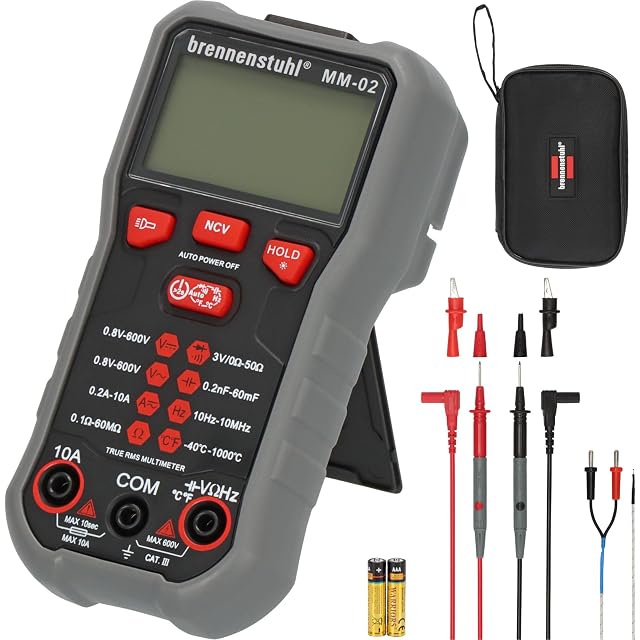
  3. Brennenstuhl True-RMS multimeter, 6000 counts

    True RMS · 6000 counts · 600 V · temperature, capacitance and frequency

    A true-RMS meter with 6000-count resolution and a wide function list — voltage, current, resistance, temperature, diode, continuity, capacitance and frequency — with probe caps included.

    Best for: Household and light installation work where waveforms are not clean and the reading has to be right.

    7.8/10

  4. AstroAI Digital multimeter with ceramic fuses

    AC/DC voltage · DC current · resistance · diode · double ceramic fuse

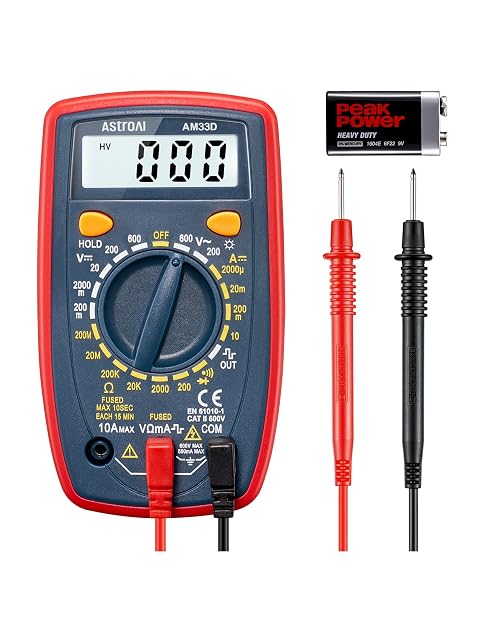
    A compact meter whose distinguishing specification is its protection: a double ceramic fuse stated as flame-retardant, plus a silicone sleeve, at fourteen euros.

    Best for: A first multimeter for household and hobby electronics, chosen for its fusing rather than its features.

    7.8/10

    ≈ $15

  5. coczow CAT III digital multimeter

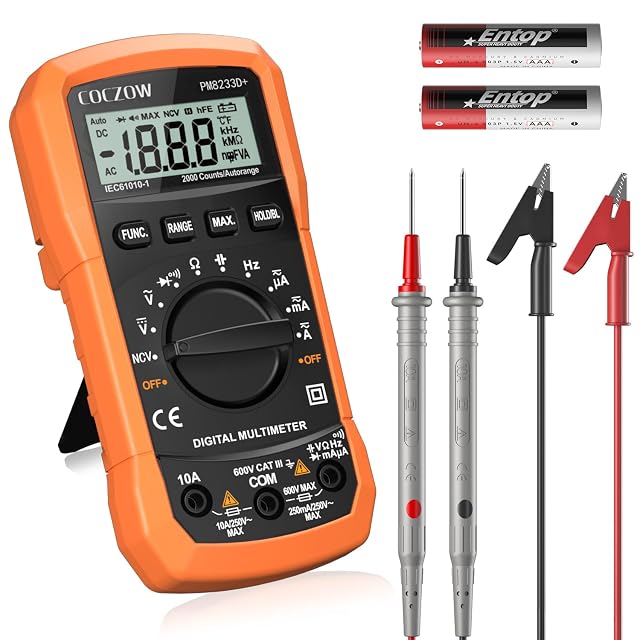
    CAT III stated · 600 V AC/DC · 10 A · 20 MΩ · auto power-off

    The only multimeter in this hub whose listing states a measurement category. It also gives its ranges plainly: 600 V AC and DC, 10 A, 20 MΩ.

    Best for: Household and installation fault-finding where knowing the category matters more than the feature list.

    7.8/10

    ≈ $25

  6. KAIWEETS CAT III 600 V multimeter, double fused

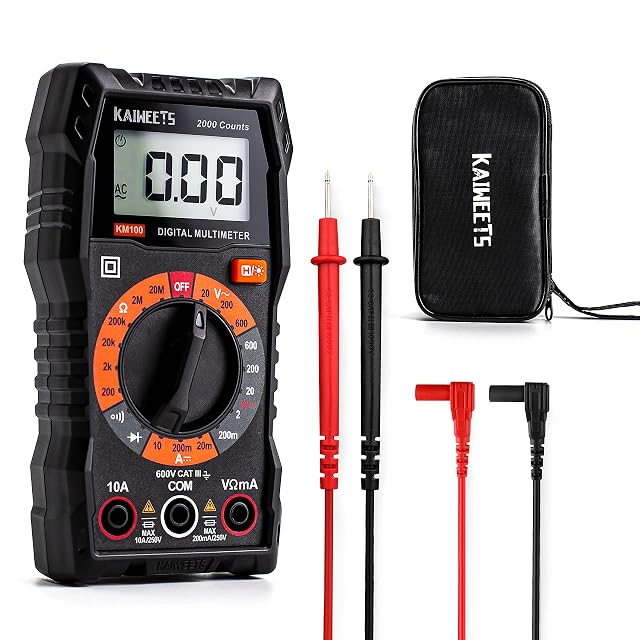
    IEC rated CAT III 600 V — one of only two stated categories on this shelf · DC current only, "Can not for AC current" · DOUBLE FUSES stated, the only input protection published here · overload protection on all ranges · case, two leads and two AAA cells supplied · $11.89

    Twelve dollars, and the only meter on this shelf bar the coczow that publishes a measurement category — and it cannot read AC current.

    Best for: Car electrics, household DC work and anyone who wants the category in writing for twelve dollars

    ≈ $12

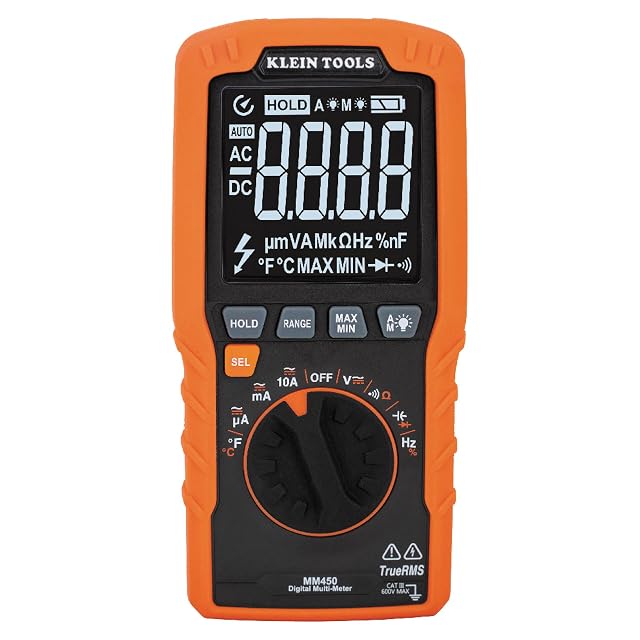
  7. Klein Tools Manual-ranging multimeter, 600 V

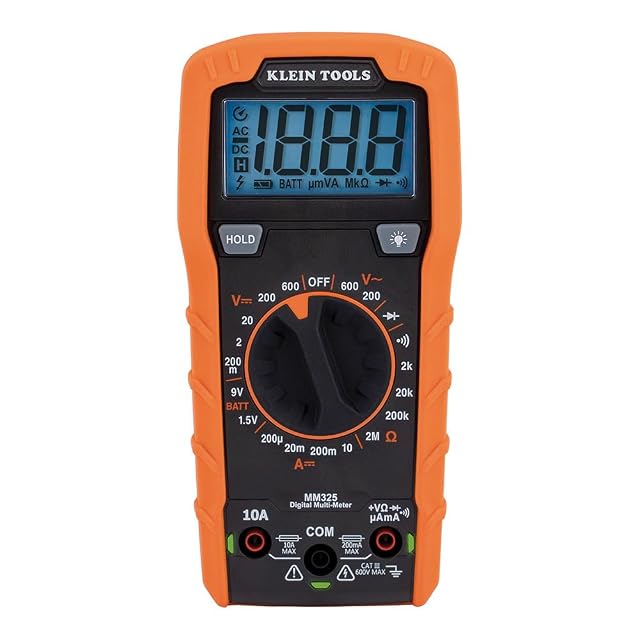
    MANUAL ranging, the only one here · 600 V AC/DC · 10 A DC only · 2 MΩ, the lowest resistance ceiling on this shelf · LEAD-ALERT LEDs on the meter face · battery test mode · NO measurement category published and NO count

    A deliberately plain meter with LEDs that tell you the leads are in the right sockets — and no stated measurement category.

    Best for: An electrician who already knows the range before turning the dial and wants a second meter on the van

    ≈ $30

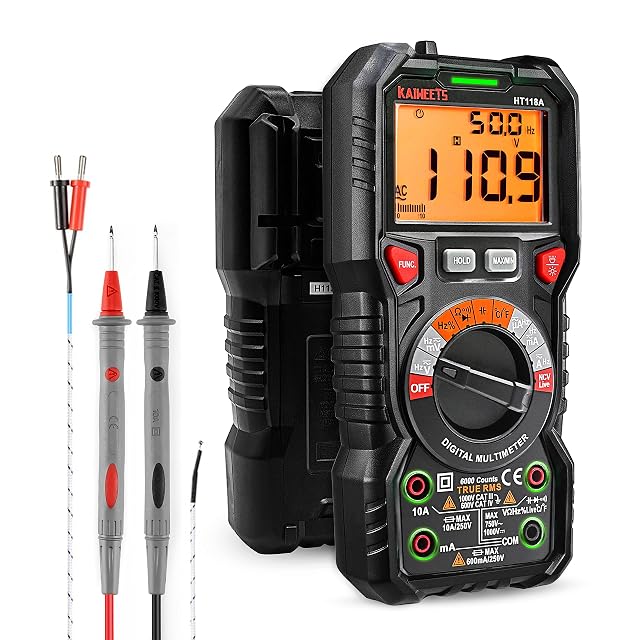
  8. KAIWEETS True-RMS multimeter with lit sockets

    True RMS auto-ranging · 6000 counts · lit input jacks · NCV with alarm

    A true-RMS auto-ranging meter that lights the correct input socket in green for the function selected — the one design idea in this hub aimed squarely at the mistake that damages meters.

    Best for: Beginners and shared toolboxes, where the lit jacks stop the mistake that kills meters.

    8.4/10

    ≈ $38

  9. Klein Tools True-RMS slim multimeter, auto-ranging

    TRUE RMS auto-ranging · 600 V AC/DC · 10 A AC AND DC · 50 MΩ, the highest resistance ceiling on this shelf · temperature, capacitance, frequency and duty cycle · 2 m (7 ft) drop rating · the CAT III/CAT IV rating on this page belongs to the LEAD CAPS, not the meter

    The best-equipped meter on this shelf, and the one whose only published CAT rating is for the caps on its test leads.

    Best for: Facilities, HVAC and maintenance work where the meter lives in a pocket and has to read distorted waveforms correctly

    ≈ $75

Need by need, within digital multimeters

A safe instrument for an installation

The measurement category defines the transient overvoltages the instrument is built to withstand. It is a safety matter, not a convenience characteristic.

Klein Tools MM450

Measuring on low voltage

For electronics and batteries, a simple instrument is enough and never goes near a dangerous voltage.

Actron CP7665

Being read without a torch in a panel

An unlit display is unreadable at the back of a consumer unit with one hand holding a probe. The stated display type decides real use on an installation.

KAIWEETS Auto-ranging multimeter

Who each family suits, across digital multimeters

Electronics
Continuity, resistance and DC voltage cover the essentials. The voltages involved stay low.
Domestic installation
The measurement category and the quality of the leads become decisive. That is where cheap equipment is dangerous.
Automotive diagnosis
DC current and duty-cycle measurements are frequent. Not every range offers them.

What you gain and what you give up, on digital multimeters

Measurement category against price
A high category assumes an internal design, fuses and leads built for it. An instrument with no credible category on an installation is a real risk.
Many functions against legibility
A crowded selector multiplies wrong-position errors. A range error while measuring current puts the instrument across a short circuit.
True RMS against approximation
On non-sinusoidal signals, an instrument without true RMS is distinctly wrong. On a clean mains supply the deviation is small.

Frequent questions on digital multimeters

What does the measurement category mean?

It states the level of transient overvoltage the instrument is built to withstand according to where on the supply it is used. Using an under-rated instrument on an installation risks an arc flash.

Do the leads matter as much as the instrument?

Just as much: a well-rated instrument with poor leads does not offer the protection claimed. The chain is worth its weakest link.

What happens if I measure a voltage in ammeter position?

The instrument goes across the source as a short circuit. That is what the internal fuse is meant to stop, and it is the aisle's most dangerous mistake.

Do I need true RMS?

On distorted signals, yes: without it the reading is wrong. On a clean supply the deviation stays small.

How do I measure a current?

In series in the circuit, never in parallel. The opposite of a voltage measurement, and the mistake is frequent.

Should the instrument be checked before use?

A continuity test on the leads and a measurement on a known source before any work. A broken lead gives a zero reading you may take for an absence of voltage.

Does a multimeter replace a voltage tester?

For confirming the absence of voltage before work, two-pole testers are built for that precise task and do not depend on a selector position.

What does true root-mean-square mean?

It means the meter reads a distorted waveform correctly, which is the case downstream of a dimmer or a switching supply. Without it, the reading can be well off the real value.

What stays with you, on digital multimeters

The measurement category is a safety matter, and it only counts if the leads are rated to the same level. Measuring a voltage in ammeter position puts the instrument across the source as a short circuit — and a broken lead reads zero, which can be taken for an absence of voltage.

Summed up: digital multimeters

    The full table of digital multimeters

    A column is raised only if four instruments in five publish the value. Below that, it would be measuring the silence of the manuals.

    ModelPriceFunctionsVoltage measurement
    Actron CP7665$1119 RANGES, stated — the only range count published anywhere on this shelf. AC and DC voltage, DC current, resistance; tests for diodes, batteries, FUSES, switches, solenoids and relays. The word "fuses" in that list is the reason this line was relevéd on the multimeter-fuses shelf: it TESTS them. A hold button retains the reading, and there is a low-battery indicator and overload protectionAC and DC, stated, with no maximum published. That is the gap on this page: every other meter on this shelf that publishes a voltage states 600 V. Battery tests are called out at 1.5 V, 9 V and 12 V, which is where this meter is meant to live
    KAIWEETS KM100$12AC and DC voltage, DC current, resistance, continuity and diode measurement, with a DATA HOLD and a backlight. No resistance ceiling is published — the MM325 states 2 MΩ, the MM450 50 MΩ, the published coczow 20 MΩ. A rotary switch sets the range, and the listing asks you to check it is in the right position, so the ranging is manualAC and DC, stated, at CAT III 600 V. This shelf's buying tip insists the category and the voltage are one specification rather than two, and this is the only listing on this shelf that gives them as one: CAT III AND 600 V, in the same phrase
    AstroAI Digital multimeter$15resistance · diodeAC/DC voltage
    coczow Digital multimeter$25auto power-off600 V AC/DC
    Klein Tools MM325$30Resistance to 2 MΩ, continuity, diode test and a BATTERY TEST mode. Two megohms is the lowest resistance ceiling published anywhere on this shelf — the MM450 states 50 MΩ and the published coczow 20 MΩ. For continuity and for checking a winding that is plenty; for leakage across an insulator it is notAC and DC up to 600 V, stated. That matches every other meter on this shelf that publishes a figure: the published coczow is 600 V AC/DC, the Brennenstuhl 600 V, and the Klein MM450 beside it 600 V AC/DC. Six hundred volts is the ceiling of this whole hub
    KAIWEETS Auto-ranging multimeter$38NCV with alarm—
    Klein Tools MM450$75Resistance to 50 MΩ, continuity, TEMPERATURE with a supplied thermocouple, capacitance, frequency and duty cycle, diode test. Fifty megohms is the highest resistance ceiling published on this shelf — against 20 MΩ on the coczow and 2 MΩ on the MM325 beside it. Duty cycle is a function nothing else here publishesAC and DC up to 600 V, stated — the same ceiling as every other meter on this shelf that publishes one
    Brennenstuhl MM-02—temperature, capacitance and frequency600 V
    RICOKEY Digital multimeter—resistance · continuity · diode and transistor testAC/DC voltage

    What each budget buys in accuracy here

    Lower range

    $11 – $12

    2 models

    Actron CP7665, KAIWEETS KM100

    Our guides on digital multimeters

    Where the figures are read

    Specifications: manufacturer sheets for measuring instruments and the matching Amazon product pages. Prices and availability: Keepa. Every figure in this table names its source.

    Most recent revision in this category: October 8, 2026.

    The method applied to digital multimeters

    Prices quoted in these summaries are dated readings. The live price is shown next to each product.