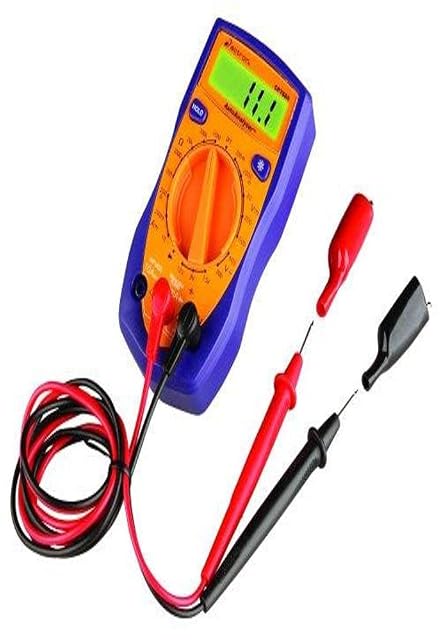
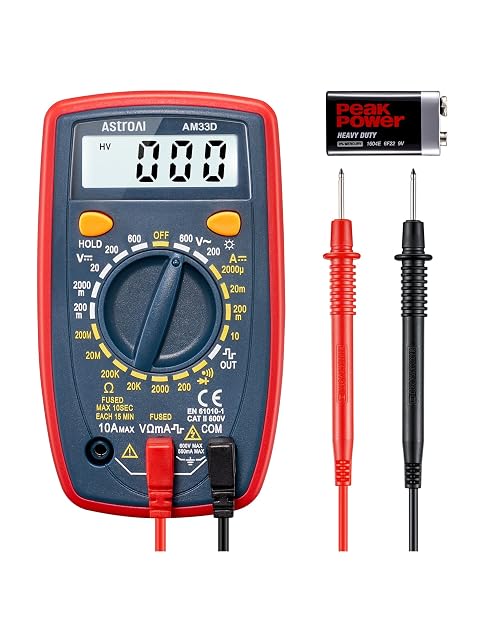
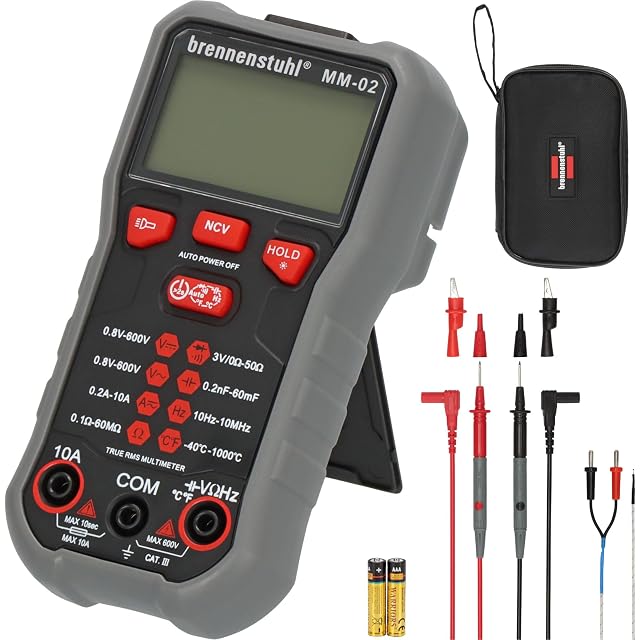
What the figures leave us with A plain, well-judged thirty-dollar meter whose one distinctive feature is the right one: LEDs on the face that tell you the leads are in the correct sockets. Manual ranging suits anyone who already knows the circuit. What the listing does not publish is a measurement category, a count, or anything at all about its input fuses — and its 2 MΩ resistance ceiling is the lowest on this shelf.
What the maker puts in writing
“Measures AC/DC voltage up to 600V, 10A DC current, 2MΩ resistance”
“continuity, diode test and battery test”
“LEAD-ALERT PROTECTION: LEDs on the meter illuminate to indicate proper test lead placement”
“Digital Manual-Ranging”
Test lead holders on the back of the meter, a fold-out stand, and an optional magnetic hanger (Cat. Nos. 69445 or 69417)
Backlit LCD · $29.98
NO measurement category. NO count. NOTHING about its fuses.
The specification the hub asks for first
“The specification to read first is the measurement category the manufacturer
states — CAT II, III or IV, each with a voltage.”
This listing states 600 V and no category.
Of the four American meters on this shelf, ONE publishes a category: the KAIWEETS
KM100, IEC rated CAT III 600 V.
Six hundred volts is what it will read. A category is what it is built to survive
when the supply spikes.
LEDs for the sockets
Which is the feature worth the thirty dollars, and nothing else here has it.
The mistake that destroys meters: probes across a live supply with the leads still
in the 10 A current sockets.
A current input is a near short circuit by design. The supply goes through the
meter, and the fuse does its job violently.
LEDs on the face that light for the right socket combination are a cheap answer
to an expensive error.
Manual ranging, alone on this shelf
The MM450 beside it is auto-ranging. The published KAIWEETS is auto-ranging
true-RMS.
This one you set yourself.
That is a trade, not a shortfall. An auto-ranging meter re-decides the range
mid-reading on an unstable signal, and the display never settles.
The cost: you must know roughly what you are about to measure.
Two megohms
The lowest resistance ceiling published anywhere on this shelf.
The MM450 states 50 MΩ. The published coczow states 20 MΩ.
For continuity and for a motor winding, two megohms is ample. For leakage across
an insulator it stops short.
DC current only
Which is easy to miss on a meter sold for 600 V work.
“10A DC current.”
Three of the four American meters here cannot read alternating current — this
one, the KAIWEETS which writes “Can not for AC current” in a bullet, and the
Actron. The MM450 reads 10 A in both.
Availability
On sale at around 30 € on the American Amazon store at the time of checking.
Prices and availability are what Keepa reported on the date this page was updated; both move.
Prices quoted in this text were read on 8 October 2026. The live price is at the top of the page.
What it has, and what it lacks
Strengths
LEDs that tell you the leads are in the right holes
Manual ranging, so it never hunts on a noisy reading
Six hundred volts AC and DC, the hub ceiling
A battery test mode on the dial
Lead holders, a fold-out stand and a hanger option
Thirty dollars for a Klein
Compromises
No measurement category published at all
Two megohms — the lowest resistance ceiling here
DC current only, on a 600 V mains meter
No count, so the resolution is unstated
Nothing published about its input fuses
No true-RMS, so distorted waveforms read low
Specifications
Measurement category
NOT PUBLISHED. This shelf's introduction calls the measurement category "the specification to read FIRST", and this listing states no CAT II, III or IV at all. Of the four American meters on this shelf, only the KAIWEETS KM100 publishes one — CAT III 600 V. A 600 V working voltage is published here; the transient energy the instrument is built to survive is not
Voltage measurement
AC and DC up to 600 V, stated. That matches every other meter on this shelf that publishes a figure: the published coczow is 600 V AC/DC, the Brennenstuhl 600 V, and the Klein MM450 beside it 600 V AC/DC. Six hundred volts is the ceiling of this whole hub
Current measurement
10 A DC, stated — DC ONLY. Three of the four American meters on this shelf cannot read alternating current: this one, the KAIWEETS which writes "Can not for AC current" outright, and the Actron. The MM450 next to it reads 10 A in both. On a meter bought for mains work, that is the specification most likely to be assumed rather than read
Functions
Resistance to 2 MΩ, continuity, diode test and a BATTERY TEST mode. Two megohms is the lowest resistance ceiling published anywhere on this shelf — the MM450 states 50 MΩ and the published coczow 20 MΩ. For continuity and for checking a winding that is plenty; for leakage across an insulator it is not
True-RMS
NOT PUBLISHED, and the ranging is MANUAL — you pick the range before you measure. This is the only manual-ranging meter on this shelf: the MM450 is auto-ranging, and the published KAIWEETS is auto-ranging true-RMS. Manual ranging is a deliberate choice rather than a shortfall, because it stops a meter hunting on a noisy reading
Display count
NOT PUBLISHED. This shelf's introduction names the count — 2,000, 6,000, 20,000 — as what sets display resolution, and none of the four American meters on this shelf gives one. The two fiches here that do both state 6,000
Fuse
NOT PUBLISHED. Nothing on this listing says whether the current inputs are fused, which this shelf's introduction lists among the five things compared. This site carries a whole shelf of multimeter fuses, and three of the four American meters here — this one, the MM450 and the Actron — say nothing about their own
Construction and safety
LEAD-ALERT PROTECTION: LEDs on the meter face light to show the test leads are in the correct sockets. That is the one feature on this listing nothing else on the shelf has, and it addresses the mistake that destroys meters — probing a live supply with the leads still in the current sockets. Test lead holders on the back, a fold-out stand, and an optional magnetic hanger (Cat. No. 69445 or 69417)
Amazon reference
B0B57L9FNL
EAN
0092644693731
Where this one lands in its group
At $30, it is the 5 cheapest of the 7 models in this category published here.
Cheapest in the group$11
Median$25
Dearest in the group$75
What gets asked here
Does 600 V tell me the same thing as a CAT rating?
No, and this shelf's buying tip is blunt about it: the category and the voltage are one specification, not two. Six hundred volts is the working voltage the meter will read. A category describes the transient energy it is built to survive at a point in an installation — a spike from a motor starting or a supply fault, which can be thousands of volts for microseconds. CAT III 600 V and CAT II 1000 V are different instruments, and this listing gives the voltage without the category. Follow the manufacturer's instructions for the work you are doing.
What do the lead-alert LEDs actually prevent?
The mistake that kills meters and occasionally people: putting the probes across a live supply while the leads are still plugged into the 10 A current sockets. A current input is a near short circuit by design, so the supply goes through the meter and the fuse — which is the component this site sells a whole shelf of — does its job violently. LEDs on the face that light for the correct socket combination are a cheap answer to an expensive error, and nothing else on this shelf publishes them.
Is manual ranging a drawback?
It is a trade, and for someone who knows their circuits it is the right side of the trade. An auto-ranging meter decides the range for you and will re-decide it mid-reading on an unstable signal, which shows as a display that cannot settle. Manual ranging holds where you put it. The cost is that you must know roughly what you are about to measure, and a wrong guess reads as an over-range rather than a number. The MM450 on this shelf is the auto-ranging alternative at two and a half times the price.
Against the measuring instruments in the same bracket
Same category, nearby prices, between measuring instruments. What remains is the specifications every one publishes — half empty, a column is no use.
Model
Price
Functions
Klein Tools Manual-ranging multimeter, 600 V
$30
Resistance to 2 MΩ, continuity, diode test and a BATTERY TEST mode. Two megohms is the lowest resistance ceiling published anywhere on this shelf — the MM450 states 50 MΩ and the published coczow 20 MΩ. For continuity and for checking a winding that is plenty; for leakage across an insulator it is not
Amazon reports what buyers took in the month before this page was last checked: at least 9,000.
The figure is a floor, rounded by Amazon, and read through Keepa — it says what buyers picked, not what a maker claims.
Sources
Specifications: the manufacturer sheet for measuring instruments and the matching Amazon product page. Prices and availability: Keepa. Every figure on this page names its source.
19 RANGES, the only range count published on this shelf · 10 MΩ input impedance, stated for automotive computer circuits · automatic POLARITY sensing · automatic zero on volts, amps and battery tests · battery tests at 1.5, 9 and 12 V · the ONLY meter on this shelf sold WITHOUT its battery · NO measurement category
An automotive meter built around the one specification car electronics actually need — a 10 MΩ input impedance.
Best for: Car and bench electrical diagnosis, where the circuits are 12 V and the sensors must not be loaded by the meter
AC/DC voltage · DC current · resistance · diode · double ceramic fuse
A compact meter whose distinguishing specification is its protection: a double ceramic fuse stated as flame-retardant, plus a silicone sleeve, at fourteen euros.
Best for: A first multimeter for household and hobby electronics, chosen for its fusing rather than its features.
True RMS · 6000 counts · 600 V · temperature, capacitance and frequency
A true-RMS meter with 6000-count resolution and a wide function list — voltage, current, resistance, temperature, diode, continuity, capacitance and frequency — with probe caps included.
Best for: Household and light installation work where waveforms are not clean and the reading has to be right.