What the figures leave us with The only meter here that names a category. That alone puts it ahead of the cheaper ones, incomplete though the statement is.
Twenty-one euros, and the one listing in five that mentions the safety specification.
What the manufacturer publishes
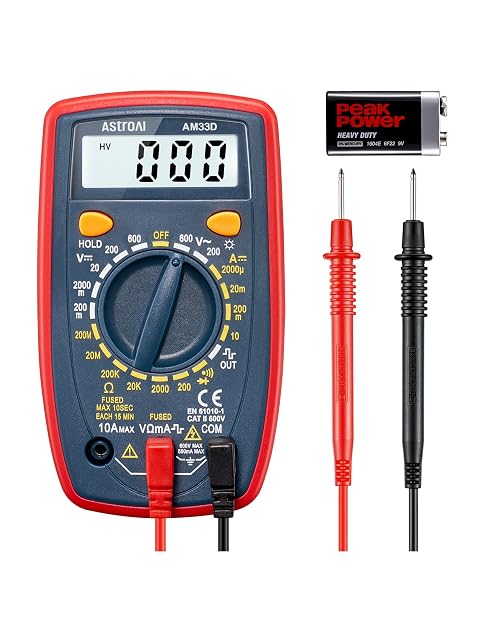
A circuit based on integrated circuits, measuring AC and DC voltage up to 600 V, AC and DC current up to 10 A, and resistance to 20 MΩ. CAT III, stated for optimal safety. A 15 mm (0.59 in), 3.5-digit backlit LCD. Data hold, a maximum-value display, automatic switch-off after 15 minutes, a battery-level indication and a continuity indication.
Why the category is the specification to look for
The measurement category describes the transient over-voltage an instrument is built to survive at a given point in an installation — a spike from a motor starting, a supply fault, a switching surge. CAT II covers appliances and socket outlets; CAT III covers distribution boards and fixed installation; CAT IV covers the supply side. It is a safety rating, not a quality grade, and a meter that does not state one is a meter you cannot place.
Across the five multimeters and five clamp meters in this hub, two listings state a category. This is one of them.
What is still missing
The voltage that belongs with the category, and the fuse type. Both are in the manual, and both are worth reading before the first measurement.
Availability
Read on the day this page was built: $25 at the American Amazon shop.
Read from Keepa on the day this page was last revised; stock and price both move without notice.
Prices quoted in this text were read on 31 August 2026. The live price is at the top of the page.
What it has, and what it lacks
Strengths
States a CAT III category — one of only two meters in this hub that publish one
Ranges given explicitly: 600 V AC/DC, 10 A AC/DC, 20 MΩ
A 3.5-digit, 15 mm (0.59 in) backlit LCD
Data hold, maximum-value display, low-battery indication and auto power-off after 15 minutes
On sale across all six markets
Compromises
The category is stated without its voltage — CAT III alone is an incomplete specification
No true-RMS
The listing does not name the fuse type
Specifications
Amazon reference
B09SPYTP84 (identical on 6 markets)
EAN
0707443344028
Measurement category
CAT III stated
Voltage measurement
600 V AC/DC
Current measurement
10 A
Stated dimension or range
20 MΩ
Functions
auto power-off
Where this one lands in its group
At $25, it is the 4 cheapest of the 7 models in this category published here.
Cheapest in the group$11
Median$25
Dearest in the group$75
What gets asked here
Is "CAT III" on its own enough?
Not quite. A category and a voltage are one specification, not two: CAT III 600 V and CAT III 1000 V are different instruments. coczow states CAT III for optimal safety without the voltage, which is more than every other meter here publishes and less than a complete statement. The manual will carry the full rating.
What do the ranges tell me?
600 V AC and DC covers domestic and light commercial installation work; 10 A covers most appliance and automotive current measurement; 20 MΩ is a normal resistance ceiling. All three are stated explicitly, which is unusual in this price band.
Does it have true-RMS?
Not stated, which means no. On distorted waveforms — dimmers, drives, inverters — the reading will be low.
Our score
7.8/ 10
The only meter here that names a category. That alone puts it ahead of the cheaper ones, incomplete though the statement is.
Against the measuring instruments in the same bracket
Same category, nearby prices, between measuring instruments. What remains is the specifications every one publishes — half empty, a column is no use.
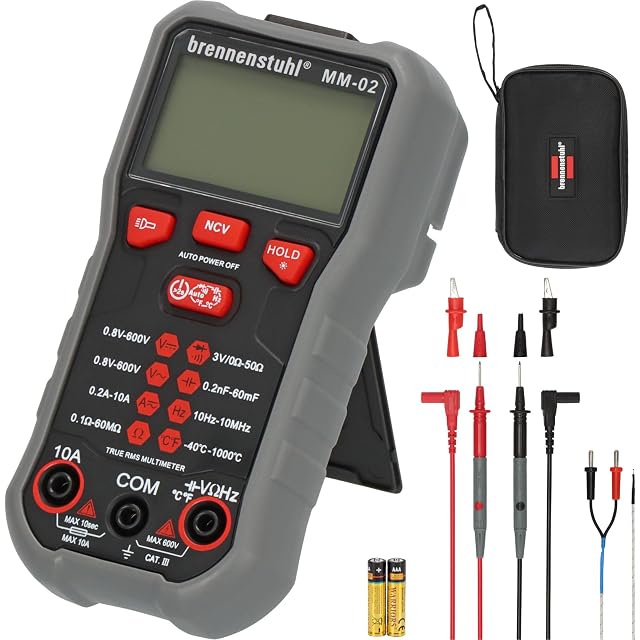
AC and DC up to 600 V, stated. That matches every other meter on this shelf that publishes a figure: the published coczow is 600 V AC/DC, the Brennenstuhl 600 V, and the Klein MM450 beside it 600 V AC/DC. Six hundred volts is the ceiling of this whole hub
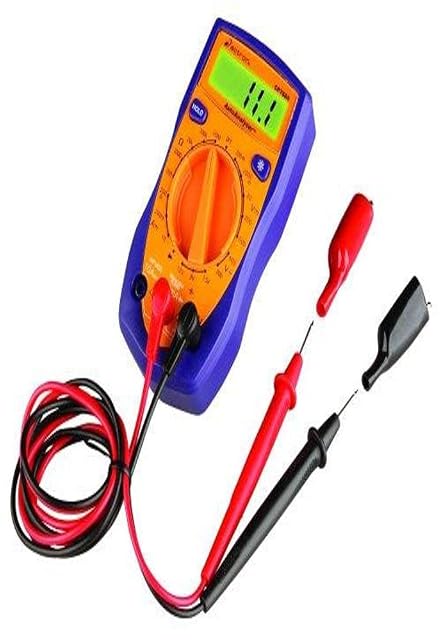
10 A DC, stated — DC ONLY. Three of the four American meters on this shelf cannot read alternating current: this one, the KAIWEETS which writes "Can not for AC current" outright, and the Actron. The MM450 next to it reads 10 A in both. On a meter bought for mains work, that is the specification most likely to be assumed rather than read
Resistance to 2 MΩ, continuity, diode test and a BATTERY TEST mode. Two megohms is the lowest resistance ceiling published anywhere on this shelf — the MM450 states 50 MΩ and the published coczow 20 MΩ. For continuity and for checking a winding that is plenty; for leakage across an insulator it is not
AC and DC, stated, at CAT III 600 V. This shelf's buying tip insists the category and the voltage are one specification rather than two, and this is the only listing on this shelf that gives them as one: CAT III AND 600 V, in the same phrase
DC ONLY, and the listing says so outright: "DC current (Can not for AC current)". No ampere figure is published. That is the limit of the instrument and it is stated in a bullet rather than buried — which is more than can be said for a good deal of this shelf
AC and DC voltage, DC current, resistance, continuity and diode measurement, with a DATA HOLD and a backlight. No resistance ceiling is published — the MM325 states 2 MΩ, the MM450 50 MΩ, the published coczow 20 MΩ. A rotary switch sets the range, and the listing asks you to check it is in the right position, so the ranging is manual
What the models do not share, in measuring instruments
If price decides: KAIWEETS CAT III 600 V multimeter, double fused, at $12.
This one’s price among measuring instruments
A reference exists on these Amazon stores: France, Germany, Italy, Spain, United Kingdom, United States. Listed is not the same as in stock — availability changes daily.
Details checked on August 31, 2026.
Who should pick this one, among measuring instruments
Household and installation fault-finding where knowing the category matters more than the feature list.
Accessories stated to fit this instrument
Listed because the accessory names this instrument itself.
Amazon reports what buyers took in the month before this page was last checked: at least 100.
The figure is a floor, rounded by Amazon, and read through Keepa — it says what buyers picked, not what a maker claims.
Sources
Specifications: the manufacturer sheet for measuring instruments and the matching Amazon product page. Prices and availability: Keepa. Every figure on this page names its source.
True RMS · 6000 counts · 600 V · temperature, capacitance and frequency
A true-RMS meter with 6000-count resolution and a wide function list — voltage, current, resistance, temperature, diode, continuity, capacitance and frequency — with probe caps included.
Best for: Household and light installation work where waveforms are not clean and the reading has to be right.
19 RANGES, the only range count published on this shelf · 10 MΩ input impedance, stated for automotive computer circuits · automatic POLARITY sensing · automatic zero on volts, amps and battery tests · battery tests at 1.5, 9 and 12 V · the ONLY meter on this shelf sold WITHOUT its battery · NO measurement category
An automotive meter built around the one specification car electronics actually need — a 10 MΩ input impedance.
Best for: Car and bench electrical diagnosis, where the circuits are 12 V and the sensors must not be loaded by the meter
AC/DC voltage · DC current · resistance · diode · double ceramic fuse
A compact meter whose distinguishing specification is its protection: a double ceramic fuse stated as flame-retardant, plus a silicone sleeve, at fourteen euros.
Best for: A first multimeter for household and hobby electronics, chosen for its fusing rather than its features.