A first multimeter: what to look for, and what to ignore
A multimeter is sold on function count and bought on three things that rarely appear in the headline: the measurement category, what kind of fuse protects the current input, and whether it reads distorted waveforms correctly. Across the five meters we compare, one listing states a category and one names its fuse type.
Three meters, chosen on the specifications a first-time buyer cannot easily judge.
First: the only one that states a category
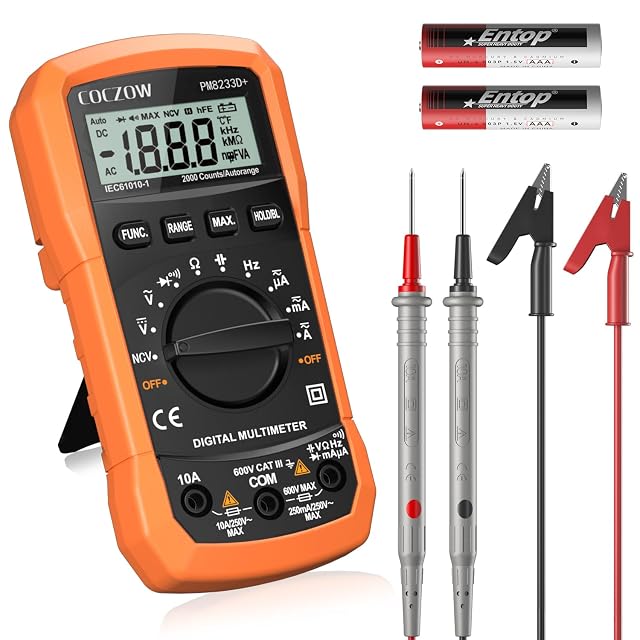
The coczow publishes CAT III and its ranges — 600 V AC and DC, 10 A, 20 MΩ. It states the category without its voltage, which is half a specification and more than any other meter in the hub offers. For a first meter, knowing roughly where it belongs is worth more than an extra measuring function.
Second: the one with true-RMS
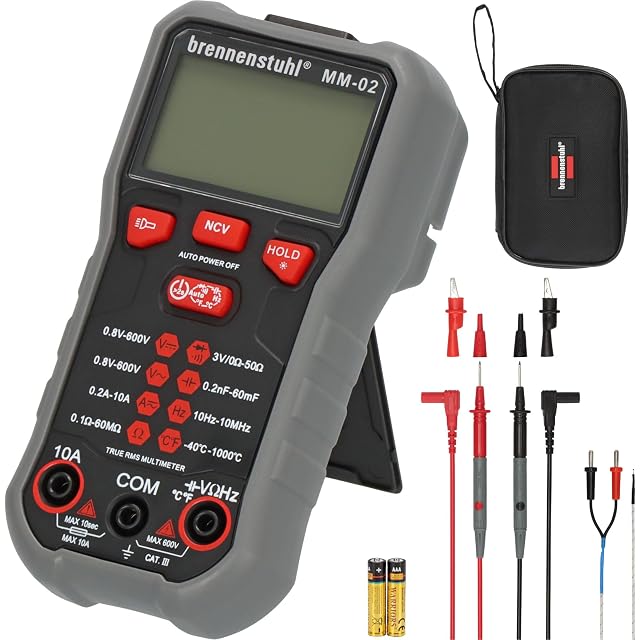
The Brennenstuhl adds true RMS, 6000 counts, temperature, capacitance and frequency, and puts protective caps on the probe tips. It publishes no category, which is the disappointment — but true-RMS is the specification that decides whether readings on modern electrical loads mean anything.
Third: the one that names its fuse
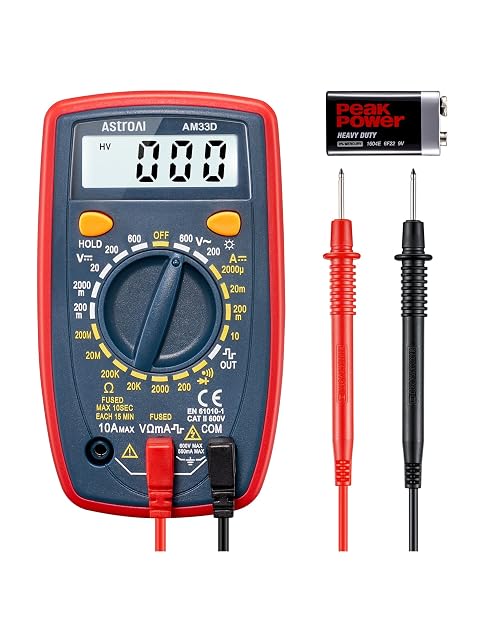
The AstroAI is the cheapest here and the only listing in the hub that mentions the fuse type: double ceramic, stated as flame-retardant. On a first meter that will be used carelessly at least once, that is the component you want specified.
The habit that matters more than the meter
Leads back in the voltage sockets, every time, before the meter goes down. The KAIWEETS meter in this hub lights the correct jacks in green for the selected function, which is the only design here that addresses the mistake directly.
Which instrument does your work demand?
You are testing batteries and low-voltage circuits
A basic meter does the job, and the safety category matters less at low voltage.
You will go anywhere near mains
The safety category is the specification that matters, before anything about functions.
You want to check a socket is dead
A dedicated voltage tester and the proper procedure, not a multimeter alone.
You are learning electronics
Functions and resolution start to matter, and the voltages involved are usually modest.
Picking by the measurement
Continuity and fuses
The single most used function for most people, and the one that answers most questions.
Battery and DC voltage
Straightforward, low risk, and where most beginners start.
Mains voltage
Where the instrument's safety category and your procedure matter far more than any feature.
Current measurement
The function most often used wrongly, because it requires breaking the circuit and using the correct terminals.
The figures that settle accuracy accuracy
The safety category
Instruments carry a category rating describing the type of circuit they are designed to survive. Using one below the category required for the work is a genuine hazard.
The test leads
Leads are part of the safety system and they are what fails first. Cracked insulation or a loose plug means replacing them, not taping them.
Fusing on the current ranges
Properly fused current inputs are what protect you when the meter is connected wrongly, which happens to everyone eventually.
Auto or manual ranging
Auto-ranging is easier for a beginner; manual is faster once you know what you are looking at. Neither is more accurate in itself.
The functions you will actually use
Continuity, DC voltage, AC voltage and resistance cover almost everything a beginner does. The rest is mostly unused.
Which tolerance for which work
Your work
What matters most
What matters least
Batteries and electronics
Resolution
The safety category
Anything on mains
The safety category
Extra functions
Checking a circuit is dead
A proper voltage tester
The multimeter alone
Car electrics
Good leads and DC ranges
AC accuracy
The errors that cost you
Using an unrated meter on mains
The category rating describes what the instrument is designed to survive. Using one that is unrated or under-rated is where people are seriously hurt.
Leaving the leads in the current sockets
Then measuring voltage puts a near short across the circuit. This is the single most common and most dangerous multimeter error.
Testing a circuit is dead with a multimeter alone
The recognized procedure uses a dedicated tester proved on a known source before and after. A meter can fail silently between the two.
Ignoring damaged leads
Leads are part of the safety system. Cracked insulation or exposed metal at the plug is a reason to replace them, not to work around them.
By the trade you are in
The electronics beginner
A modest auto-ranging meter with good continuity, used on low voltages.
The car mechanic
Good DC ranges, robust leads and a clip so both hands are free.
Anyone working on mains
Properly rated equipment, good leads, and the correct proving procedure — or a qualified electrician.
Calibration and how long accuracy holds
A multimeter is stable, and what fails is the leads, the fuses and the battery. Leads fail at the flex where they enter the plug, fuses blow when the meter is connected wrongly, and a weak battery gives readings that look plausible and are not.
Inspect the leads before every session, especially where the flex enters the plugs.
Replace blown fuses with the correct type and rating, never with wire or a substitute.
Change the battery when readings drift; a weak battery misleads before the display dies.
Store the meter with the selector on off and the leads unplugged.
Safety
Electrical testing is the one area in this trade where the wrong tool causes injury rather than inconvenience.
Use an instrument with a safety category appropriate to the circuit; never work above what it is rated for.
Prove a dedicated voltage tester on a known live source before and after testing that a circuit is dead.
Never leave leads in the current terminals when measuring voltage.
If you are not confident, stop and use a qualified electrician; this is not a place to learn by trial.
True RMS · 6000 counts · 600 V · temperature, capacitance and frequency
A true-RMS meter with 6000-count resolution and a wide function list — voltage, current, resistance, temperature, diode, continuity, capacitance and frequency — with probe caps included.
Best for: Household and light installation work where waveforms are not clean and the reading has to be right.
AC/DC voltage · DC current · resistance · diode · double ceramic fuse
A compact meter whose distinguishing specification is its protection: a double ceramic fuse stated as flame-retardant, plus a silicone sleeve, at fourteen euros.
Best for: A first multimeter for household and hobby electronics, chosen for its fusing rather than its features.
A manufacturer statement of the transient over-voltage an instrument is built to survive at a point in an installation — CAT II at socket outlets, CAT III in fixed installation. It is a safety rating rather than a quality grade, and a meter that does not state one cannot be placed. Follow the manual supplied with your instrument.
Do I need true-RMS?
If the meter will ever be pointed at a dimmer, an LED driver, an inverter or a variable-speed drive, yes. An averaging meter assumes a clean sine wave and reads those systematically low.
Why does the fuse matter?
Because the most destructive error with a multimeter is measuring voltage with the lead still in the current socket — a near short circuit across the supply. The fuse is what interrupts it, and ceramic sand-filled fuses are specified for that duty where glass ones are not.
What is a safety category on a multimeter?
A rating describing the kind of circuit the instrument is designed to survive, including transient faults. Working above what an instrument is rated for is a genuine hazard.
Can I test that a socket is dead with a multimeter?
The recognized procedure uses a dedicated voltage tester proved on a known live source before and after. A meter can fail silently, which is why the proving step exists.
Auto-ranging or manual?
Auto-ranging is easier when you are learning; manual is faster once you know roughly what to expect. Neither is inherently more accurate.
What is the most common mistake?
Leaving the leads in the current terminals and then measuring voltage. It puts a near short across the circuit and it is why properly fused inputs matter.
Do the test leads matter?
They are part of the safety system and they fail first. Cracked insulation or exposed metal means replacement, not repair.
What functions do I actually need?
Continuity, DC voltage, AC voltage and resistance cover almost everything a beginner does. Most of the remaining functions are rarely used.
Targets, tripods and spares from the same aisle, at the price we noted. Check the thread matches the instrument you pick before ordering: it depends on the mount and the part number, which the listing states.
AUTOOL Multimeter Leads Kit · Test leads and probes — 68 pieces · silicone insulation · universal instrument fit · $62
Bionso 0001A · Test leads and probes — 25 pieces · FIVE tip sizes — 1.0, 2.0, 3.8 and 0.7 mm (0.03 in) plus hooks · a WRENCH to change them, the only tool on this shelf · 2 tip SHROUDS · silicone, double insulated · 43 in (109 cm) · 2 storage boxes · NO category and NO voltage published · $29.99 · $30
Fluke 203406 · Multimeter fuses — 11 A · 1000 V to ground · fast-acting · FIVE to a pack, $8.48 each · dimensions NOT published · body material NOT published · $42
GP Extra Alkaline 9V · Instrument batteries — 9 V alkaline · eight-pack · G-TECH construction
The instruments above come from the catalog of this site. Specifications are the ones the manufacturer states and the ones on the Amazon listing; prices are the Keepa reading for the date below, and both change. Ranking uses declared specifications, stated strengths weighed against stated limits, and price. Nothing here has had its accuracy checked by us, and the page says as much.
Last checked on
Prices quoted in these summaries are dated readings. The live price is shown next to each product.
The tool we use ourselves
Chosen your tool? Now buy it at the right price.
Thermal cameras, line lasers and clamp meters swing by thirty dollars or more
across the
year, and the biggest "discounts" often land at prices the same model sold for six weeks
earlier.
UniverTrack tracks the real price history across retailers, spots fake
reductions, and alerts you when it is genuinely the moment to buy.
Real price historyBuy-now alertsAI buying assistant