Skip to content

The best thread gauges for 2026

A thread gauge answers one question — what pitch is this? — by matching a stamped leaf against the thread until one seats without rocking. The specification is simply which pitches are covered and how clearly each leaf is marked; a worn stamp on a greasy leaf is the practical failure. Sets that carry metric and imperial leaves on the same pivot are convenient and are also where mistakes happen, since a 1.25 mm (0.05 in) leaf and a 20 TPI leaf sit side by side. We compare leaf counts and ranges, marking legibility, pivot strength, and whether the two systems are separated.

The models we recommend

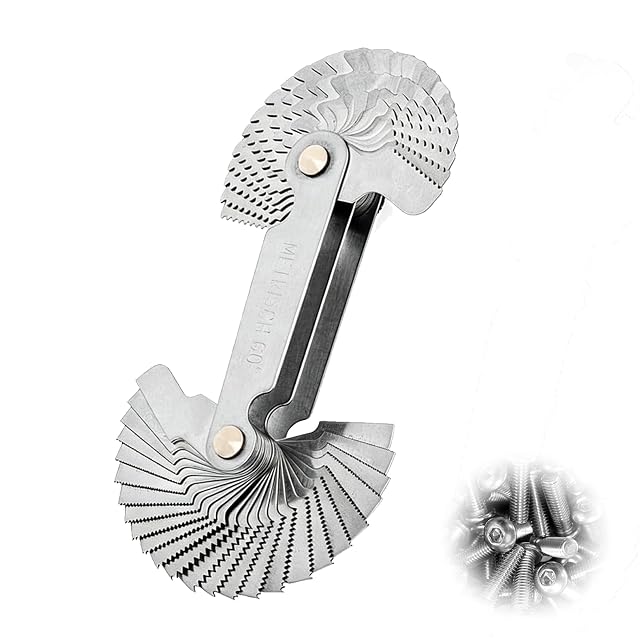
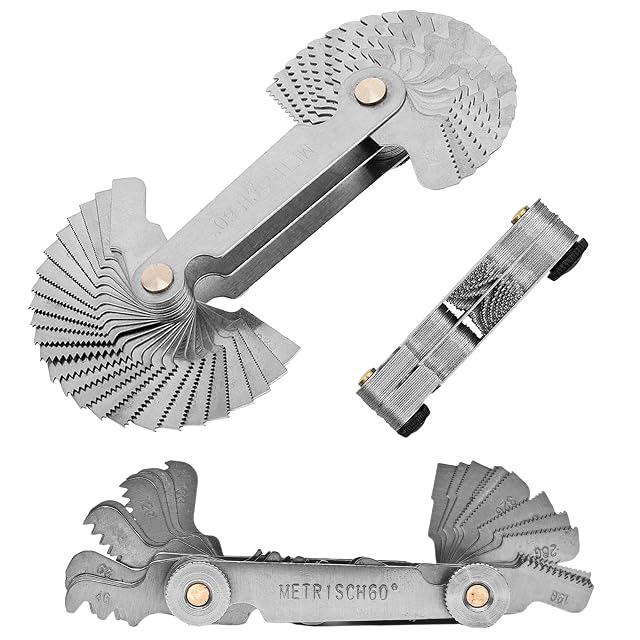
  1. shttoca Thread pitch gauge, 52 leaves

    52 leaves · 24 metric 0.25–6.0 mm (0.01 to 0.24 in) · 28 imperial 4G–62G · stainless

    A 52-leaf stainless set covering 24 metric pitches from 0.25 to 6.0 mm (0.01 to 0.24 in) at 60° and 28 imperial pitches from 4G to 62G at 55°, folding into a pocket-sized body.

    Best for: A first thread gauge, where the job is identifying a bolt rather than certifying it.
    7.3/10

  2. MniimaLuxe Thread and radius gauge, 52 leaves

    52 leaves · metric 0.25–6.0 mm (0.01 to 0.24 in) 60° · imperial 4G–62G 55° · radius gauge included

    A 52-leaf stainless set that also includes a radius gauge, and the only set in this hub sold across five European markets.

    Best for: Anyone who wants the thread gauge available across Europe rather than on one market.

    7.9/10

  3. gihun Thread pitch gauge, 52 leaves

    52 leaves · metric and imperial · 60° to international standards

    A 52-leaf stainless set stating that its metric leaves follow the internationally recognized 60° angle, with clearly visible markings on each leaf.

    Best for: The same job as every other 52-leaf set — pick on price and on which one is in stock.

    7.7/10

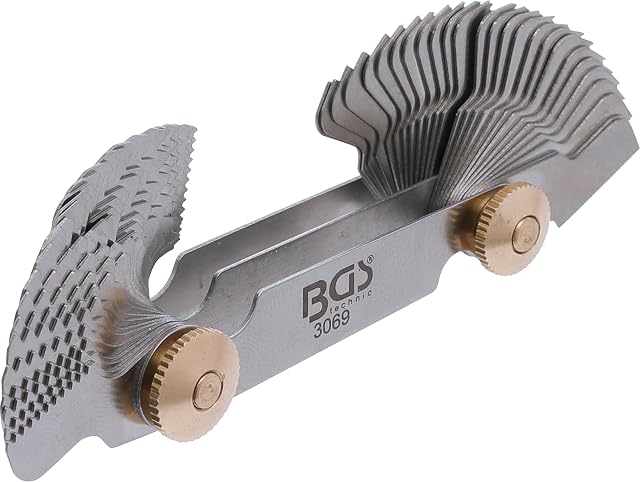
  4. BGS Double thread pitch gauge, 52 leaves

    52 leaves · every metric ISO pitch listed · trade catalog reference

    The only set here that prints its contents: BGS lists every metric ISO pitch it carries, from 0.25 to 4.0 mm (0.01 to 0.16 in) and beyond, rather than quoting a range.

    Best for: Anyone who wants to know a specific pitch is in the set before buying it.

    8.5/10

Need by need, within thread gauges

Covering every pitch

Each leaf corresponds to one precise pitch. An incomplete gauge leaves threads that cannot be identified.

BGS 3069

Covering metric and imperial

A metric-only set leaves you stuck in front of an imperial machine screw. Both systems stated in one set save buying twice.

BGS 3069

Who each family suits, across thread gauges

Identifying fasteners
The aisle's whole use: knowing what pitch a screw has before ordering another.
Two systems
Metric and imperial coexist on many machines. A gauge covering one system alone leaves half the cases unresolved.
Repair
Identifying a damaged thread lets you choose the right tap or die to chase it. Without that step you damage the part.

What you gain and what you give up, on thread gauges

Number of leaves against bulk
A complete gauge covers every common pitch and becomes thick to handle. Two separate gauges, metric and imperial, are often more practical.
Reading with the gauge against with a caliper
The gauge gives the pitch, the caliper gives the diameter. You need both to specify a thread completely.
Leaf quality against price
Badly cut leaves engage approximately and leave you hesitating between two neighboring pitches. That is where quality shows.

Frequent questions on thread gauges

How do I identify a thread completely?

The pitch with the gauge and the diameter with a caliper. The two together specify the thread; one alone is not enough.

How do I know which leaf is right?

The one that engages with no gap and no forcing, checked against the light. Two neighboring pitches are told apart by the light passing through.

Metric or imperial?

Both coexist depending on origins and trades. A gauge covering one system alone leaves half the cases unanswered.

Can a damaged thread be measured?

On a sound portion of the thread, yes. On a crushed area, the reading is wrong.

How do I measure the diameter of a tapped hole?

The diameter of a tapped hole is measured with a caliper at the root of the thread, which is approximate. A test screw is more reliable.

Do I need a gauge for fine threads?

Fine pitches exist at the same diameters as standard pitches. A gauge that does not cover them leaves confusion possible.

How do I look after a gauge?

Dry and lightly oiled, without forcing the leaves in their housing. A bent leaf no longer engages properly.

How do you read a pitch when two leaves seem to fit?

Look against the light: the right leaf lets no light through between its teeth and the thread. Two neighboring leaves often differ by a tenth, and the light settles it.

What stays with you, on thread gauges

A thread is specified by its pitch and its diameter: the gauge alone is not enough. The right leaf engages with no gap and no forcing — check it against the light — and a fine pitch exists at the same diameters as a standard one, which makes confusion possible.

Summed up: thread gauges

    Thread gauges, side by side

    There is no table here, and the reason is in the listings. The figure published most often across these 4 products is leaves, given by 4 of them — short of the four in five a column needs to compare rather than to display gaps. Each product page says what its own maker published.

    Where the figures are read

    Specifications: manufacturer sheets for measuring instruments and the matching Amazon product pages. Prices and availability: Keepa.

    Most recent revision in this category: August 31, 2026.

    The method applied to thread gauges