Skip to content

The best thermal cameras for 2026

The only figure that describes what a thermal camera can actually resolve is its detector resolution — 160 × 120, 256 × 192, 320 × 240 — and it is routinely buried under a much larger "image resolution" produced by upscaling. Second is thermal sensitivity in millikelvin, which decides whether a faint difference appears at all. Emissivity adjustment matters because a shiny surface reports a temperature that is not its own. We compare detector resolution, sensitivity, temperature range, emissivity setting, and phone-attached against standalone bodies.

The models we recommend

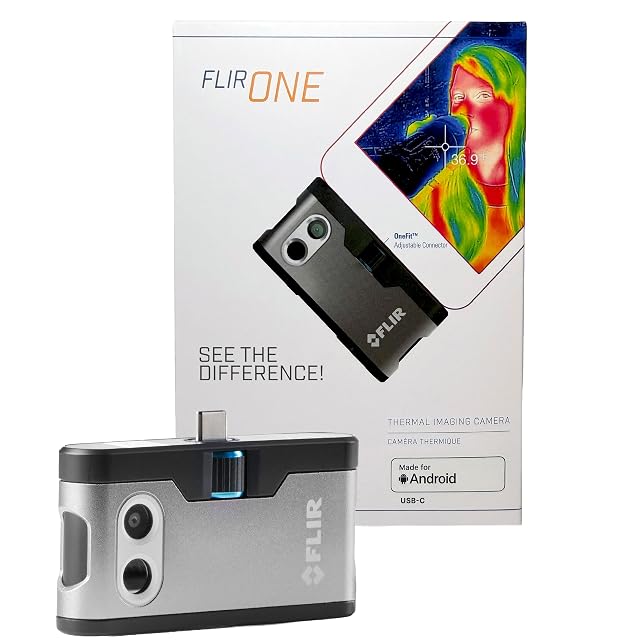
  1. FLIR FLIR ONE Gen 3, phone thermal camera

    80 × 60 detector · 1440 × 1080 image · ± 3 °C (37 °F) or ± 5% stated · USB-C Android

    A phone-attached thermal camera whose listing states both numbers plainly: an 80 × 60 thermal detector behind a 1440 × 1080 displayed image, with accuracy given as ± 3 °C (37 °F) or ± 5%.

    Best for: A first thermal camera for home inspection, where finding the cold spot matters more than resolving it finely.

    7.2/10

    ≈ $214

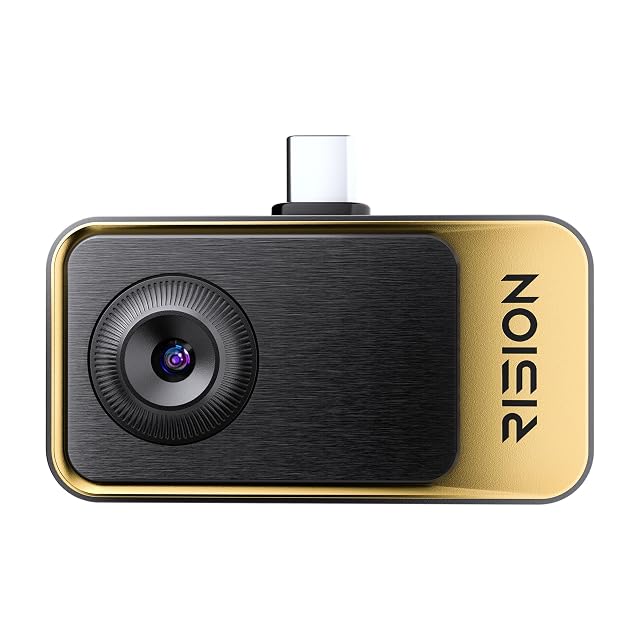
  2. RISION Phone thermal camera, 320 × 240 from 160 × 120

    160 × 120 DETECTOR, stated, upscaled to 320 × 240 "QuadIR" · 40 mK sensitivity · −20 to 600 °C (-4 to 1112 °F), the WIDEST range on this shelf · ADJUSTABLE EMISSIVITY · 52° × 39° field of view · 25 Hz · 12 palettes · USB-C for iOS, Android and Windows, NOT Mac · 23 g (0.8 oz) · $139

    The same 160 × 120 detector as the $299.99 Klein phone camera, with a published sensitivity and emissivity setting the Klein does not give.

    Best for: A first thermal camera, where the phone is the screen and the detector matters more than the body

    ≈ $139

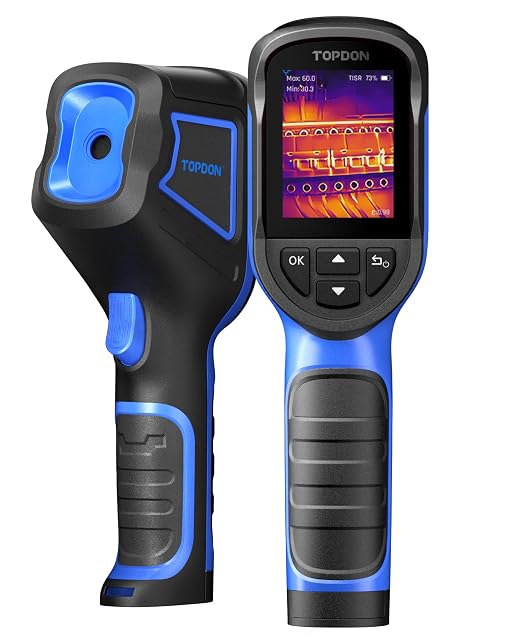
  3. TOPDON Thermal camera, 320 × 240 upscaled from 160 × 120

    160 × 120 detector, 320 × 240 displayed · −20 to 550 °C (-4 to 1022 °F) · ± 2 °C (36 °F) stated · Wi-Fi

    A standalone thermal camera stating a 320 × 240 output produced by upscaling a 160 × 120 detector, with ± 2 °C (36 °F) accuracy, a −20 to 550 °C (-4 to 1022 °F) range and Wi-Fi to a PC.

    Best for: Regular inspection work where images have to be reviewed and reported afterwards rather than glanced at.

    7.8/10

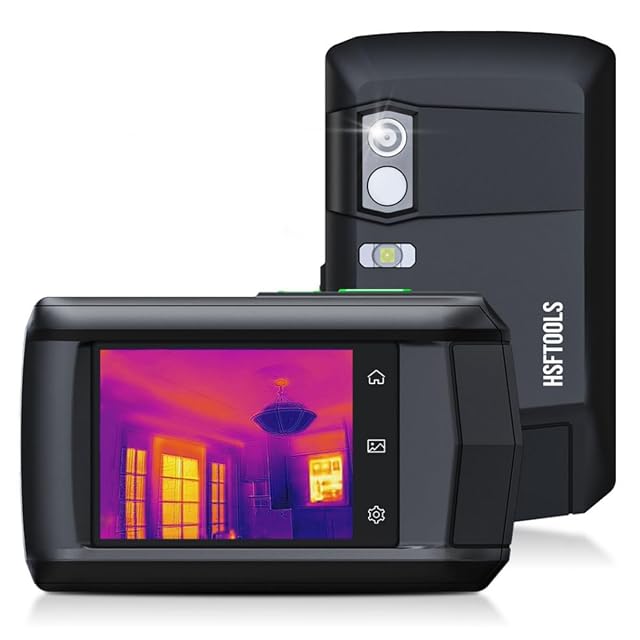
  4. HSFTOOLS Imager, 640 × 480 from a 256 × 192 VOx detector

    256 × 192 DETECTOR stated, upscaled to 640 × 480 — SIX AND A QUARTER TIMES the pixels · VOx detector, named · under 40 mK, 0.04 °C (32 °F) · −4 to 1022 °F (−20 to 550 °C) · max(±3.6 °F, ±2%) · EMISSIVITY and DISTANCE both adjustable · 3.2 in LCD · 2 MP visible cam, 4 image modes, 7 palettes · Wi-Fi · LED torch · ¼ in TRIPOD HOLE · $439

    A 256 × 192 detector — two and a half times the pixels of the Klein pair — upscaled to a 640 × 480 figure six times larger.

    Best for: Serious inspection work where a 256 × 192 detector is the requirement and the camera lives on a tripod as often as in a hand

    ≈ $439

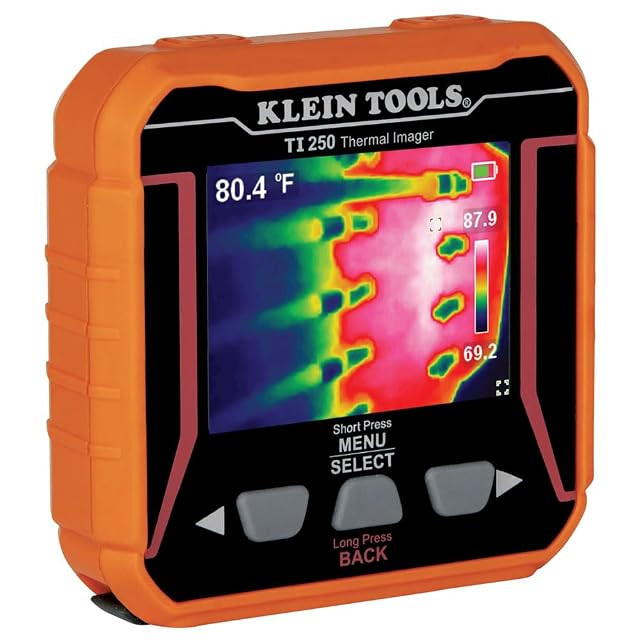
  5. Klein Tools Standalone imager, emissivity 0.01 to 0.99

    Resolution published as "OVER 19,200 pixels" — a count, and a vague one · EMISSIVITY 0.01 to 0.99, the only NUMERIC emissivity range on this shelf · −4 to 752 °F (−20 to 400 °C) with user-set high and low ALARMS · crosshairs · USB-C · built-in NON-REMOVABLE battery · case supplied · 245 g (8.6 oz) · NO sensitivity in mK · $314.38

    The only camera on this shelf that publishes an emissivity range — and the only one whose resolution is given as "over" a number.

    Best for: Troubleshooting on surfaces whose emissivity you need to dial in, in a standalone body that does not depend on a phone

    ≈ $314

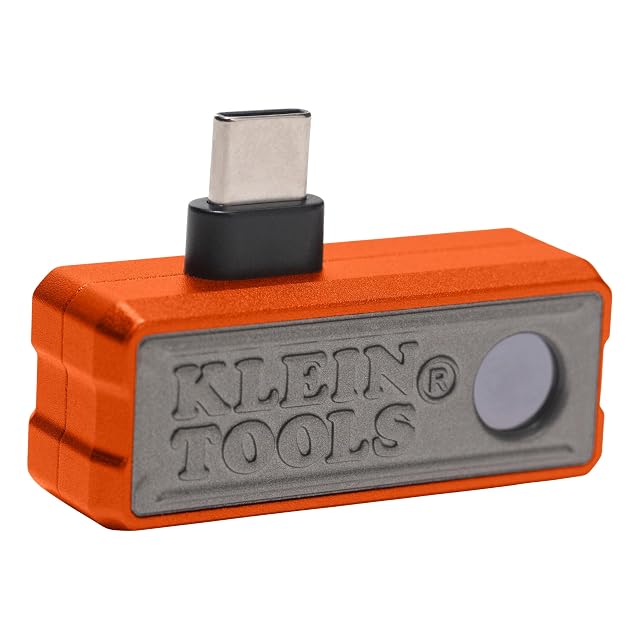
  6. Klein Tools Phone thermal imager, 19,200 pixels

    Resolution published as a PIXEL COUNT — "19,200 PIXELS", never as a grid · −4 to 752 °F (−20 to 400 °C) · 3 palettes · touch-screen spot, high/low and DIFFERENTIAL readout · TIME-LAPSE video · USB-C, iOS and Android, fits cases up to 1/5 in · 32 g · NO sensitivity in mK and NO emissivity setting · $299.99

    A phone imager that gives its resolution as a pixel count and publishes neither a sensitivity nor an emissivity setting.

    Best for: An electrician who already carries Klein tools and wants thermal imaging on the phone already in their hand

    ≈ $300

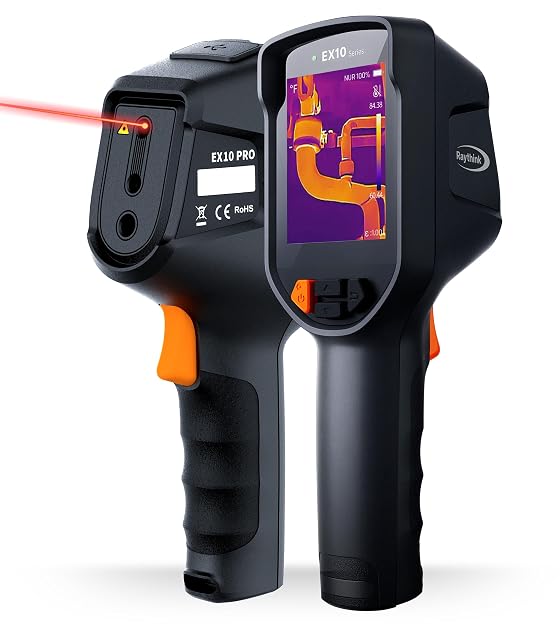
  7. Raythink Dual-lens imager, 320 × 240 upscaled

    320 × 240 "Super Resolution" — and NO NATIVE DETECTOR FIGURE ANYWHERE, alone on this shelf · 40 mK, 0.04 °C (32 °F) · −4 to 1022 °F (−20 to 550 °C) · ±2 °C (36 °F) or ±2% · 2.8 in display · 2 MP visible camera, 4 image modes, 9 palettes · a LASER POINTER, unique here · 8 GB · 10 h, the longest runtime published · IP54 and a 6.6 ft drop · NO emissivity setting published · $199.99

    The only camera on this shelf that publishes an upscaled resolution and no native one at all.

    Best for: Long inspection days in a rough environment, where ten hours of battery and a laser pointer matter more than a published detector

    ≈ $200

  8. HSFTOOLS Touchscreen imager, 256 × 192 VOx, 8 MP visual

    256 × 192 DETECTOR stated, upscaled to 640 × 480 · VOx · under 40 mK, 0.04 °C (32 °F) · −4 to 752 °F (−20 to 400 °C) · max(±3.6 °F, ±2%) · emissivity AND distance adjustable · 3.5 in TOUCHSCREEN, the largest here · 8 MP visible cam — four times the Raythink and the F2VW · 5 image modes, 8 palettes · Wi-Fi + PC software with 3D plotting · 16 GB / 60,000 images / 54 h video · 4 h battery · IP54, 6.6 ft · $479

    The most expensive camera on this shelf: the same 256 × 192 detector as the F2VW with a bigger touchscreen, four times the visible camera, and a lower temperature ceiling.

    Best for: Reporting work, where the images go into a document and the 8 MP visible shot is half the evidence

    ≈ $479

Need by need, within thermal cameras

Seeing thermal detail

The sensor resolution decides the size of the smallest visible fault. The most structuring and most costly characteristic.

Klein Tools TI250

Telling half a degree apart

A thermal bridge shows as one or two degrees on a wall, not ten. The stated thermal sensitivity decides what the image really shows.

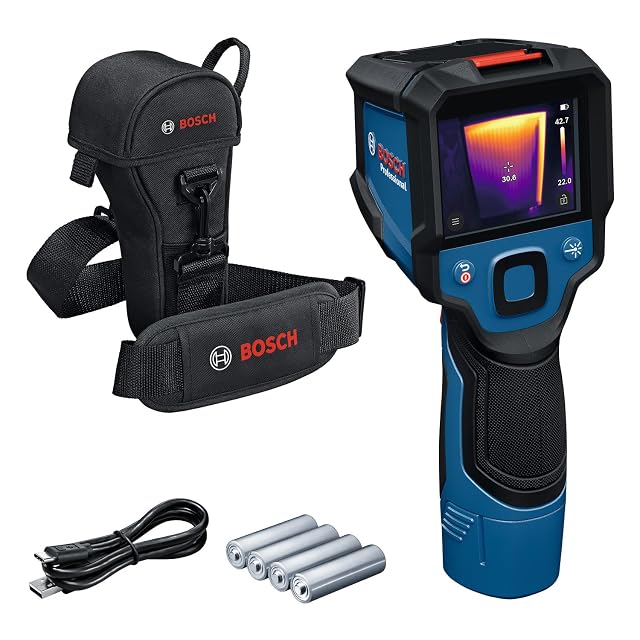
Bosch Professional GTC 12V-450-13

Being set to the material's emissivity

A reading on shiny metal without emissivity correction is wrong by tens of degrees. A stated emissivity setting separates an instrument from a toy.

RISION AF01

Who each family suits, across thermal cameras

Finding heat loss
A camera reveals thermal bridges and insulation faults invisible otherwise. The most common use in building work.
Electrical checking
A hot spot in a board signals a failing connection. A preventive diagnosis nothing else provides as fast.
Leak finding
Underfloor heating or a pipe is located by thermal contrast. Detection depends heavily on the conditions.

What you gain and what you give up, on thermal cameras

Resolution against price
Sensor resolution is what makes the biggest price difference in the aisle. Interpolated images create no additional information.
Thermal image against interpretation
A camera shows temperature differences, not causes. Reading a thermal image means knowing the conditions it was taken in.
Emissivity against trueness
A shiny surface reflects the temperature of its surroundings, not its own. Without a suitable emissivity setting, the value displayed is wrong.

Frequent questions on thermal cameras

What is emissivity?

A surface's ability to radiate its own heat. A shiny surface has a low one and reflects the temperature of its surroundings: the measurement becomes wrong.

When should a building thermal survey be done?

When the temperature difference between inside and outside is marked, away from recent direct sunlight. Without contrast, the image shows nothing.

Does interpolated resolution count?

No: interpolation smooths the image without adding information. Only the sensor's real resolution counts.

Does a camera replace an infrared thermometer?

It gives an image instead of a point, which changes everything for locating a fault. The thermometer stays simpler for a single value.

Can it see through a wall?

No, never: the camera reads surface temperature. It reveals what the surface betrays, which is already a great deal.

Is glass transparent to thermal imaging?

No: it reflects infrared radiation. You do not measure the temperature behind a pane.

Is training needed?

Interpreting a thermal image correctly means understanding emissivity, reflections and the conditions of the shot. Many reading errors come from there.

Can you measure through glass?

No: glass is opaque to the infrared band involved, and the camera measures the temperature of the pane. It is the most common error in window surveys.

What stays with you, on thermal cameras

A camera reads surface temperature; it does not see through a wall or through a pane of glass. Interpolated resolution adds no information, and without a suitable emissivity setting a shiny surface reflects the temperature of its surroundings.

Summed up: thermal cameras

    The full table of thermal cameras

    A column is raised only if four instruments in five publish the value. Below that, it would be measuring the silence of the manuals.

    ModelPriceCamera resolutionConnectivity and storageStated temperature range
    RISION AF01$139160 × 120 DETECTOR, stated plainly — "upscales the image to 320×240 QuadIR resolution from NATIVE 160×120". That is 19,200 real measured points, which is exactly what both Klein cameras on this shelf publish as "19,200 pixels" at $299.99 and $314.38. This shelf's introduction says the detector is the only figure that describes what a camera can resolve, and this is the cheapest 160 × 120 here by a factor of twoNone of its own: images and video live on the phone, through the RISION View app, which the listing states requires NO REGISTRATION. The app offers temperature threshold, picture-in-picture, spot, line and area analysis with real-time graphs and isotherm capture, and 12 color palettes — more palettes than anything else on this shelf−4 °F to 1112 °F (−20 °C to 600 °C), stated — the WIDEST range on this shelf. Both Kleins stop at 400 °C (752 °F), the published Bosch at 450 °C (842 °F), and the two HSFTOOLS cameras at 550 °C (1022 °F) and 400 °C (752 °F). Six hundred degrees reaches a flue, a brake disc and an exhaust manifold
    Raythink EX10 Pro$200"BOOSTS thermal resolution to 320x240 in real time", stated — and NO NATIVE DETECTOR FIGURE APPEARS ANYWHERE on the listing. That makes it the only camera on this shelf that publishes the upscaled number alone. This shelf's introduction is explicit: the detector resolution is the only figure that describes what a camera can actually resolve, and it is routinely buried under a larger image resolution produced by upscaling. Here it is not buried; it is absent. The word "boosts" tells you there is a smaller number and not what it is8 GB internal storage, wireless transfer to a mobile app, and WINDOWS PC SOFTWARE for real-time display, temperature analysis and data export. Automatic maximum, minimum and center points plus SIX customisable spots, and high and low alarms−4 °F to 1022 °F (−20 to 550 °C), stated. Behind only the RISION's 600 °C (1112 °F) on this shelf, level with the published TOPDON, and well past both Kleins' 400 °C (752 °F)
    FLIR 435-0005-03$21480 × 60 detector · 1440 × 1080 imageUSB-C Android—
    Klein Tools TI223$300"19,200-PIXEL RESOLUTION", stated — as a COUNT and never as a grid. Nineteen thousand two hundred is 160 × 120, which is what the RISION on this shelf states explicitly for $139. This shelf's introduction lists resolutions as grids — 160 × 120, 256 × 192, 320 × 240 — because a grid tells you the shape of the image and a pixel count does not. This and its TI250 sibling are the only cameras on this shelf whose resolution is published in this formImages and video are stored on the phone, including a TIME-LAPSE video feature, which nothing else on this shelf publishes. Three color palettes — ironbow, rainbow and greyscale — against 12 on the RISION, 9 on the Raythink and 7 or 8 on the HSFTOOLS pair−4 to 752 °F (−20 to 400 °C), stated. That is 150 degrees below the HSFTOOLS F2VW and 200 below the RISION, and the same ceiling as the HSFTOOLS P2W
    Klein Tools TI250$314"OVER 19,200 PIXELS", stated. Nineteen thousand two hundred is 160 × 120 — and the word "over" makes this the vaguest resolution statement on the shelf. This shelf's introduction asks for a detector resolution as a grid; this gives neither a grid nor a definite count. The RISION here states 160 × 120 outright at $139, and the two HSFTOOLS cameras state 256 × 192, which is 49,152 pointsCapture and save over USB-C. No Wi-Fi, no app, no storage capacity published — where the Raythink states 8 GB, the P2W 16 GB and both HSFTOOLS cameras offer Wi-Fi to a phone. Supplied with the imager, a charging cable, a carrying case and instructions−4 to 752 °F (−20 to 400 °C), with USER-SELECTABLE HIGH AND LOW ALARMS across that span. The alarms are the useful part: a camera that beeps when something exceeds a threshold can be pointed at a panel and watched rather than read
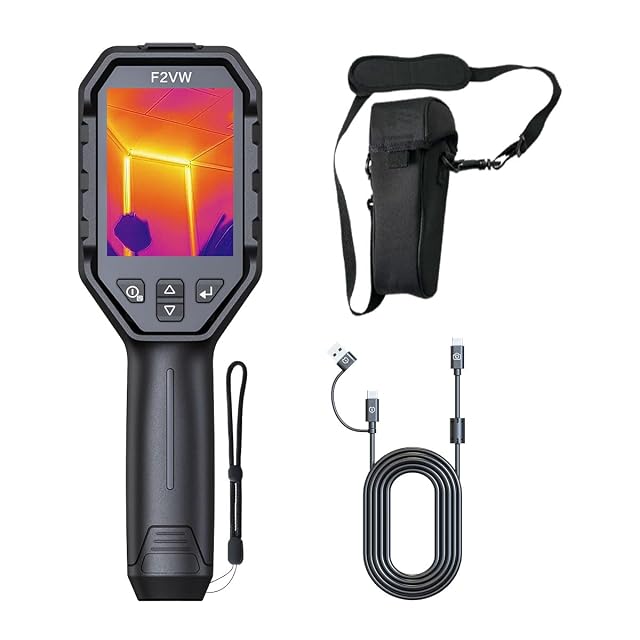
    HSFTOOLS F2VW$439256 × 192 DETECTOR, stated, "as the resolution jumps from 256x192 detector resolution to an impressive 640x480 imaging resolution". That is 49,152 real measurements — two and a half times the 19,200 both Kleins publish, and the same detector as the published Bosch GTC 12V-450-13 on this shelf. The 640 × 480 output is 307,200 pixels, SIX AND A QUARTER TIMES the measurements, which is a six-and-a-quarter-fold interpolationWi-Fi to a phone or tablet for sharing. A built-in LED FLASHLIGHT for dark sites, and a ¼-inch TRIPOD HOLE — which only this and the P2W publish on this shelf, and which matters for the one job a hand cannot do: leaving the camera still and watching a panel over time−4 ℉ to 1022 ℉ (−20 to 550 °C (-4 to 1022 °F)), stated, with high, low, center and CUSTOM measurement points and high and low alarms. Behind only the RISION's 600 °C (1112 °F) on this shelf
    HSFTOOLS P2W$479256 × 192 DETECTOR, stated — "elevate the base 256×192 detector resolution to an stunning 640×480 output". Identical to the F2VW beside it and to the published Bosch, and two and a half times the 19,200 pixels both Kleins publish. The 640 × 480 output is six and a quarter times the measurementsWi-Fi to the HSFTOOLS app, plus HSF Studio Windows software offering image analysis, screen projection, real-time monitoring and 3D PLOTTING. 16 GB eMMC stated to hold up to 60,000 images and 54 hours of MP4 video — the largest storage figure on this shelf, against 8 GB on the Raythink and 8 GB on the published TOPDON. Built-in microphones for live video and audio recording−4 ℉ to 752 ℉ (−20 to 400 °C (-4 to 752 °F)), stated. That is 150 degrees LOWER at the top than its own $439 sibling, which reaches 550 °C (1022 °F), and it is the lowest ceiling on this shelf alongside both Kleins. On the most expensive camera on this shelf, that is the specification to check against the work: 400 °C (752 °F) covers electrical and HVAC and stops short of a flue
    Bosch Professional GTC 12V-450-13—256 × 192 px—−20 to +450 °C (842 °F)
    TOPDON TC004 MINI——Wi-Fi−20 to 550 °C (-4 to 1022 °F)

    What each budget buys in accuracy here

    Lower range

    $139 – $200

    2 models

    RISION AF01, Raythink EX10 Pro

    Mid range

    $214 – $300

    2 models

    FLIR 435-0005-03, Klein Tools TI223

    Upper range

    $314 – $479

    3 models

    Klein Tools TI250, HSFTOOLS F2VW, HSFTOOLS P2W

    Our guides on thermal cameras

    Where the figures are read

    Specifications: manufacturer sheets for measuring instruments and the matching Amazon product pages. Prices and availability: Keepa. Every figure in this table names its source.

    Most recent revision in this category: October 8, 2026.

    The method applied to thermal cameras

    Prices quoted in these summaries are dated readings. The live price is shown next to each product.