What the maker puts in writing
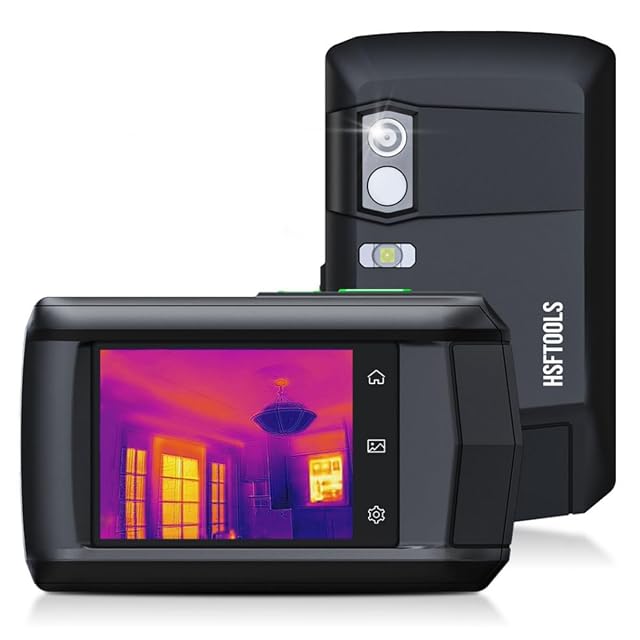
- “the resolution jumps from 256x192 detector resolution to an impressive 640x480 imaging resolution”
- “an exceptional thermal sensitivity below 40 mK” · “detect temperature differentials as small as 0.04℃”
- “a wide temperature measurement range from -4℉ to 1022℉”
- “temperature readings discrepancy is within max(±3.6°F, ±2%)”
- “change emissivity settings based on specific materials and adjust the distance to objects”
- “an advanced VOx detector” · “the ¼”-2 tripod hole” · “built-in LED flashlight”
- 3.2” LCD at 25 Hz · 4 image modes · 7 palettes · Wi-Fi · $439
NO runtime. NO storage capacity. No ingress rating. No drop rating.
Forty-nine thousand measurements
Two hundred and fifty-six by a hundred and ninety-two.
Both Klein cameras on this shelf publish 19,200 pixels, which is 160 × 120.
Forty-nine thousand one hundred and fifty-two against nineteen thousand two
hundred: two and a half times the measurements, and the same detector as the
published Bosch here.
That is what the extra money buys, and it is the only thing on a thermal camera
that cannot be improved later by software.
And then six and a quarter times, in the title
Six hundred and forty by four hundred and eighty is 307,200 pixels.
From 49,152 measurements.
The listing is honest about it — “the resolution JUMPS from 256x192 detector
resolution” — and it is still a six-and-a-quarter-fold interpolation.
Interpolation makes a smoother picture. It does not add a measurement.
Emissivity and distance, both
The distance setting is the rarer one, and only this camera and its P2W sibling
publish it on this shelf.
Air absorbs a little infrared, and the water vapor in it absorbs more. A surface
read from ten meters comes out slightly cooler than the same surface at half a
meter.
The camera can only correct for that if you tell it how far away you are.
It matters on a roof, a high ceiling or a transmission line. At arm’s length it
does not, which is where most readings happen.
A tripod hole, which is the job a hand cannot do
A quarter inch, twenty threads per inch.
Watching a panel over ten minutes to see which terminal climbs. Taking the same
framing before and after a repair. Recording a heating circuit warming up.
None of those can be done hand-held, and only this and the P2W publish the thread
on this shelf.
With an LED torch for the cupboard it is in.
Two degrees Celsius, or two per cent of the reading, whichever is larger.
A fixed figure dominates at low temperatures. A percentage dominates at high ones.
A camera claiming ±2 °C (36 °F) at 500 degrees would be making an extraordinary claim, and
this listing does not make it.
And the AI, which is a prompt and not a verdict
“IntellFault” and “Pro Scene”, stated to use deep learning to flag suspicious
areas.
No accuracy figure. No false-positive rate. No description of what trained it.
“A thermal image shows surface temperature and nothing else … it shows where to
look with another instrument.”
A flagged area is somewhere to take a moisture meter. An unflagged area is not
cleared.
Availability
On sale at around 439 € on the American Amazon store at the time of checking.
Prices and availability are what Keepa reported on the date this page was updated; both move.
Prices quoted in this text were read on 8 October 2026. The live price is at the top of the page.