Skip to content

The best inspection cameras for 2026

Two dimensions decide whether an endoscope reaches the thing you want to see: probe diameter, which sets the smallest opening it enters, and cable behavior — a semi-rigid gooseneck holds the shape you bend into it, while a soft cable simply falls. Resolution matters less than lighting, since almost everything inspected is unlit. We compare probe diameter, cable length and stiffness, sensor resolution, the ingress rating of the head, and whether it feeds a built-in screen or a phone.

The models we recommend

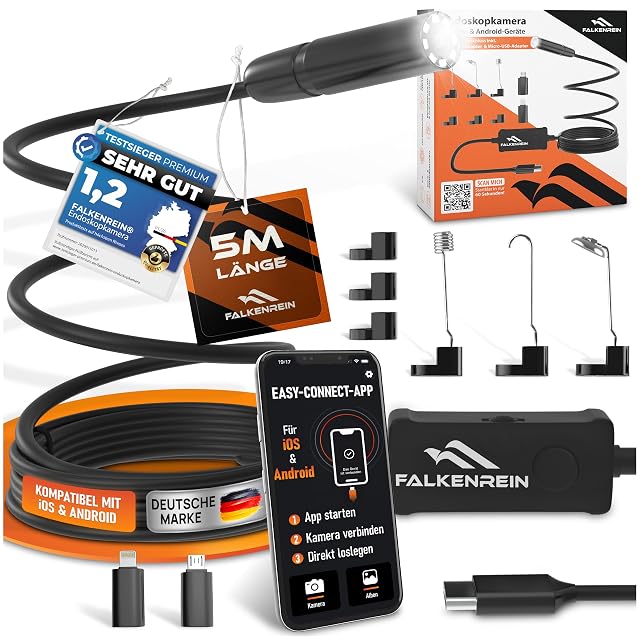
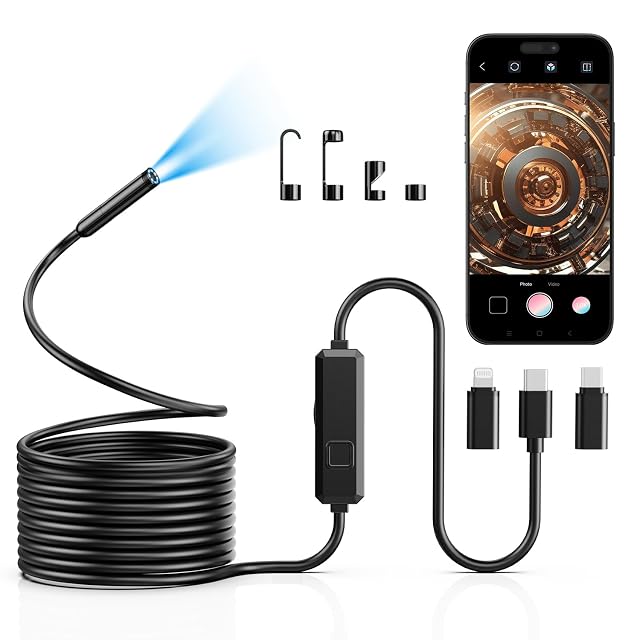
  1. Vorth Phone endoscope, 8 mm (0.31 in) probe, 5 m (16 ft)

    8 mm (0.31 in) probe · 5 m (16 ft) semi-rigid cable · IP67 · 8 LEDs · iOS and Android

    An 8 mm (0.31 in) probe on 5 m (16 ft) of semi-rigid cable that holds the shape you bend into it, IP67-rated for an hour of immersion, feeding an iOS or Android phone.

    Best for: A first endoscope for cavities, drains and behind appliances, where a phone is always to hand anyway.

    7.5/10

    ≈ $24

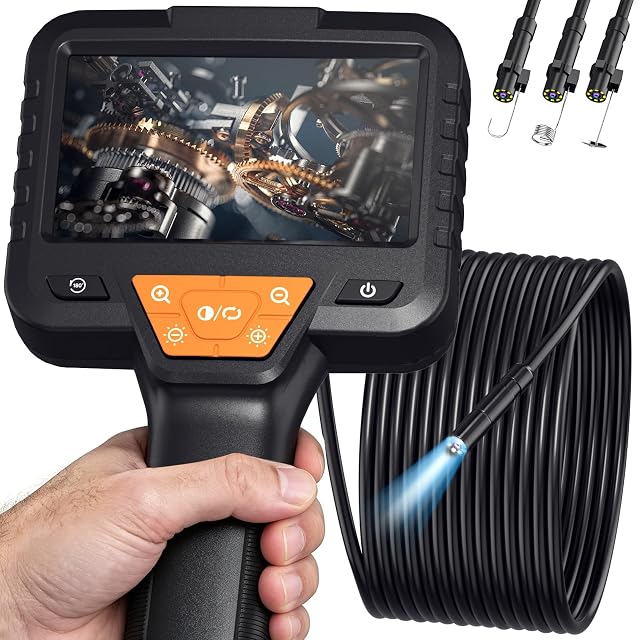
  2. Yamokizy Endoscope with 4.3-inch screen, 10 m (33 ft)

    8 mm (0.31 in) probe · 10 m (33 ft) semi-rigid · 4.3-inch IPS 1080p · 8 LEDs, 3 brightness levels · IP67

    A self-contained endoscope with its own 4.3-inch screen and 10 m (33 ft) of semi-rigid cable — no phone, no app, and twice the reach of the phone-based cameras here.

    Best for: Drains, cavities and vehicle work where a phone is the wrong thing to be holding.

    8.1/10

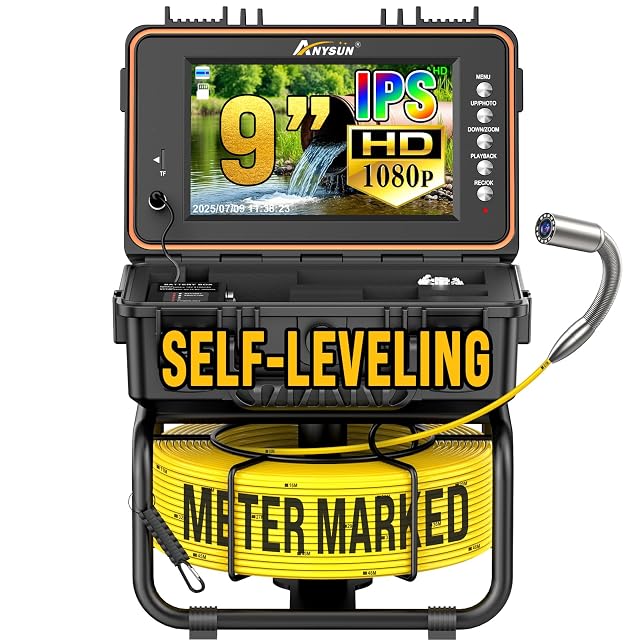
  3. anysun Drain camera, 30 m (98 ft), self-leveling

    7 mm (0.28 in) cable, 30 m (98 ft) with meter marks · self-leveling image · 9-inch IPS · DVR 32 GB

    A drain inspection camera on 30 m (98 ft) of meter-marked cable, with a self-leveling image that stays upright however the head rotates, recording to a 32 GB card.

    Best for: Surveying a drain run properly — with a distance, an orientation and a recording rather than an impression.

    8.1/10

Need by need, within inspection cameras

Seeing comfortably

The screen size decides what you can actually make out in an image that is often dark and distorted. More decisive than the stated definition.

FALKENREIN 1090105

Passing the duct's diameter

A seventeen-millimeter head will not go down a fifteen-millimeter tube, and it is often in the small diameters that you are looking. The stated head diameter is this aisle's first sort.

anysun L09D2

Reaching the far end of the duct

A one-meter cable stops at the first bend of a waste pipe. The stated cable length is compared with the real path, not with the apparent depth.

Vorth YP-105-001

Who each family suits, across inspection cameras

Looking behind a partition
A camera passed through a small hole avoids opening a wall. The use that justifies the purchase.
Pipework
A long, sealed probe travels up a duct. The length and the stiffness of the neck decide what you can reach.
Mechanical work
Inspecting a cylinder or a housing without dismantling saves hours. A mirror attachment lets you look sideways.

What you gain and what you give up, on inspection cameras

Probe diameter against image quality
A slim probe goes everywhere and carries a tiny sensor. Slimness is paid for in definition and in lighting.
Stiff neck against flexible
A semi-rigid neck can be shaped and keeps its position, which lets you push; a flexible neck follows a duct and cannot be steered.
A long probe reaches far and steers badly
A long probe reaches far and becomes hard to aim. Beyond a certain length you are pushing without knowing where you are going.

Frequent questions on inspection cameras

What probe diameter should I choose?

The slimmest that gives a usable image. A very slim probe goes everywhere and carries a tiny sensor, so a poor image.

Is the probe waterproof?

The protection rating generally covers the probe, not the housing. Immersing the whole instrument is almost never intended.

Can the camera be steered?

A semi-rigid neck is shaped before insertion and keeps its curve. A mirror tip lets you look sideways.

Is the lighting enough?

The LEDs at the probe tip light from very close and dazzle on a nearby surface. An intensity adjustment is very useful.

Can the images be recorded?

Many models record to a card, which lets you show what you saw. Useful for documenting a quotation or a dispute.

Will the camera go round a bend?

A flexible neck follows, a rigid one jams. The main limit in pipework.

Is the image distorted?

Very wide-angle lenses distort strongly and make distances hard to judge. Inherent to the format.

How do you orient the view inside a pipe?

The cable rotates and the image with it, which disorients. Devices with a stated image-rotation function put up back at the top, and that comfort separates two models of the same resolution.

What stays with you, on inspection cameras

Take the slimmest probe that still gives a usable image: slimness is paid for in definition. The waterproof rating covers the probe and not the housing, and a semi-rigid neck is shaped before insertion — after that, you steer nothing.

Summed up: inspection cameras

  • Highest figure for supplied: Vorth YP-105-001 (8 mm (0.31 in) probe).

The full table of inspection cameras

A column is raised only if four instruments in five publish the value. Below that, it would be measuring the silence of the manuals.

ModelPriceSupplied
Vorth YP-105-001$248 mm (0.31 in) probe
anysun L09D2——
FALKENREIN 1090105—adapters for phones and tablets
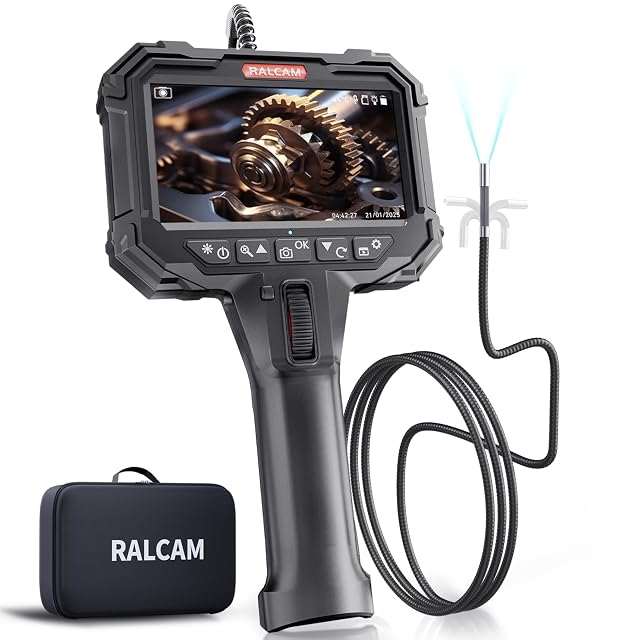
Ralcam N506—6.2 mm (0.24 in) probe
Yamokizy SC08—8 mm (0.31 in) probe

Where the figures are read

Specifications: manufacturer sheets for measuring instruments and the matching Amazon product pages. Prices and availability: Keepa. Every figure in this table names its source.

Most recent revision in this category: August 31, 2026.

The method applied to inspection cameras

Prices quoted in these summaries are dated readings. The live price is shown next to each product.