Probe diameter decides where it goes; cable stiffness decides if it arrives · review
anysun Drain camera, 30 m (98 ft), self-leveling review
A drain inspection camera on 30 m (98 ft) of meter-marked cable, with a self-leveling image that stays upright however the head rotates, recording to a 32 GB card.
What the figures leave us with A survey instrument rather than a look-and-see tool. Self-leveling and meter markings are what separate the two.
The only camera here that produces evidence rather than an impression.
What the manufacturer publishes
A self-leveling function keeping the camera image automatically upright. A wear-resistant 30 m (98 ft), 7 mm (0.28 in) cable with meter markings, stated as designed for narrow pipes from 40 mm (1.57 in). An integrated DVR recording HD video and photos to a supplied 32 GB TF card, expandable to 128 GB. 1080P image quality in real time on a 9-inch IPS display.
Why orientation is a specification and not a nicety
A drain camera on a flexible cable rotates as it goes. Every defect it finds therefore appears at an arbitrary angle, and “there is a crack” is all you can honestly say. With a self-leveling head, “there is a crack at the crown of the pipe” becomes possible — and the crown, the invert and the haunches fail for different reasons and get repaired differently.
The recording, and what it is for
An inspection nobody else saw is an assertion. A recorded survey with distances on it is something a contractor can quote against and a homeowner can keep. For anyone inspecting drains other than their own, that is the reason this instrument costs what it does.
Availability
No such listing: the American Amazon shop answers the reference with a search box rather than a page.
Read from Keepa on the day this page was last revised; stock and price both move without notice.
What it has, and what it lacks
Strengths
A self-leveling head, so the picture stays upright and a defect can be described as at the top or the side of the pipe
Thirty meters of 7 mm (0.28 in) cable with meter markings, so a fault has a distance as well as a picture
A DVR recording 1080P video and stills to a 32 GB card, expandable to 128 GB
A 9-inch IPS display, the largest here
Stated as suited to pipes from 40 mm (1.57 in)
Compromises
The most expensive instrument in this hub
A 7 mm (0.28 in) cable over 30 m (98 ft) is long enough to be difficult to handle alone
Not found on the British or American markets
Specifications
Amazon reference
B0G4LWZMF5 (identical on 5 markets)
EAN
0717405519005
Probe and body
7 mm (0.28 in) cable, 30 m (98 ft) with meter marks
Self-leveling range
self-leveling image
Stated dimension or range
9-inch IPS
Connectivity and storage
DVR 32 GB
What gets asked here
What is self-leveling and why is it worth paying for?
The camera head rotates freely as the cable is pushed. Without self-leveling, a defect appears at a random angle and there is no way to say whether it is at the top of the pipe, where a joint failure sits, or the bottom, where scale collects. anysun states the image stays automatically upright.
Why are meter markings important?
A picture of a crack is not actionable. A picture of a crack at 12 m (39 ft) from the chamber is. The markings turn an inspection into a location.
Does it record?
Yes — a built-in DVR writing HD video and photos to a 32 GB card, expandable to 128 GB, which is what makes the survey something you can show someone else.
Our score
8.1/ 10
A survey instrument rather than a look-and-see tool. Self-leveling and meter markings are what separate the two.
This one’s price among measuring instruments
A reference exists on these Amazon stores: France, Germany, Italy, Spain, United Kingdom. Listed is not the same as in stock — availability changes daily.
Details checked on August 31, 2026.
Who should pick this one, among measuring instruments
Surveying a drain run properly — with a distance, an orientation and a recording rather than an impression.
Sources
Specifications: the manufacturer sheet for measuring instruments and the matching Amazon product page. Prices and availability: Keepa. Every figure on this page names its source.
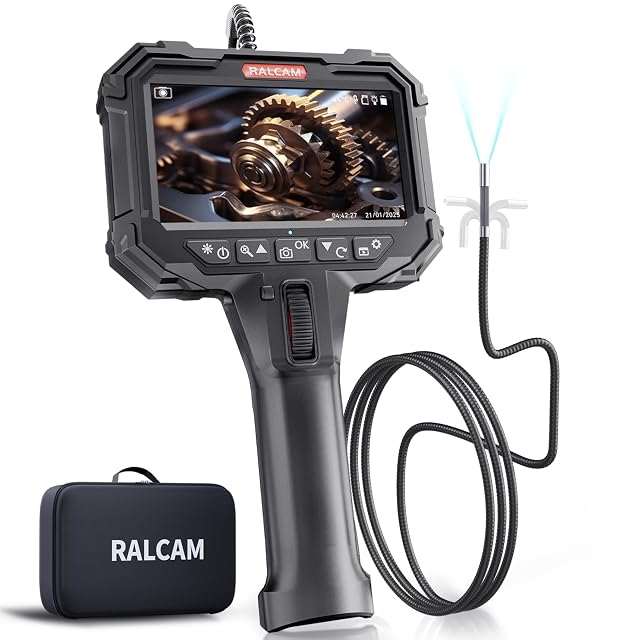
6.2 mm (0.24 in) probe · 210° articulating head · 5-inch 1280 × 720 · over-90 °C warning
The thinnest probe here at 6.2 mm (0.24 in), on a head that articulates through 210° — so the camera can look back along the cavity it entered rather than only forwards.
Best for: Engine bays, machinery and cavities where the thing you need to see is beside the hole, not beyond it.
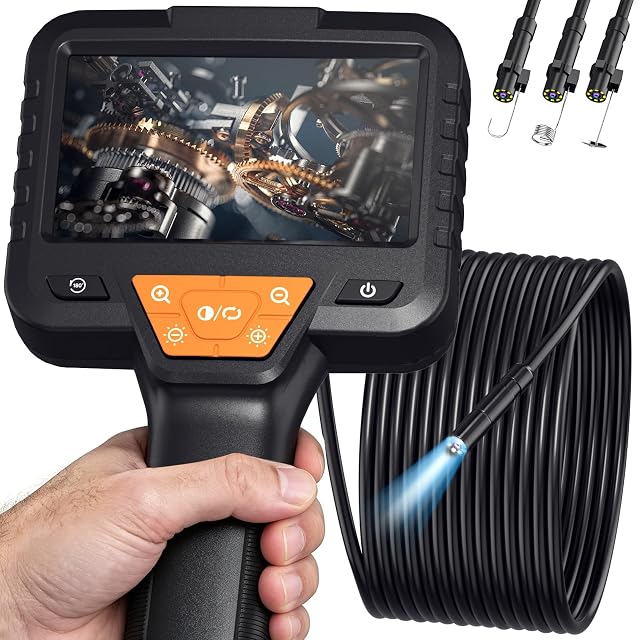
A self-contained endoscope with its own 4.3-inch screen and 10 m (33 ft) of semi-rigid cable — no phone, no app, and twice the reach of the phone-based cameras here.
Best for: Drains, cavities and vehicle work where a phone is the wrong thing to be holding.