Skip to content

The best digital angle gauges for 2026

Most of the work an angle gauge does is relative: not "what angle is this?" but "how far from the surface I just zeroed on?" — setting a blade to a table, a bracket to a wall. A tool with a clean relative-zero button is therefore more useful than one with a finer stated accuracy and no zero. Stated accuracy is usually ± 0.1° to ± 0.2° near the cardinal points and looser between them, which manufacturers publish separately. We compare stated accuracy, magnetic base strength, relative zero, display reversal when inverted, and battery type.

The models we recommend

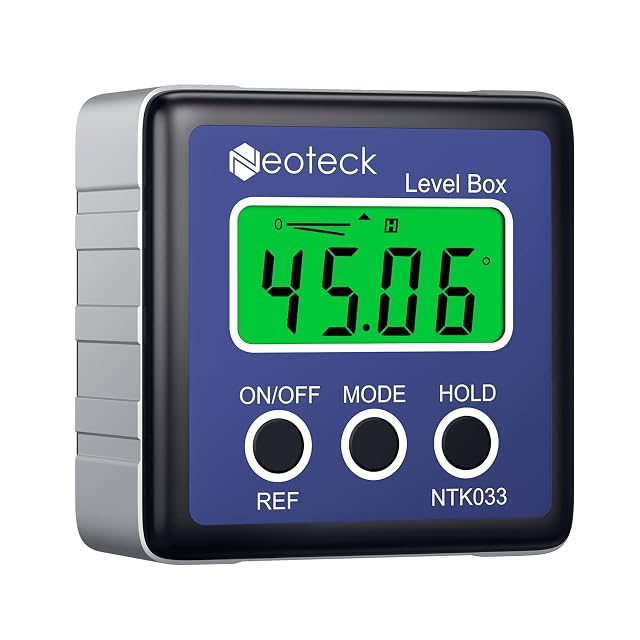
  1. Neoteck Digital angle gauge, 4 × 90°

    ± 0.2° stated · 4 × 90° range · built-in magnets · 3.5 × 1.7 cm (1.4 × 0.7 in) display

    A four-quadrant angle gauge stating ± 0.2°, aimed at relative angles between surfaces, with a magnetic base and a stated display size.

    Best for: Comparing two surfaces to each other — the job an angle gauge actually does most often.

    8.3/10

    ≈ $17

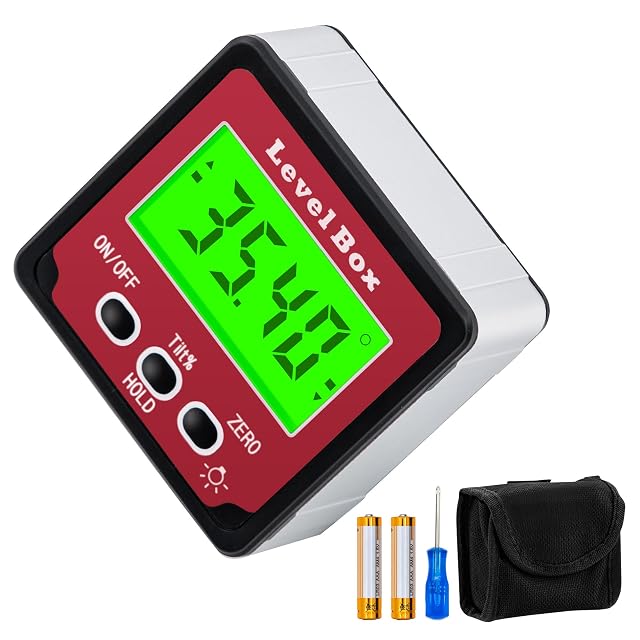
  2. Mcbazel Digital angle gauge, ± 0.2°

    ± 0.2° stated · 0–90° · four reference faces · aluminum, splash-proof

    A MEMS-based angle gauge stating ± 0.2° over 0–90°, in a splash-proof aluminum housing with all four faces usable as a measuring reference.

    Best for: The value pick: a published figure, a metal housing and four reference faces for thirteen euros.

    8.1/10

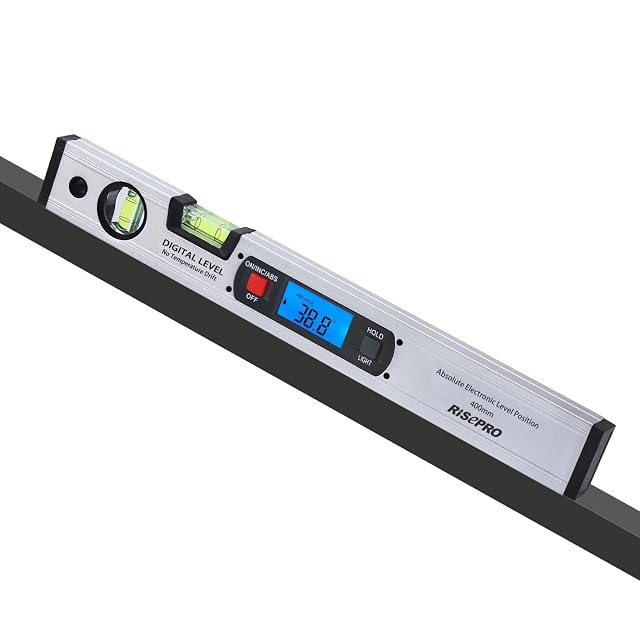
  3. RISEPRO Digital angle gauge, 360°

    4 × 90° (360°) · four magnets · absolute and relative modes · backlit

    A 360° angle gauge with four base magnets and both absolute and relative measuring modes — the second mode being the one most angle work actually needs.

    Best for: Work that alternates between absolute slopes and relative angles without changing tools.

    8.1/10

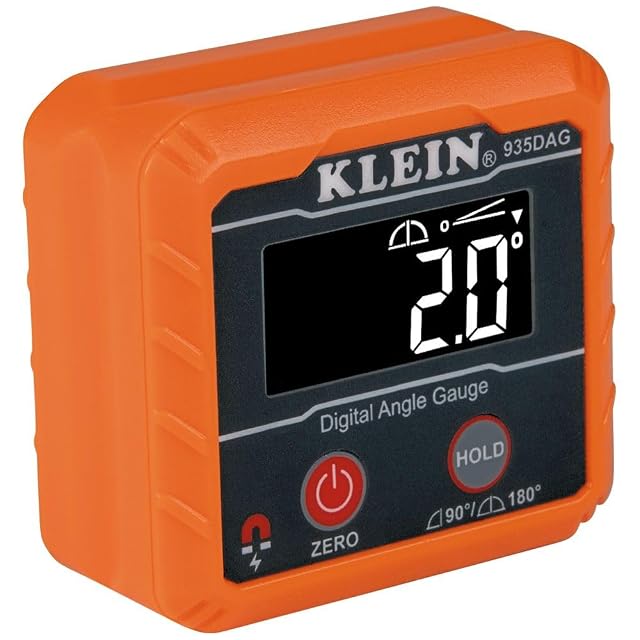
  4. Klein Tools Digital angle gauge with V-groove

    0–90° and 0–180° · magnetic base · V-groove for pipe and conduit

    A trade angle gauge with dual 0–90° and 0–180° ranges and a V-groove machined around the base, so it sits on pipe and conduit instead of rocking on them.

    Best for: Pipe and conduit bending, where the tool has to sit on a cylinder and stay there.

    8.1/10

    ≈ $33

Need by need, within digital angle gauges

A reliable, legible angle gauge

The stability of the reading and the quality of the magnetic base decide the real use on a machine. That is what the price buys.

Klein Tools 935DAG

Setting a machine simply

A basic digital angle gauge is enough to set a saw blade or a table to the angle wanted.

Neoteck Digital inclinometer

Holding on a cast-iron machine table

An angle gauge with no magnet slides at the slightest touch on a tilted saw table. The stated magnet strength decides how repeatable the setting is.

Neoteck Digital inclinometer

Who each family suits, across digital angle gauges

Setting a machine
Setting a blade tilt with a digital gauge is far faster and truer than by the machine's own scale.
Mitre cuts
Measuring an existing angle lets you cut the exact counterpart. Walls are rarely at the angle you assume.
Level checking
Many angle gauges also serve as a digital level. A frequent secondary use.

What you gain and what you give up, on digital angle gauges

Relative against absolute measurement
Zeroing on a reference gives a relative angle, often what you are after. An absolute angle assumes the base really is level.
Magnetic base against non-ferrous surfaces
The magnet holds on a blade and a steel table and is useless on aluminum or wood. You then have to hold the instrument.
Displayed resolution against trueness
A display to a tenth of a degree does not guarantee that trueness. The turn-around check reveals the real deviation.

Frequent questions on digital angle gauges

How do I measure a relative angle?

By setting the instrument on the reference and zeroing it, then setting it on the workpiece. The most common and most reliable use.

How do I check the instrument?

By setting it down and then turning it a hundred and eighty degrees in the same spot. The two readings should be symmetrical.

Does the magnet hold everywhere?

Only on ferrous metals. On aluminum and wood you have to hold or wedge the instrument.

Can I set a saw blade with it?

The most frequent use, and you have to zero on the table before measuring the blade. The machine's own scale is rarely exact.

Does the surface need to be clean?

A chip under the base skews the measurement completely. The most mundane source of error.

Does the battery affect the reading?

A weak battery causes unstable readings before it dies. A value that jumps is a signal.

Does an angle gauge replace a square?

For a right angle, an engineer's square stays faster and more reliable. The gauge excels on arbitrary angles.

Should it be zeroed at every use?

Yes, on the reference surface itself, otherwise you measure the machine's own tilt on top of the blade's. Relative zeroing is the most used function of these devices.

What stays with you, on digital angle gauges

Zero on the reference before measuring: the relative angle is almost always what you are after. A chip under the base skews everything, the magnet only holds on ferrous metal, and a display to a tenth does not guarantee that trueness.

Summed up: digital angle gauges

    Digital angle gauges, side by side

    There is no table here, and the reason is in the listings. The figure published most often across these 5 products is display, given by 3 of them — short of the four in five a column needs to compare rather than to display gaps. Each product page says what its own maker published.

    Our guides on digital angle gauges

    Where the figures are read

    Specifications: manufacturer sheets for measuring instruments and the matching Amazon product pages. Prices and availability: Keepa.

    Most recent revision in this category: August 31, 2026.

    The method applied to digital angle gauges