under twenty dollars: the instruments that still publish a figure
Cheap instruments are not necessarily bad ones. What separates them is whether the maker states the number that governs the tool, and at every price point on this site some do and some do not. These five do.
Five instruments under twenty dollars, each chosen for a published figure.
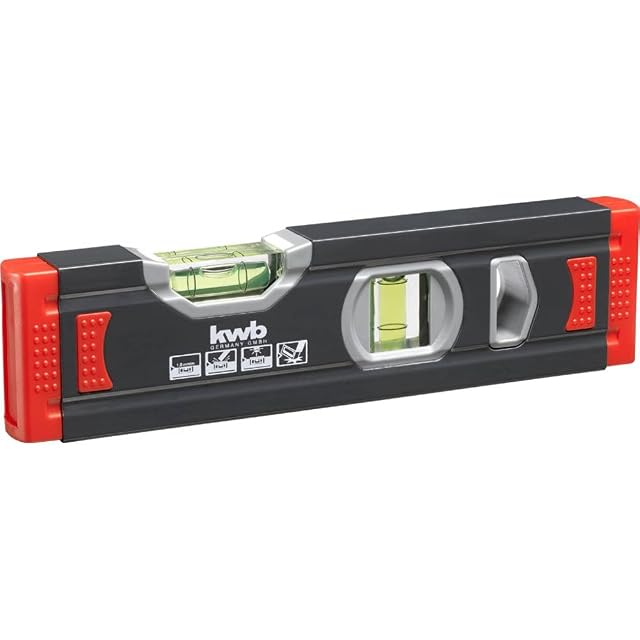
A level that states 1 mm (0.04 in)/m
The kwb mini at seven euros states its accuracy — loosely, and honestly. Rubber bumpers at both ends protect the one relationship that matters, between the vial and the bearing face.
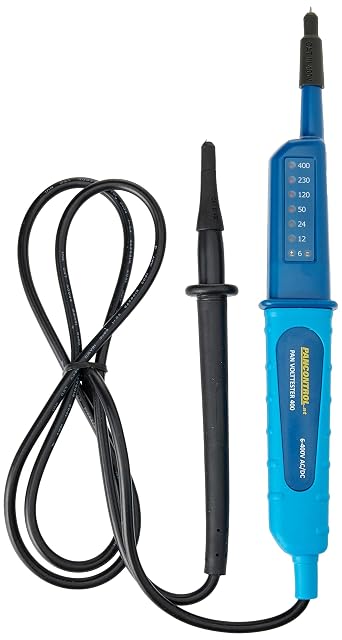
A voltage tester that states CAT III
Twelve euros, eight LEDs from 6 to 400 V, thermal overload protection and a stated category. Follow the manufacturer instructions and the rules that apply where you live; the tester is the cheapest part of doing that properly.
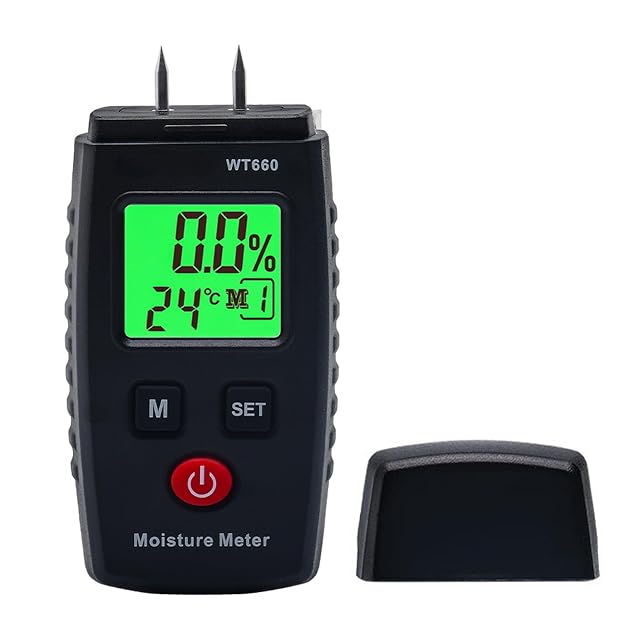
A moisture meter that states two figures
Eleven euros for a pin meter publishing ± 2.0% accuracy and 0.10% resolution, with seven calibrated material scales. That is more published specification than meters at four times the price in the same hub.
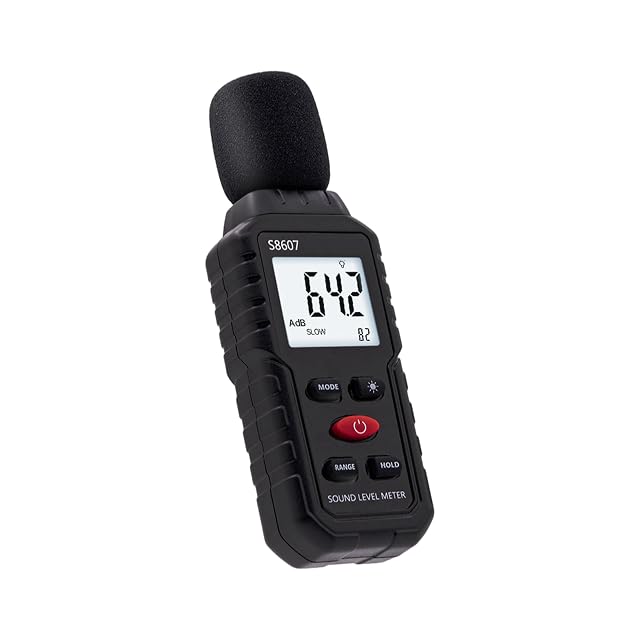
A sound meter that states its conditions
Thirteen euros, ± 1.5 dB at 94 dB and 1 kHz — accuracy quoted at the reference point, which is the correct form and the only way the figure can be compared.
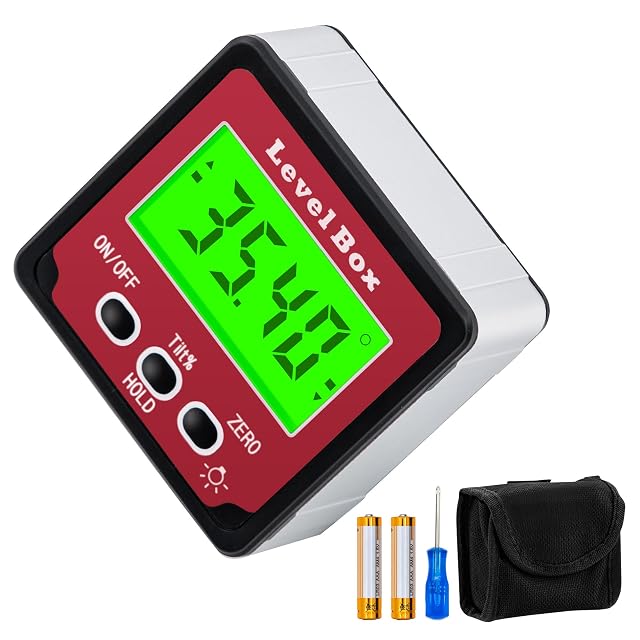
An angle gauge that states ± 0.2°
Thirteen euros, MEMS sensing, four faces usable as a reference and a splash-protected aluminum housing. The gauges at two and three times the price in that hub publish no figure at all.
Which instrument does your work demand?
You need a tool once
Cheap is often the right answer, and hiring is sometimes better still.
You will use it weekly
Cheap tools cost more over time in rework, and the saving disappears fast.
The reading matters for safety
Do not buy cheap. Electrical test equipment is the clearest example of where price reflects protection.
You are learning
A cheap tool teaches you what you actually need before you spend properly.
Picking by the measurement
One-off jobs
Where a cheap tool is entirely rational, and where the alternative is not owning one at all.
Learning a technique
A cheap caliper or level teaches the method; you can buy better once you know what annoys you.
Second copies
A cheap tape for the car or the shed, so the good one stays where it belongs.
Anything safety related
Where cheap is the wrong answer, and where the specification exists precisely to protect you.
The figures that settle accuracy accuracy
Whether the tool can be verified
A cheap tool you can check against a known reference is usable. One you cannot check is a guess with a display.
Repeatability rather than accuracy
A tool that gives the same reading twice is useful even if it is offset. One that gives different readings is useless at any price.
Whether a battery is a hidden cost
Cheap electronic tools often use unusual batteries or eat ordinary ones. That is a running cost the price does not show.
Safety certification where it matters
For electrical instruments, the safety category is not a feature to save on. Uncertified equipment is a genuine hazard, not just a poor buy.
The cost of being wrong
A wrong measurement on a shelf costs a shelf. A wrong measurement on a worktop costs a worktop. Buy in proportion to that.
Which tolerance for which work
The situation
Cheap is
Why
A one-off job
Fine
The alternative is not having one
Weekly use
False economy
Rework costs more
Electrical testing
Dangerous
Safety categories exist for a reason
Learning
Sensible
You discover what you need
The errors that cost you
Buying cheap electrical test equipment
This is the one category where a low price can reflect the absence of protection you would need in a fault. It is not a place to economize.
Judging a cheap tool by its display
Extra digits cost nothing to print. They say nothing about whether the instrument is accurate or repeatable.
Buying cheap twice
The classic pattern is a cheap tool, frustration, and then the proper one. If you already suspect that will happen, skip the first step.
Not checking a cheap tool against a known reference
A cheap caliper checked against a gauge, or a cheap tape against a good one, becomes usable. Unchecked, it is unusable.
By the trade you are in
The occasional user
Cheap tools, checked once against something known, are entirely reasonable.
The frequent user
Buy properly for the two or three tools you actually use, and cheaply for the rest.
Anyone testing electrics
Certified equipment appropriate to the work, without exception.
Calibration and how long accuracy holds
Cheap tools are less tolerant of neglect than good ones. Thin castings distort, plastic jaws wear, and cheap electronics drift. That does not make them unusable; it makes checking them a routine rather than an occasional exercise.
Check a cheap tool against a known reference before trusting a critical measurement.
Keep the batteries out of cheap electronic tools during long storage; leaks ruin them.
Clean and dry them like any other tool; cheap finishes corrode faster.
Replace rather than repair when a cheap tool starts reading inconsistently.
Safety
There is one category where price and safety are directly connected.
Never use uncertified equipment on mains electrical work.
Check that any electrical instrument carries a safety category appropriate to the circuit you are testing.
Discard cheap tools that have been dropped rather than assuming they still read true.
Do not use a damaged or cracked instrument, at any price.
20 cm (7.9 in) · 1 mm (0.04 in)/m stated · two vials · rubber end bumpers
A 20 cm (7.9 in) pocket level with ground bearing faces, a stated accuracy of 1 mm (0.04 in) per meter and rubber bumpers at both ends. The loosest published figure here, in the smallest and cheapest body.
Best for: The level that lives in a drawer or a kitchen cupboard for hanging pictures and checking appliances.
Pin type · ± 2.0% stated · 0.10% resolution · 4 wood + 3 building scales
A pin meter publishing both its accuracy and its resolution — ± 2.0% and 0.10% — with seven calibrated scales split between four wood groups and three building materials.
Best for: Timber and firewood, where a pin reading at a known depth is exactly the right measurement.
30–130 dB · ± 1.5 dB at 94 dB / 1 kHz · A-weighted · fast and slow response
A 30 to 130 dB meter publishing its accuracy with the conditions it applies at — ± 1.5 dB at 94 dB and 1 kHz — with A-weighting and fast and slow response modes.
Best for: Getting a sense of a noise problem, with a figure whose conditions are stated.
It is if it publishes what it does. a twenty-dollar angle gauge stating ± 0.2° is a usable instrument; a forty-dollar one stating nothing cannot be evaluated at all. Price and published specification are only loosely related.
Where does cheap genuinely fail?
Enclosures and longevity. None of these has an ingress rating worth the name, and none is built for a site. They are drawer and workshop tools.
What should I not buy cheaply?
Anything that goes near a live installation without a stated measurement category, and anything whose reading you would act on without a second check.
Are cheap measuring tools worth buying?
For one-off jobs and for learning, often yes. For weekly use they cost more over time, and for electrical testing they are the wrong choice entirely.
How can I tell if a cheap tool is good enough?
Check it against something known: a good tape, a gauge, a reversed level. A tool that repeats consistently is usable even if it is slightly offset.
Why is electrical test equipment different?
Its price partly reflects the protection built in for fault conditions. That protection is what stands between you and a serious injury, so it is not a place to save.
Does a bigger display mean more accuracy?
No. Extra digits cost nothing to add and say nothing about whether the instrument reads correctly or repeatably.
Should I hire instead of buying?
For expensive instruments used once, often yes. It also gets you a properly maintained tool, which is worth more than the saving.
What is worth spending on first?
The tool you reach for most, and anything where being wrong is expensive or dangerous. Everything else can be cheap for a long time.
Targets, tripods and spares from the same aisle, at the price we noted. Check the thread matches the instrument you pick before ordering: it depends on the mount and the part number, which the listing states.
CREAWEA CREA9 · Chalk lines — 100 ft · 5.3 × 3.94 in — the ONLY reel on this shelf that publishes its own dimensions · high-impact ABS · large refill port · NO gear ratio, no sealing organ, no line diameter · ten dollars · $10
IRWIN IWHT48441BC · Chalk lines — FIVE TO SIX STRIKES PER PULL — the only strike count published on this shelf · a 1:1 gear ratio, the slowest here, chosen for torque · Aluminum housing · a spool stated to AERATE the chalk, unique on this shelf · steel handle and large center hub · the center line doubles as a plumb bob · blue chalk included · $10
Hultafors 650100U Dry Marker HDM · Marking pencils — ROLL STOP ON BOTH the pencil AND the holster, the only one here that treats both · a DRAIN HOLE in the holster base to lead dirt and moisture away from the pen, published by nobody else · sharpener in the holster, accessible without releasing the pencil · the dispenser doubles as a blade snapper and fits SRP knife handles · easy to change lead · $16
Klein Tools 80189 Skribes · Marking pencils — 2.8 mm (0.11 in) lead · TEN replacement leads in a carry case, the largest lead count on this shelf · a TRIANGULAR barrel so it cannot roll off a beam — the flat pencil's one virtue, kept in a mechanical body · built-in sharpener · stated for OSB, wood, concrete and metal · "assorted color" leads, with no color named · $15
Alyco 197932 · Mason lines and plumb bobs — 500 g (17.6 oz) · zinc-plated steel and walnut · 5 m (16 ft) nylon line
AWF PRO AWF 5000 · Mason lines and plumb bobs — TWO bobs, 16 oz AND 8 oz, in SOLID BRASS — the only brass on this shelf · FOUR replaceable steel tips, two per bob with one hidden in each cap, and the caps interchange between sizes — the only spare tips here · a 14 ft retracting reel with RARE-EARTH MAGNETS and a fold-out bracket · bright orange braided nylon · zipped case · $50
The instruments above come from the catalog of this site. Specifications are the ones the manufacturer states and the ones on the Amazon listing; prices are the Keepa reading for the date below, and both change. Ranking uses declared specifications, stated strengths weighed against stated limits, and price. Nothing here has had its accuracy checked by us, and the page says as much.
Last checked on
Prices quoted in these summaries are dated readings. The live price is shown next to each product.
The tool we use ourselves
Chosen your tool? Now buy it at the right price.
Thermal cameras, line lasers and clamp meters swing by thirty dollars or more
across the
year, and the biggest "discounts" often land at prices the same model sold for six weeks
earlier.
UniverTrack tracks the real price history across retailers, spots fake
reductions, and alerts you when it is genuinely the moment to buy.
Real price historyBuy-now alertsAI buying assistant