A flat battery in a torch is obvious. A flat battery in a measuring instrument can look exactly like a reading. These five have no such state — and two of them are the only instruments on this site that cannot go out of adjustment at all.
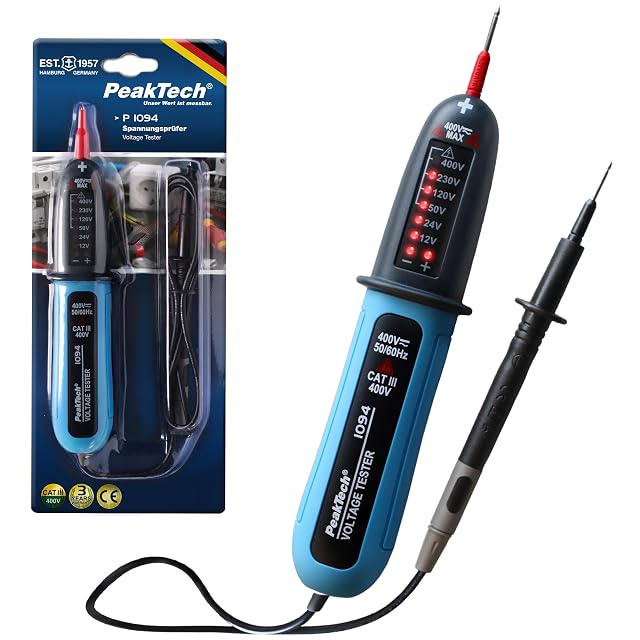
The PeakTech P 1094 has no battery because it does not need one — it takes its indication current from what it is measuring. That removes the single most dangerous failure mode a voltage tester can have.
The level with bonded vials
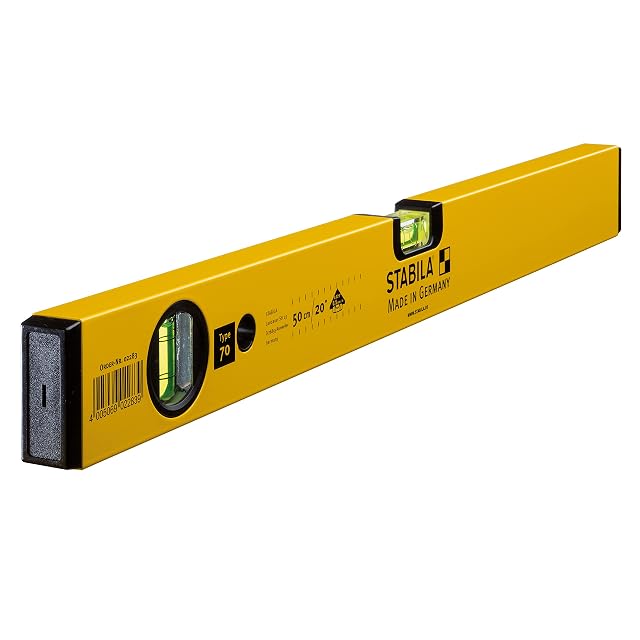
The Stabila Type 70 states ± 0.5 mm (0.02 in)/m in the normal position, exact reading from −20 °C (-4 °F) to +50 °C (122 °F), and vials permanently bonded to the profile. No electronics, and the one mechanical failure mode designed against.
The rule with brass joints
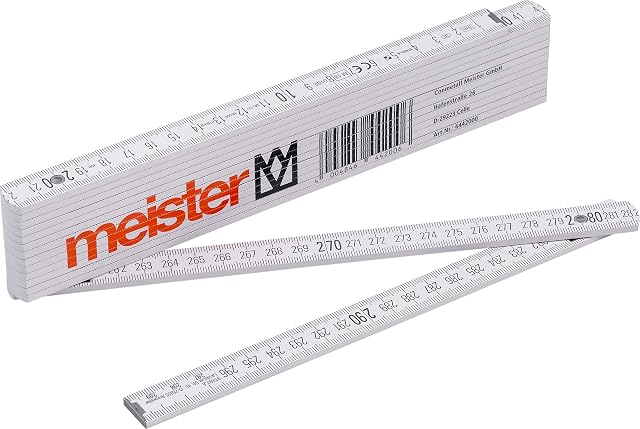
Three meters of beech, EC accuracy class III, joints latching at 90°. Nothing to fail except the joints, and those are what the construction is about.
The micrometer with carbide faces
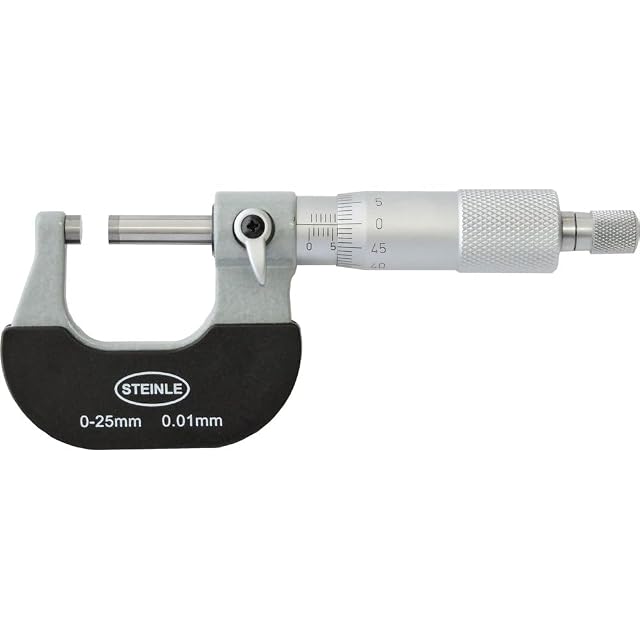
Analog, matt-chromed thimble, carbide measuring faces, 0.01 mm reading. It will still read correctly in twenty years if the faces are looked after, and it has no auto-off to catch you mid-measurement.
The tape with a window
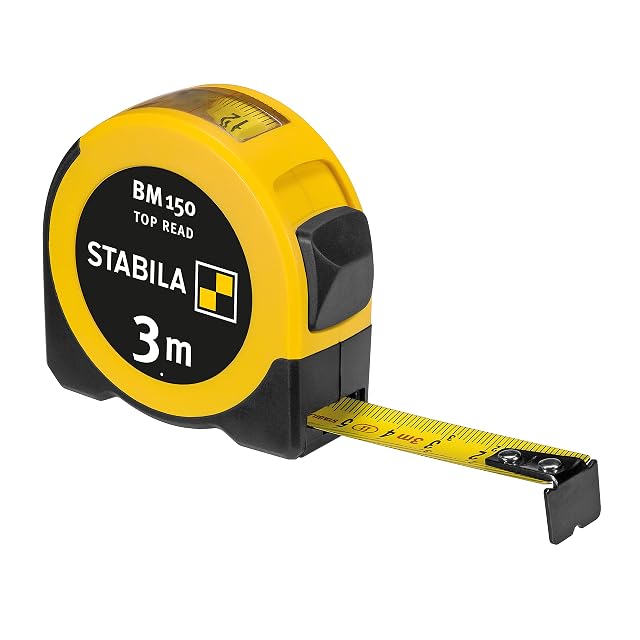
Three meters, a metal belt clip, a lacquered scale and a window in the top of the case for internal measurements. The whole instrument is a spring and a printed steel band.
And the one that beats all of them
A plumb bob. Gravity needs no calibration certificate.
Which instrument does your work demand?
You want tools that always work
A tape, a rule, a square and a spirit level are ready every time you pick them up.
You work outdoors or in the cold
Batteries fail in cold and damp long before mechanical tools do.
You want the fastest short measurement
A tape beats a laser inside a few meters, every time.
You want long distances alone
This is where an electronic tool genuinely earns its battery.
Picking by the measurement
Everyday measurement
A tape and a rule. Between them they handle almost everything without a single cell.
Leveling and plumbing
A spirit level and a plumb bob, both of which are self-verifying in a way electronics are not.
Squaring
A square, or the 3-4-5 method with a tape, which needs nothing but arithmetic.
Marking out
Chalk line, dividers, marking gauge. Traditional, precise, and immune to a flat battery.
The figures that settle accuracy accuracy
Readiness
The advantage that matters. A tool that works the instant you pick it up removes a category of frustration entirely.
Self-verification
A level can be reversed, a square can be flipped, a tape can be compared. These checks need nothing and catch real errors.
Cold and damp tolerance
Batteries lose capacity in cold and connections corrode in damp. Mechanical tools simply do not care.
Durability
A steel rule outlasts almost anything electronic, and a dropped square can usually be checked and kept.
Where they genuinely lose
Long distances alone, area calculation and awkward corners. That is what electronic tools are for, and it is a real advantage.
Which tolerance for which work
The task
Battery-free tool
When electronics win
Short measurement
Tape or rule
Almost never
Leveling
Spirit level
Long distances
Squaring
Square or 3-4-5
Setting out a whole room
Room dimensions
Tape and a helper
Measuring alone
The errors that cost you
Assuming a battery-free tool cannot be wrong
A bent tape hook, a level knocked out of true and a square dropped on a corner are all wrong in ways that look confident. Checking still matters.
Letting a tape blade snap back
It damages the hook, which changes every subsequent reading, and it is the fastest way to ruin a good tape.
Storing a level loose in a bag
Levels go out of true from knocks. A level kept properly stays right for years; one thrown into a bag does not.
Using a short level on a long run
A short level over a long distance amplifies any small error. Use the longest level that fits the work.
By the trade you are in
The traditionalist
Tape, rule, square, level, chalk line. Nothing to charge and nothing to fail at the wrong moment.
The pragmatist
Battery-free tools for everything short, and a laser meter for rooms and long runs.
The outdoor worker
Mechanical tools by default, because cold and damp defeat electronics first.
Calibration and how long accuracy holds
Battery-free tools last for decades if they are kept dry and not crushed. What ends them is rust, a bent tape hook and a level knocked out of true, and only the last of those is invisible without a deliberate check.
Wipe steel tools dry; rust is what ends a rule or a square.
Do not let a tape blade snap back; the hook is what reads correctly.
Check levels and squares periodically by reversing them.
Store them so they are not crushed or bent by heavier tools.
Safety
Mechanical tools carry mechanical hazards.
A tape blade edge cuts; let it retract under control rather than releasing it.
Wear eye protection when a blade may snap back.
Keep a steel tape away from live electrical work; the blade is conductive.
Do not use a damaged tool and assume the reading is still fine.
50 cm (19.7 in) · ± 0.5 mm (0.02 in)/m stated · locked vials · −20 to +50 °C (122 °F)
The level built around keeping its vials where they were set: Stabila states ± 0.5 mm (0.02 in)/m in the normal position, permanently bonded vials, and accurate reading from −20 °C (-4 °F) to +50 °C (122 °F).
Best for: A level that stays right. The bonding of the vials is the specification you are buying.
3 m (10 ft) beech · 15 segments · EC class III · extra-large tens
Three meters of beech in fifteen segments, marked to EC class III, with extra-large tens figures for reading at arm's length and a double scale along both edges.
Best for: The default building-site rule: three meters, legible, and cheap enough to replace without thinking.
3 m (10 ft) · TOP READ window · ABS case with softgrip · metal belt clip
A compact 3 m (10 ft) tape whose distinguishing feature is a window in the top of the case, so internal measurements — a window reveal, a door opening — are read directly instead of by adding the case length.
Best for: Fitting work — windows, doors, openings — where most measurements are internal.
Because a two-pole tester draws its indication current from the circuit it is testing. If it indicates, current is flowing through it. There is no condition where a dead cell makes a live circuit look dead.
Do mechanical instruments stay accurate longer?
They have fewer ways to drift, and their failures are usually visible — a bent frame, a loose vial, a worn face. Electronic instruments fail by reading, which is harder to notice.
What about the plumb bob?
It cannot go out of adjustment at all. It reports vertical by hanging, and there is nothing in it to adjust. It is still the check when a laser plumb point and a spirit level disagree.
Are battery-free tools less accurate?
No. A good tape, rule, square and level are as accurate as most work requires, and they can be checked against themselves in a way electronics cannot.
When is an electronic tool genuinely better?
Long distances measured alone, area and volume calculation, and awkward corners. That is what a laser meter is for and it is a real advantage.
How do I check a spirit level?
Reverse it end for end on the same surface. The bubble should read identically. If it does not, the level is out.
Why does my tape read short?
Usually a bent hook, which is designed to slide by its own thickness. Letting the blade snap back is the commonest way it gets bent.
Is a longer level always better?
For a long run, yes: a short level amplifies error over distance. For tight spaces you need a short one, so most people end up with two.
Targets, tripods and spares from the same aisle, at the price we noted. Check the thread matches the instrument you pick before ordering: it depends on the mount and the part number, which the listing states.
Bionso 0001A · Test leads and probes — 25 pieces · FIVE tip sizes — 1.0, 2.0, 3.8 and 0.7 mm (0.03 in) plus hooks · a WRENCH to change them, the only tool on this shelf · 2 tip SHROUDS · silicone, double insulated · 43 in (109 cm) · 2 storage boxes · NO category and NO voltage published · $29.99 · $30
Eiranoly E-67-001 · Test leads and probes — CAT II 1000 V 20 A — a LOWER category than everything else rated on this shelf · −58 to 392 °F (−50 to 200 °C), the ONLY operating temperature range published here · double-insulated SILICONE · 40.5 in (103 cm) · gold-plated ultra-sharp probes · 2 clips, 4 caps · a "4.2 mm (0.17 in)" banana plug, where the standard is 4 mm (0.16 in) · $6.79 · $7
GP Extra Alkaline 9V · Instrument batteries — 9 V alkaline · eight-pack · G-TECH construction
CREAWEA CREA9 · Chalk lines — 100 ft · 5.3 × 3.94 in — the ONLY reel on this shelf that publishes its own dimensions · high-impact ABS · large refill port · NO gear ratio, no sealing organ, no line diameter · ten dollars · $10
IRWIN IWHT48441BC · Chalk lines — FIVE TO SIX STRIKES PER PULL — the only strike count published on this shelf · a 1:1 gear ratio, the slowest here, chosen for torque · Aluminum housing · a spool stated to AERATE the chalk, unique on this shelf · steel handle and large center hub · the center line doubles as a plumb bob · blue chalk included · $10
The one-line read
If the figure that matters is our rating → look at STEINLE 21300025
Pairings that settle the figures
Instrument against instrument, where we have already published the comparison.
The instruments above come from the catalog of this site. Specifications are the ones the manufacturer states and the ones on the Amazon listing; prices are the Keepa reading for the date below, and both change. Ranking uses declared specifications, stated strengths weighed against stated limits, and price. Nothing here has had its accuracy checked by us, and the page says as much.
Last checked on
Prices quoted in these summaries are dated readings. The live price is shown next to each product.
The tool we use ourselves
Chosen your tool? Now buy it at the right price.
Thermal cameras, line lasers and clamp meters swing by thirty dollars or more
across the
year, and the biggest "discounts" often land at prices the same model sold for six weeks
earlier.
UniverTrack tracks the real price history across retailers, spots fake
reductions, and alerts you when it is genuinely the moment to buy.
Real price historyBuy-now alertsAI buying assistant