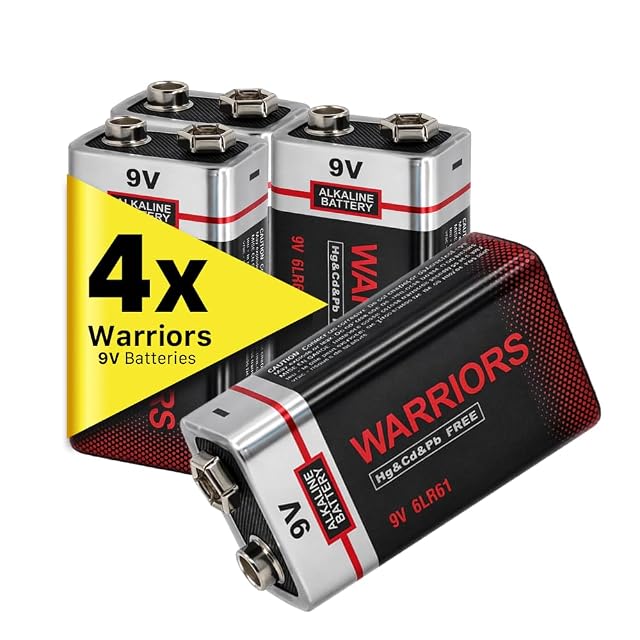
The cheap four-pack for instruments that run on a 9 V block, with a stated three-year shelf life — the figure that matters for a cell that sits in a drawer.
Warriors 9 V alkaline batteries, four-pack
The cheap four-pack for instruments that run on a 9 V block, with a stated three-year shelf life — the figure that matters for a cell that sits in a drawer.
Amazon reference
B0BYD6PXZH (identical on 6 markets)
EAN
9358199002307
Power
9 V 6LR61 · stated three-year shelf life
Supplied
four-pack
A stated three-year shelf life, which is the relevant number for an instrument used twice a year
A design the maker describes as protecting the device, with leak resistance in mind
No leak-protection guarantee published beyond the description
Best for: Instruments used often enough that the cell is replaced before it ages.
The cheapest component on this site, and the one that destroys the most instruments.
What the manufacturer publishes
A long-lasting power supply with the same discharge-hour specifications as leading brands. A waterproof design stated to protect the device, with an extended shelf life of up to three years. Compatibility with the 9 V, 6LR61, 9-volt block designations.
Shelf life is the specification, not capacity
A multimeter draws a fraction of a milliamp. A cell in one is not being used up; it is sitting there getting older. What ends it is not discharge but chemistry — the seal degrades, and potassium hydroxide finds its way out.
That is why a three-year shelf life figure is the relevant number, and why the milliamp-hours printed on the pack are nearly meaningless in this application.
The habit that saves instruments
Out of the instrument, into storage. Every time.
Availability
Catalogued and unsold: the American Amazon shop lists the reference with nobody behind it.
Read from Keepa on the day this page was last revised; stock and price both move without notice.
What gets asked here
Why does shelf life matter more than capacity?
Because a multimeter uses almost no current. The cell in it does not run down — it ages, and eventually it leaks. Shelf life is the specification that describes that, and capacity is nearly irrelevant.
What actually destroys an instrument?
A leaked cell. The electrolyte corrodes the battery compartment and travels along the contacts to the board. It is the single most common way a working meter becomes scrap, and it happens in storage rather than in use.
What is the one habit worth having?
Take the cell out of any instrument going into storage for more than a season. It costs nothing and prevents the most expensive failure on this site.
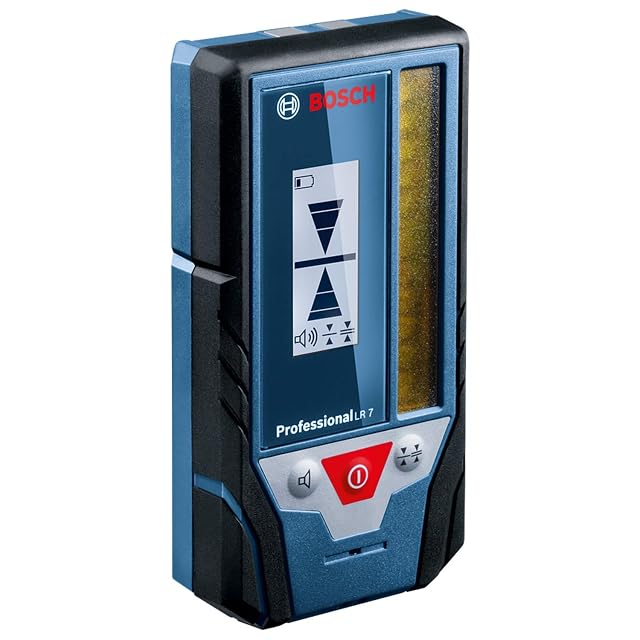
The receiver that removes the diode-color question: Bosch states it takes both red and green beams to 50 m (164 ft), through an 8 cm (3.1 in) window, in an IP54 body.
Amazon reference
B0716S9LBG (identical on 5 markets)
EAN
3165140835572
Optical
Red and green
Stated dimension or range
50 m (164 ft) stated
Body and fittings
8 cm (3.1 in) receiving window
Ingress protection
IP54
Accepts both red and green beams, so it survives a change of laser
A stated 8 cm (3.1 in) receiving window — the figure that decides how quickly the beam is found
No accuracy bands published in the listing
Best for: Anyone who owns more than one laser, or expects to.
The only receiver here that names what it will not work with — fifteen of its own maker's lasers, by model number.
Functions
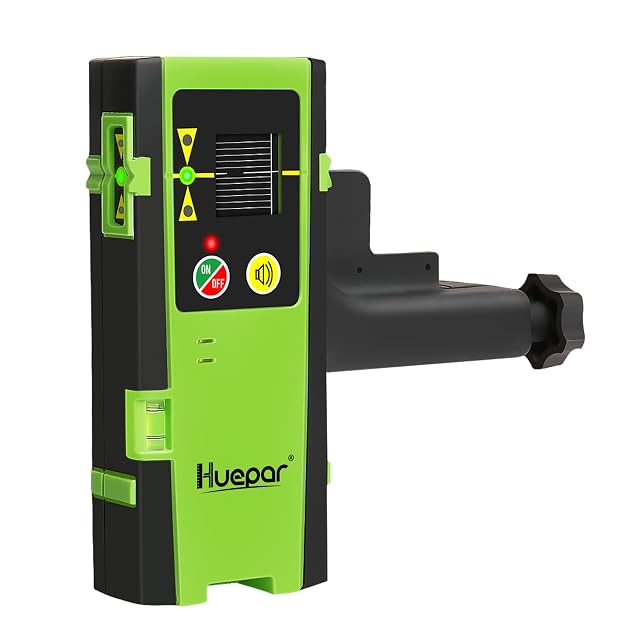
Detects red AND green pulsed beams in bright light to a working range of 200 ft (60 m) — stated, and stated three times over that the laser's PULSE MODE must be turned on and kept on. This shelf's buying tip says to confirm the laser has a pulse or manual/receiver mode before buying a receiver at all; Huepar does not leave that to the buyer
Also stated
FIFTY-TWO compatible Huepar and Huepar Pro models are listed by number — and then a second bullet lists FIFTEEN that are NOT, naming the 9011G, 9211G, FL360R, FL360G, 8300G, B011G, B011R, FC011G, FC011R, 9300G and GK011DG line lasers and the RL200HR, RL200HVG, RL300HR and RL300HVG rotary lasers, because they have no pulse mode. No other receiver on this shelf publishes an exclusion list of any kind
Display
Readouts on the FRONT, the SIDE and the BACK of the receiver, stated. Three faces is the most on this shelf, where the next has two — and the side face is the one that matters when the receiver is clamped to a rod and read from an angle
Measuring mode
Optical and acoustic signals to locate the laser plane, with beeps when the target is found, plus a dual-sided bubble vial on the front AND the top to confirm the receiver itself is level. No accuracy bands are published, which this shelf's introduction lists as one of five comparisons
Power
A 9 V dry battery giving about 70 working hours, with automatic shut-off after about 8 minutes idle. Seventy hours is the longest stated life on this shelf and the eight-minute timeout the shortest — both of which favor a receiver that gets picked up and put down all day
Reference and mounting
A heavy-duty clamp attached, stated to mount the detector to a rod or other target point. This shelf's introduction asks about clamp fit; the clamp is included rather than optional, which two of the three receivers here manage
Supplied
The receiver, the clamp and a 9 V battery. Huepar also writes out a power-on check — confirm the battery polarity, short-press the button, look for a red indicator — which is unusual and useful on a tool whose first symptom of a flat cell is silence
Amazon reference
B07L6FP48S
EAN
0790996364544
Fifty-two compatible models named by number
Fifteen of its own maker's lasers named as NOT compatible
Huepar and Huepar Pro lasers only, by the maker's own list
Best for: A Huepar laser whose model number is on the list, and anyone who has bought the wrong receiver once
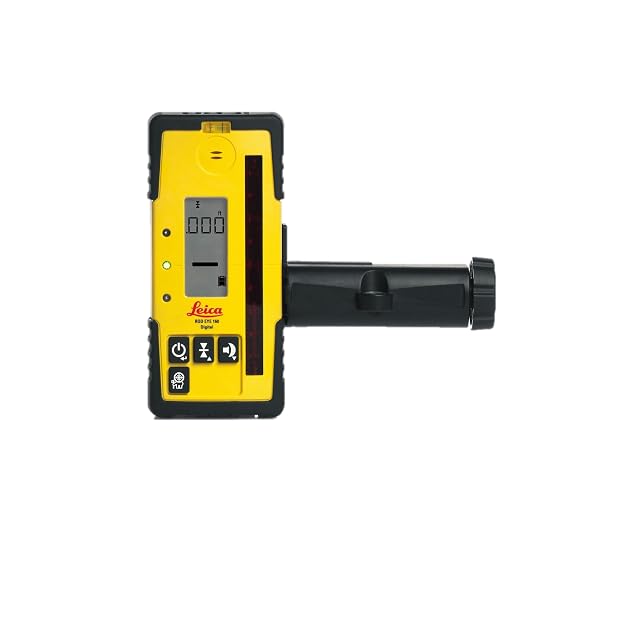
A receiver that reads the offset as a number rather than as an above/below band, through a 120 mm (4.72 in) window, with displays on both faces so it can be read from either side.
Amazon reference
B00JST4R1M (identical on 6 markets)
EAN
7640110693339
Body and fittings
120 mm (4.72 in) receiving window
Also stated
digital offset readout
Display
displays front and back
A digital readout of the offset, not just an on-grade band — the difference between "close" and a figure
The largest receiving window here at a stated 120 mm (4.72 in)
Five times the price of the Bosch
Best for: Leveling work where the question is how far off, not merely whether you are on.