A receiver that reads the offset as a number rather than as an above/below band, through a 120 mm (4.72 in) window, with displays on both faces so it can be read from either side.
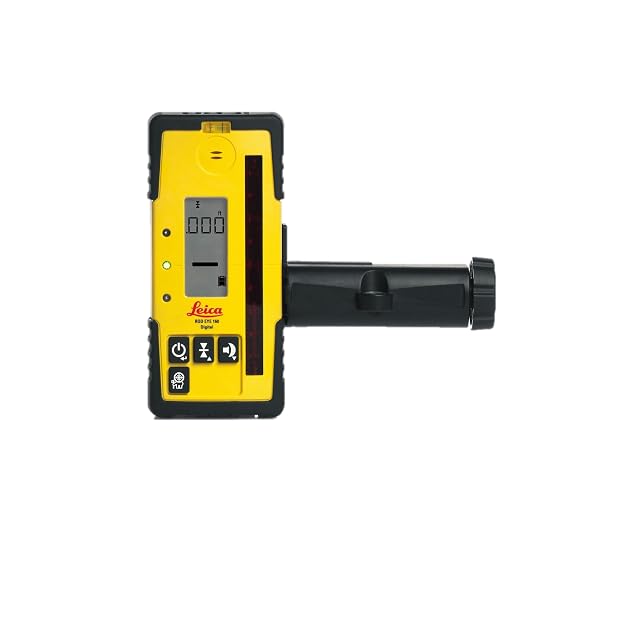
Leica Rod Eye 160 digital receiver
A receiver that reads the offset as a number rather than as an above/below band, through a 120 mm (4.72 in) window, with displays on both faces so it can be read from either side.
Amazon reference
B00JST4R1M (identical on 6 markets)
EAN
7640110693339
Body and fittings
120 mm (4.72 in) receiving window
Also stated
digital offset readout
Display
displays front and back
A digital readout of the offset, not just an on-grade band — the difference between "close" and a figure
The largest receiving window here at a stated 120 mm (4.72 in)
Five times the price of the Bosch
Best for: Leveling work where the question is how far off, not merely whether you are on.
The receiver that turns a yes-or-no into a measurement.
What the manufacturer publishes
Digital reading from the laser receiver. Flexible reading through displays placed at the front and the back of the receiver. A laser receiving window of 120 mm (4.72 in). Stated for Leica rotary lasers.
Band against number
A conventional receiver has three states: high, on grade, low. Getting to on-grade is then a search — move, check, move, check. A digital receiver reports the offset in millimeters, so the adjustment is made once and confirmed once.
Over a day of setting levels, that is not a convenience. It is most of the time the job takes.
Where it belongs
With a rotary laser on a leveling job, on a rod, with someone at the other end. It is a surveying accessory rather than an interior-fitting one, and it is priced accordingly.
Availability
Read on the day this page was built: $475 at the American Amazon shop.
Read from Keepa on the day this page was last revised; stock and price both move without notice.
Prices quoted in this text were read on 31 August 2026. The live price is at the top of the page.
What gets asked here
What does a digital readout add?
A band receiver tells you above, on or below. A digital one tells you by how much. On a leveling job that is the difference between adjusting by trial and adjusting once.
Why displays on both faces?
A receiver clamped to a rod faces one way. With a display on each face it can be read by the person holding the rod and by the person at the instrument, without turning it.
Will it work with a line laser?
It is stated for Leica rotary lasers. This site does not cover rotary lasers — the family was dropped at the arborescence stage because the catalog could not support it — so pairing is outside what we can check.
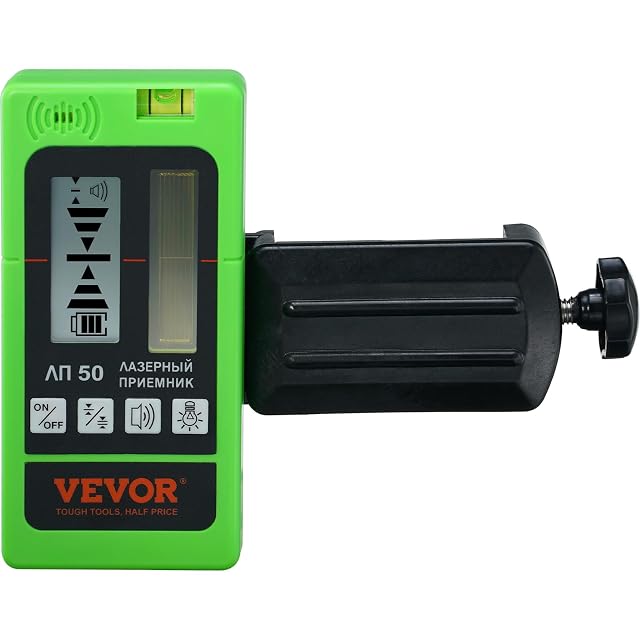
The cheapest way to use a line laser outdoors, with one condition the maker states up front: it works with VEVOR lasers that have a pulse mode, and not with everything else.
Amazon reference
B0CYZV2V9K (identical on 5 markets)
EAN
0197988569954
Stated dimension or range
60 m (197 ft) stated range
Body and fittings
wide receiving window
Functions
pulse mode required
A stated 60 m (197 ft) working range, which restores outdoor use to a laser that is invisible past a few meters in daylight
A wide receiving window, so the beam is found without hunting
The maker states it works only with VEVOR lasers that have a pulse mode — read that before ordering
Best for: Outdoor work with a compatible pulse-mode laser, where the alternative is not working at all.
The only receiver here that publishes how fine it can split the beam — and the only one that admits its range belongs to the laser.
Stated accuracy
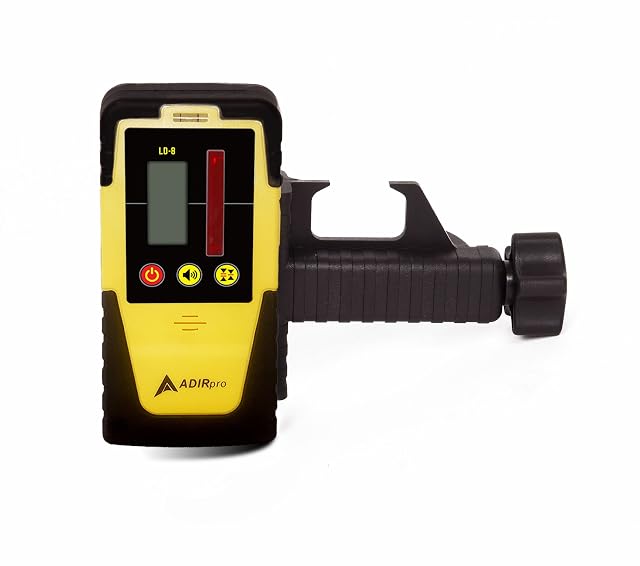
TWO accuracy bands: ±1/16 inch (1 mm) and ±1/8 inch (2.5 mm), stated, with the detector directing the user to position the laser higher or lower on the rod. It is the ONLY receiver on this shelf to publish bands at all, and this shelf's introduction lists them as one of five comparisons — a fine band finds grade slowly and precisely, a coarse one finds it fast
Stated dimension or range
A working range of 2000 feet — "depending on laser", stated. That qualification is the only honest one on this shelf: a receiver reveals the laser's range rather than creating it, and two thousand feet describes what a rotary laser can throw, not what this box can do alone
Functions
ROTARY lasers only, and RED only: compatible with most standard red rotary lasers, stated, working in all lighting conditions. It is the only receiver on this shelf that will not serve a line laser, and the only one that will not see a green beam — which rules out most of the cross-line lasers on this site
Display
A dual-sided crisp LCD showing elevation, grade sensitivity, and audio and battery status. Showing the SENSITIVITY on the screen is the detail that makes two accuracy bands usable: you can see which band you are in rather than remembering
Measuring mode
A built-in bubble level, stated. On a detector clamped to a rod that is the check that the receiver itself is not tilted, which would offset every reading by the same amount
Power
A 9 V battery giving approximately 40 working hours, with auto shut-off after 10 minutes of inactivity. Forty hours against about seventy on another receiver here
Ingress protection
IP55, dustproof and water-jet resistant, in a hard plastic housing with a rubber casing. IP55 is the highest rating on this shelf, where the other two are IP54 — jets rather than spray, which on a grading job in the rain is the relevant one
Supplied
A rod mounting bracket with 1/4 inch threading on the nut and screw, stated included. This shelf's introduction asks about clamp fit; 1/4 inch rather than 5/8 means it suits a compact rod rather than a survey tripod
Amazon reference
B00YNTC4CQ
EAN
0815236013416
Two published accuracy bands: ±1/16 in and ±1/8 in
The grade sensitivity shown on the display
Red only: it will not see a green beam
Best for: A red rotary laser on a grading job, where the difference between 1 mm (0.04 in) and 2.5 mm (0.10 in) decides the fall
The only receiver here that states its range laser by laser — and the only one whose beeper can be turned up for a noisy site.
Functions
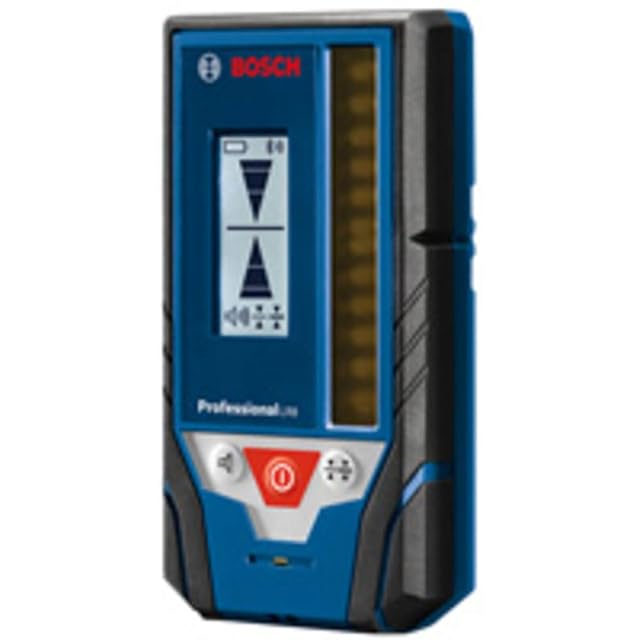
Dual compatibility with red and green beam lasers, stated, and the working range given PER LASER: up to 330 ft diameter with the GLL3-330CG or GLL3-330C, 300 ft with the GLL3-300, 165 ft with the GCL 2-160. It is the only receiver on this shelf to state the range laser by laser, which is the honest way round — a receiver does not create range, it reveals the laser's
Measuring mode
An ADJUSTABLE audio signal giving a clear indication of on-grade positioning, stated to adjust to worksite noise levels. It is the only adjustable beeper on this shelf, and it is the feature that decides whether the tone is audible beside a compressor or intolerable in a quiet room. An oversized receiver window is stated for fast reception and finding the center line, and able to catch beams midair
Display
A backlit oversized LCD for easier beam detection in dark or outdoor areas, plus DUAL-SIDED LED arrow indicators for a visual readout on both sides of the receiver. Two faces, where one receiver on this shelf has three
Reference and mounting
A quick-release mounting bracket stated to attach to a leveling rod, plus heavy-duty magnets for metal surfaces. The magnets are the second mounting route and the faster one — a receiver on a steel stud or a door frame needs no bracket at all
Ingress protection
IP54, stated to withstand rainy or dusty jobsite conditions. One receiver on this shelf is IP55, which resists water jets rather than spray
Also stated
Four compatible Bosch lasers are named. No incompatibility list is published, and nothing on the page says that the laser needs a pulse mode switched on — which this shelf's buying tip calls the condition that decides whether the two work together at all
Supplied
The receiver and the mounting bracket. No accuracy bands are published, which this shelf's introduction lists as one of five comparisons
Amazon reference
B07BDRFTQS
EAN
0000346495027
The working range stated per laser, not as one number
Adjustable audio for a noisy site
A hundred and twenty dollars, the most expensive receiver here
Best for: A Bosch line laser taken outdoors, where the beep has to carry over a compressor
The only plate here with a numbered brightness gain — on a red plate whose own listing says it suits green lasers as well.
Functions
A special reflective target film stated to increase the brightness of RED laser lines or points by 1.3 times in long-distance or bright sunlight conditions. One point three is the ONLY numbered gain on this shelf — the other plates say reflective backing, or high-contrast, and leave you to judge
Scale
Center-zero scales in BOTH inches and centimeters, stated easy to read. Center zero is the detail that matters: a target plate is used to transfer a line, and a scale reading outward from the middle gives the offset directly in either direction without arithmetic
Reference and mounting
Three fixings, stated: strong magnets for metal studs, a hole for hook mounting, and a fold-out back stand to stand it upright on a floor. Three routes is the most on this shelf, and the floor stand is what makes a plate usable where there is no steel and nothing to hang it on
Also stated
The fourth bullet reads: "compatible with both red and green beam laser levels". This shelf's introduction says a red plate does very little for a green line and calls that the one specification people get wrong, and the buying tip warns that listings frequently show both plates lit by the same beam. This is a RED plate, sold beside the maker's own GREEN plate at the same price — the two exist precisely because the tints are not interchangeable
Material
Lightweight and rugged, stated, compact enough for a toolkit. No dimensions and no weight appear, where one plate on this shelf publishes 10 × 7 cm (3.9 × 2.8 in) and 30 g (1.1 oz)
Supplied
The plate. The parcel weighs 27 g (1 oz), which is consistent with a single card rather than a pair — two plates on this shelf ship in multiples
Amazon reference
B0DCFL4DXX
EAN
0711271802087
A numbered gain: 1.3× on a red line
Center-zero scales, so the offset reads directly
Its fourth bullet claims green compatibility on a red plate
Best for: A red laser on dark brick, wet concrete or glass, where the line disappears into the wall
The green half of the only matched pair on this shelf — and the half that does not overclaim.
Functions
A special reflective target film stated to boost the visibility of GREEN laser lines or points by 1.3 times, for long-distance work or bright sunlight. The same numbered gain as the maker's red plate, and the only numbered gain on this shelf
Also stated
Universal compatibility with GREEN BEAM laser levels, rotary lasers, cross-line lasers and laser measures — green, and only green. That is the correct claim, and it is worth noting because the maker's own RED plate claims compatibility with both colors. This shelf's introduction says a plate does very little for the other diode; this listing agrees with the shelf and its twin does not
Scale
Dual measurement scales with Center ZERO in inches and centimeters, stated for framing, tiling and HVAC installation. Center zero gives the offset from the line directly, upward or downward, with no arithmetic
Reference and mounting
Three fixings: strong magnets for metal surfaces, a hanging hole, or a fold-out floor stand. The stand is what makes the plate work in an empty room with no steel and nothing to hang on
Material
Lightweight yet rugged, stated to withstand tough environments, compact for a toolkit. No dimensions and no weight appear
Supplied
The plate. No count is published, and no parcel weight was recorded for this line
Amazon reference
B0DCFBSL23
EAN
0711271802070
A numbered gain: 1.3× on a green line
It claims green only, which is the honest claim
No dimensions and no weight published
Best for: A green laser outdoors or on dark brick, where the line vanishes within a few meters
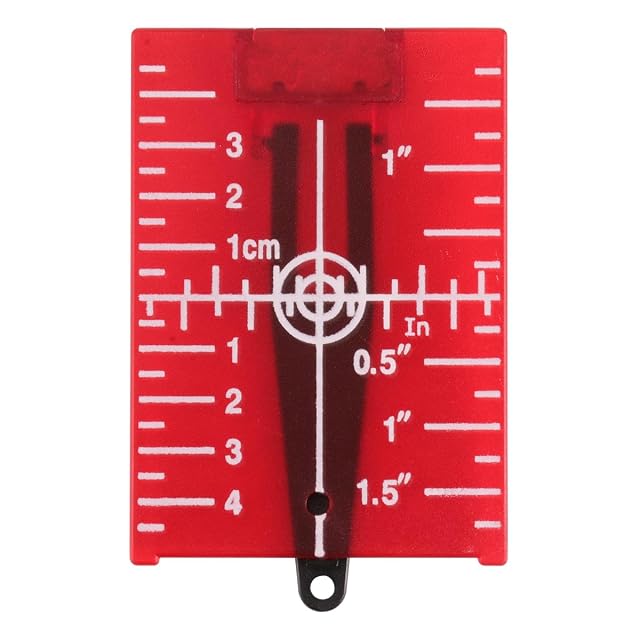
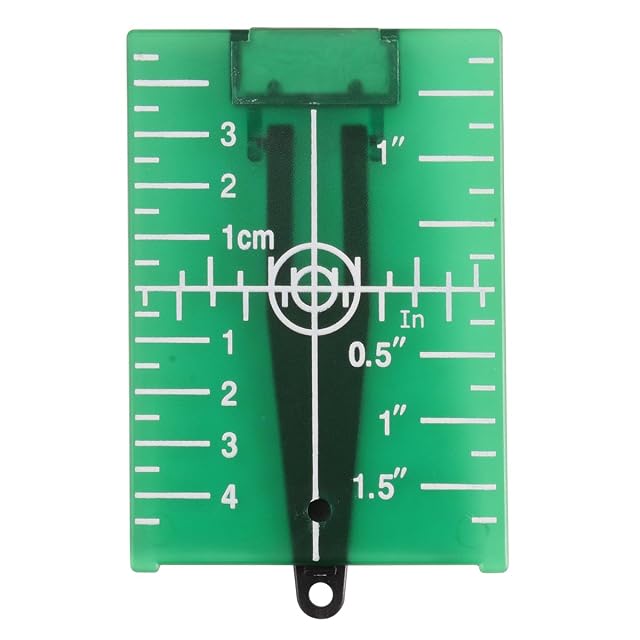
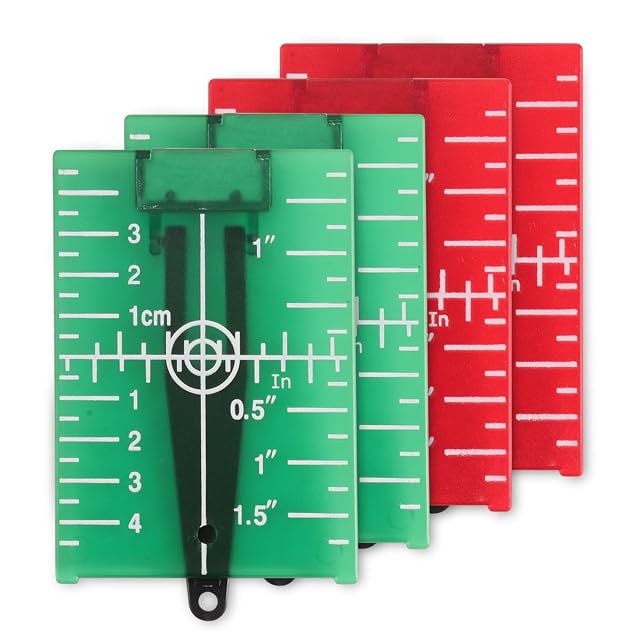
The only box on this shelf that answers the tint question by containing both answers — and the only plate that tells you how big it is.
Supplied
Two RED and two GREEN plates in one package, stated. It is the only set on this shelf that covers both diode colors — this shelf's introduction says the tint must match the diode and calls it the one specification people get wrong, and this box removes the decision. It also gives two plates per color, which is what transferring a line across a room actually takes
Stated dimension or range
10 × 7 cm (4 × 2.8 in), 30 g each, with a slim profile for a pocket or toolkit. It is the ONLY published size on this shelf — this shelf's introduction lists size as one of five comparisons and at least six of the ten plates here leave it to the photograph
Scale
Front-facing BULLSEYE patterns with dual-unit scales in inches and centimeters, stated to enable accurate measurements. A bullseye rather than a cross: concentric rings give a center that can be judged from any angle, where a cross has to be read square on
Functions
A reflective backing stated to enhance laser spot recognition in direct sunlight or low light. No brightness gain figure is published, where one maker on this shelf states 1.3×
Material
Durable ABS plastic, stated, with a magnetic base for metal surfaces. ABS is named, which four plates on this shelf do not do — a rigid plate stays flat where a card curls
Reference and mounting
A magnetic base for attachment to metal surfaces, and the title states a stand. No hook hole is published, and two plates on this shelf publish three fixing routes
Amazon reference
B0FNMYRHF9
EAN
0712110938646
Two red and two green: both diodes covered in one box
The only published size and weight on this shelf
No brightness gain figure
Best for: A van with a red laser and a green one, or two plates at each end of a line