Skip to content

AdirPro Rotary laser detector, red only, 2000 ft

The only receiver here that publishes how fine it can split the beam — and the only one that admits its range belongs to the laser.

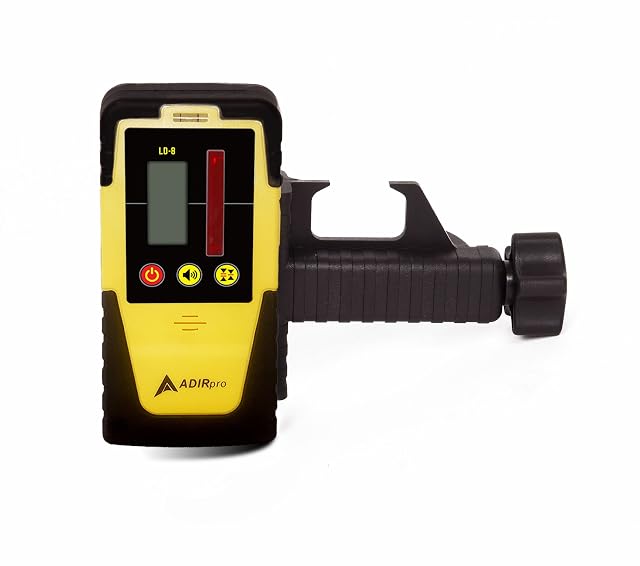
AdirPro LD-8 universal rotary laser detector with dual display and rod clamp

AdirPro Rotary laser detector, red only, 2000 ft

The only receiver here that publishes how fine it can split the beam — and the only one that admits its range belongs to the laser.

Stated accuracy
TWO accuracy bands: ±1/16 inch (1 mm) and ±1/8 inch (2.5 mm), stated, with the detector directing the user to position the laser higher or lower on the rod. It is the ONLY receiver on this shelf to publish bands at all, and this shelf's introduction lists them as one of five comparisons — a fine band finds grade slowly and precisely, a coarse one finds it fast
Stated dimension or range
A working range of 2000 feet — "depending on laser", stated. That qualification is the only honest one on this shelf: a receiver reveals the laser's range rather than creating it, and two thousand feet describes what a rotary laser can throw, not what this box can do alone
Functions
ROTARY lasers only, and RED only: compatible with most standard red rotary lasers, stated, working in all lighting conditions. It is the only receiver on this shelf that will not serve a line laser, and the only one that will not see a green beam — which rules out most of the cross-line lasers on this site
Display
A dual-sided crisp LCD showing elevation, grade sensitivity, and audio and battery status. Showing the SENSITIVITY on the screen is the detail that makes two accuracy bands usable: you can see which band you are in rather than remembering
Measuring mode
A built-in bubble level, stated. On a detector clamped to a rod that is the check that the receiver itself is not tilted, which would offset every reading by the same amount
Power
A 9 V battery giving approximately 40 working hours, with auto shut-off after 10 minutes of inactivity. Forty hours against about seventy on another receiver here
Ingress protection
IP55, dustproof and water-jet resistant, in a hard plastic housing with a rubber casing. IP55 is the highest rating on this shelf, where the other two are IP54 — jets rather than spray, which on a grading job in the rain is the relevant one
Supplied
A rod mounting bracket with 1/4 inch threading on the nut and screw, stated included. This shelf's introduction asks about clamp fit; 1/4 inch rather than 5/8 means it suits a compact rod rather than a survey tripod
Amazon reference
B00YNTC4CQ
EAN
0815236013416
  • Two published accuracy bands: ±1/16 in and ±1/8 in
  • The grade sensitivity shown on the display
  • Red only: it will not see a green beam

Best for: A red rotary laser on a grading job, where the difference between 1 mm (0.04 in) and 2.5 mm (0.10 in) decides the fall

≈ $85
Check price on Amazon
Specifications

Stated accuracy
TWO accuracy bands: ±1/16 inch (1 mm) and ±1/8 inch (2.5 mm), stated, with the detector directing the user to position the laser higher or lower on the rod. It is the ONLY receiver on this shelf to publish bands at all, and this shelf's introduction lists them as one of five comparisons — a fine band finds grade slowly and precisely, a coarse one finds it fast
Stated dimension or range
A working range of 2000 feet — "depending on laser", stated. That qualification is the only honest one on this shelf: a receiver reveals the laser's range rather than creating it, and two thousand feet describes what a rotary laser can throw, not what this box can do alone
Functions
ROTARY lasers only, and RED only: compatible with most standard red rotary lasers, stated, working in all lighting conditions. It is the only receiver on this shelf that will not serve a line laser, and the only one that will not see a green beam — which rules out most of the cross-line lasers on this site
Display
A dual-sided crisp LCD showing elevation, grade sensitivity, and audio and battery status. Showing the SENSITIVITY on the screen is the detail that makes two accuracy bands usable: you can see which band you are in rather than remembering
Measuring mode
A built-in bubble level, stated. On a detector clamped to a rod that is the check that the receiver itself is not tilted, which would offset every reading by the same amount
Power
A 9 V battery giving approximately 40 working hours, with auto shut-off after 10 minutes of inactivity. Forty hours against about seventy on another receiver here
Ingress protection
IP55, dustproof and water-jet resistant, in a hard plastic housing with a rubber casing. IP55 is the highest rating on this shelf, where the other two are IP54 — jets rather than spray, which on a grading job in the rain is the relevant one
Supplied
A rod mounting bracket with 1/4 inch threading on the nut and screw, stated included. This shelf's introduction asks about clamp fit; 1/4 inch rather than 5/8 means it suits a compact rod rather than a survey tripod
Amazon reference
B00YNTC4CQ
EAN
0815236013416

What the maker puts in writing

  • “With an accuracy of ±1/16 inches (1 mm) and ±1/8 inches (2.5 mm), it easily directs the user to position the laser higher or lower on a grade rod”
  • Working range of 2,000 feet (depending on laser)
  • Compatible with most standard RED ROTARY lasers · works in all lighting conditions
  • Dual-sided crisp clear LCD: elevation, grade sensitivity, audio and battery status · built-in bubble level
  • 9V battery, approximately 40 working hours · auto shut-off after 10 minutes of inactivity
  • IP55 dustproof and water jet resistant · hard plastic housing with rubber casing
  • Rod mounting bracket included, ¼” threading on the nut and screw

No compatible models named. No green. No line lasers.

Two bands, which is a choice nothing else here offers

Speed against precision.

Coarse — ±1/8 inch, 2.5 mm — reports on-grade across a wider slice of the beam. You find the plane quickly and the tone settles sooner.

Fine — ±1/16 inch, 1 mm — reports a much narrower slice. Slower to center, tighter result.

A drainage fall wants fine. Walking a site checking a slab wants coarse.

And the display shows WHICH BAND you are in, which is what makes the choice usable rather than something to remember.

This shelf’s introduction lists accuracy bands as one of five comparisons. This is the only receiver here that publishes any.

“Depending on laser”

Three words, and the only honest qualification on this shelf.

Two thousand feet is what a rotary laser can throw. It is not what this box does on its own.

A receiver reveals the laser’s range rather than creating it — and the other two receivers here publish a single figure, one of them per-laser and one not at all.

Red, rotary, and nothing else

Which is the limit to settle before ordering.

A rotary laser sweeps one dot round a full circle, many times a second. A line laser projects a static fan. The pulse signature a detector looks for is quite different.

And green is excluded entirely — which rules out most of the cross-line lasers on this site.

If the laser in the van is a cross-line laser, the two red-and-green receivers on this shelf are the candidates and this one is not.

IP55, because it cannot go in a pocket

A receiver stays on the rod.

IP54 resists splashing: rain on a wall, a wet hand, spray from a saw.

IP55 resists water JETS — a pump running, somebody hosing a slab down, driven rain.

Same dust protection in both. This is the only IP55 on the shelf.

Availability

On sale at around 85 € on the American Amazon store at the time of checking.

Prices and availability are what Keepa reported on the date this page was updated; both move.

Prices quoted in this text were read on 8 October 2026. The live price is at the top of the page.

What gets asked here

What do two accuracy bands actually give you?

A choice between speed and precision, and this is the only receiver on this shelf that offers it. On the coarse band — ±1/8 inch, 2.5 mm — the detector reports on-grade across a wider slice of the beam, so you find the plane quickly and the tone settles sooner; on the fine band — ±1/16 inch, 1 mm — it reports a much narrower slice, which takes longer to center and gives a tighter result. Setting out a drainage fall wants fine; running round a site checking a slab wants coarse. The display shows which band you are in, which is what makes the choice usable.

Will it work with a line laser?

No. AdirPro states most standard RED ROTARY lasers, and a rotary laser sweeps a single dot round a full circle many times a second while a line laser projects a static fan — the pulse signature a detector looks for is quite different. It also excludes green entirely, which rules out most of the cross-line lasers on this site. If the laser on your van is a cross-line laser, the two red-and-green receivers on this shelf are the candidates and this one is not.

Is IP55 worth it over IP54?

On a grading job, yes. IP54 resists splashing — rain on a wall, a wet hand, spray from a saw. IP55 resists water JETS, which is the realistic condition for a detector clipped to a rod in the open while a pump runs and somebody hoses a slab down. Both ratings share the same dust protection. A receiver is also the one tool on a grading job that cannot be put in a pocket, because it has to stay on the rod. This is the only IP55 on the shelf.

Instruments this fits

All laser receivers