Skip to content

The best two-pole voltage testers for 2026

A two-pole tester puts a real load across the two points it touches, and that is the difference that matters: a phantom voltage induced on a floating conductor collapses under load, so the tester reports what a contactless pen cannot. Most add phase rotation and continuity, turning one tool into the everyday instrument of an installation. We compare stated voltage range and measurement category, whether a load can be switched in, phase rotation and continuity, probe and tip design, and whether the tester works without batteries.

The models we recommend

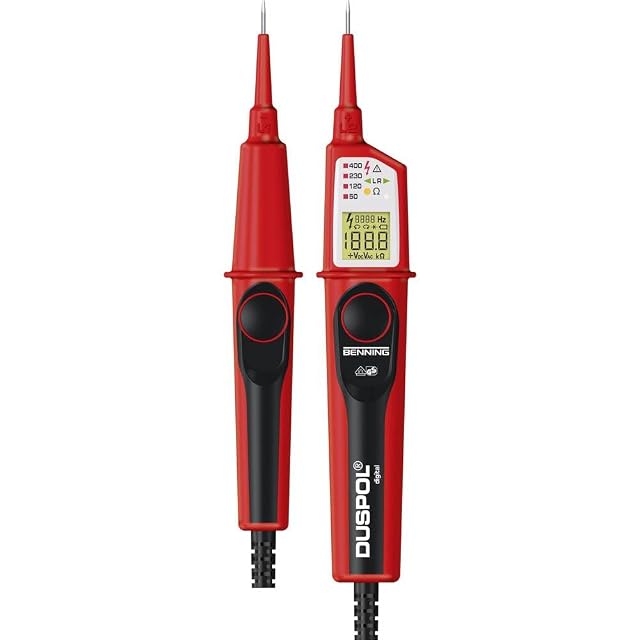
  1. BENNING DUSPOL digital, True-RMS two-pole tester

    1–1000 V AC / 1200 V DC · True RMS · tested to DIN EN 61243-3, VDE 0682-401

    The only tester here that names the standard it is approved to: DIN EN 61243-3 and VDE 0682-401:2015, with a 1–1000 V AC and 1200 V DC range and indication from 50 V even on flat batteries.

    Best for: Photovoltaic, industrial and hybrid-vehicle work, where 1200 V DC is real and the approval matters.

    8.2/10

Need by need, within two-pole voltage testers

Covering an installation's whole range

A tester must indicate the presence of voltage across the whole range encountered. Outside it, it says nothing, which can be mistaken for an absence of voltage.

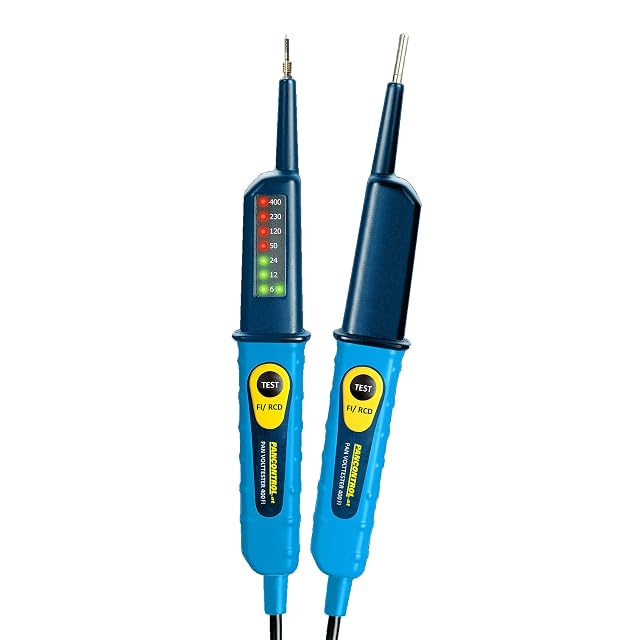
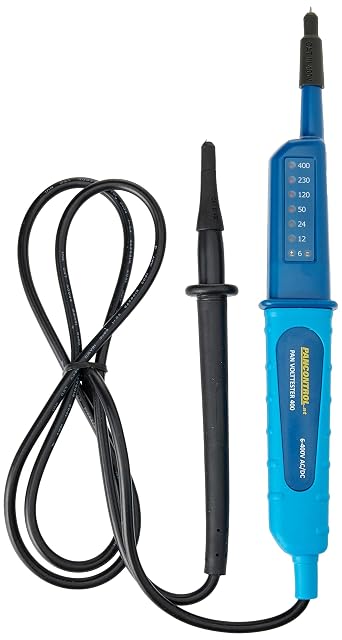
PANCONTROL PAN VOLTTESTER 400 FI

Working in difficult conditions

A high protection rating allows use outdoors and in damp environments, where the instrument is most heavily used.

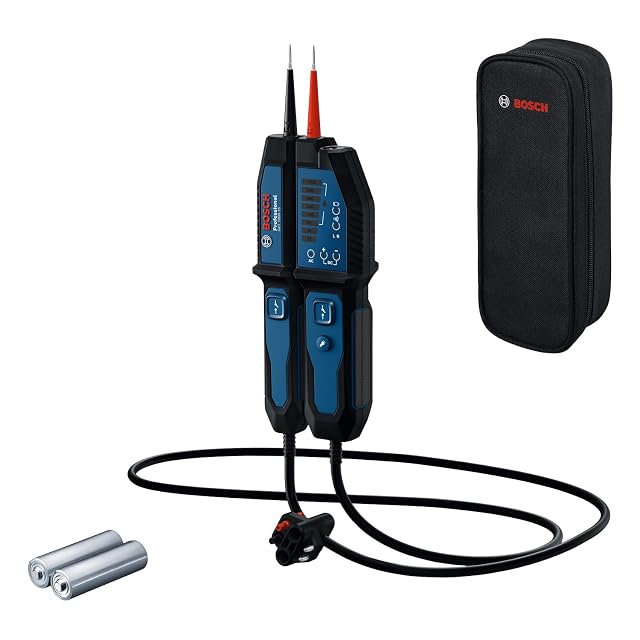
Bosch Professional GVT 1000-15

Carrying the measurement category of the place

A category two instrument is not intended for a supply panel, and the category is marked on the case. The stated category and voltage are compared with the measuring point, not with the price.

PANCONTROL PAN VOLTTESTER 400 FI

Who each family suits, across two-pole voltage testers

Checking before work
The function these instruments exist for: confirming the absence of voltage before touching anything. Nothing else fills that role as directly.
Finding which wire is still live
A two-pole tester shows the voltage between two points, which identifies a broken conductor. More direct than a multimeter for that.
A check before touching a terminal
On many models a two-pole tester depends on no selector position and no battery to indicate voltage. That is what makes it dependable.

What you gain and what you give up, on two-pole voltage testers

Two LEDs or a screen that gives the figure
A two-pole tester says whether there is voltage, not its exact value. That is precisely what makes it safe and quick to read.
Protection rating against bulk
A robust, sealed housing is bulkier. On a field instrument that is amply justified.
Measurement category against price
The category and the quality of the probe tips are what protect you in the event of a fault. On this kind of instrument, saving money is badly placed.

Frequent questions on two-pole voltage testers

How do I check for absence of voltage correctly?

By testing the instrument on a known source first, then on the point to be checked, then again on the known source. Without the third test, an instrument that failed in between goes undetected.

Is a mains tester screwdriver enough?

No. Neon tester screwdrivers can indicate a voltage capacitively or indicate none despite its presence. They are not suitable for confirming an absence of voltage.

What does the measurement category mean?

It states the level of transient overvoltage expected according to where on the supply it is used. It must match the point of work.

Does the instrument work without a battery?

Many two-pole testers indicate voltage with no power supply of their own. Some auxiliary functions need one.

Should I test between line and earth or between conductors?

A two-pole tester is placed between two points, which lets you check several combinations. Testing one combination alone proves very little.

Does the protection rating matter?

Outdoors, in a damp board or on site, yes. An unsealed instrument degrades there and becomes unreliable.

Does the installation have to be locked off?

Checking for absence of voltage does not replace isolating and locking off. They are two complementary steps, not alternatives.

Does a tester replace a lock-out procedure?

No: checking for absence of voltage is one step of a procedure that also includes isolating, locking off and identifying. Work on an installation is for a qualified person.

What stays with you, on two-pole voltage testers

Test the instrument on a known source before and after the check: without the second test, an instrument that failed in between goes undetected. A neon tester screwdriver never confirms an absence of voltage, and the check does not replace locking off.

Summed up: two-pole voltage testers

  • Ingress protection: 54 to 65, on 3 of the 5 models.
  • Voltage measurement: 1 to 24 V, on 3 of the 5 models.

Two-pole voltage testers, side by side

There is no table here, and the reason is in the listings. The figure published most often across these 5 products is ingress protection, given by 3 of them — short of the four in five a column needs to compare rather than to display gaps. Each product page says what its own maker published.

Our guides on two-pole voltage testers

Where the figures are read

Specifications: manufacturer sheets for measuring instruments and the matching Amazon product pages. Prices and availability: Keepa.

Most recent revision in this category: August 31, 2026.

The method applied to two-pole voltage testers