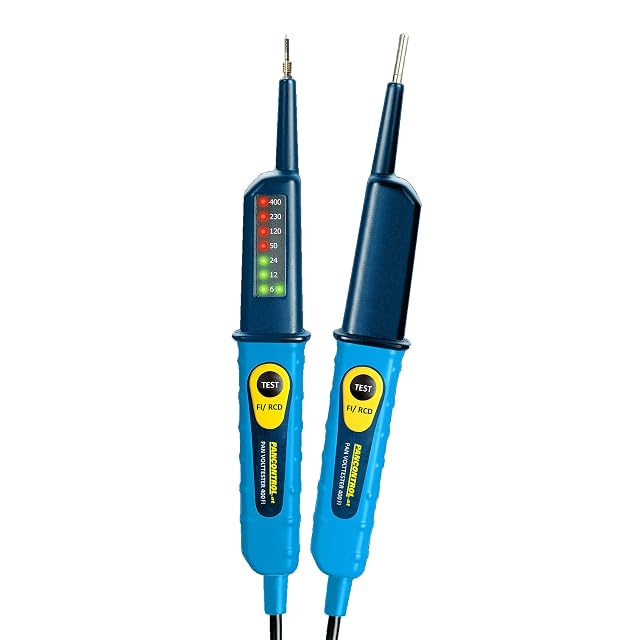
What the figures leave us with The tester to actually own. A stated category, a step scale and thermal protection at twelve euros.
The cheapest instrument on this site that publishes a safety category.
What the manufacturer publishes
Two-pole testing with an LED display, stated as CAT III, with eight LEDs covering 6 to 400 V. Thermal overload protection. Screw-on contact sleeves.
What the category means and what it does not
A measurement category describes the transient over-voltage an instrument is built to survive at a point in an installation — CAT II at socket outlets, CAT III in fixed installation and distribution. It is a safety statement made by the manufacturer, not a mark of measuring quality, and this site does not assess conformity to it.
What is notable is simply that it is here. Across the multimeters and clamp meters on this site, two listings in ten state a category. Among two-pole testers, most do.
The one thing a tester cannot do for you
Prove it on a known live source before and after the measurement that matters. A tester that failed between the two checks is the one scenario a single test cannot catch, and no specification prevents it.
Availability
No such listing: the American Amazon shop answers the reference with a search box rather than a page.
Read from Keepa on the day this page was last revised; stock and price both move without notice.
What it has, and what it lacks
Strengths
States a CAT III category — which most instruments on this site do not
Eight LEDs from 6 to 400 V, so the reading is a range rather than a yes-or-no
Thermal overload protection stated
Screw-on contact sleeves, which make socket contacts reliable
The cheapest tester here
Compromises
The category is stated without its voltage, which is half a specification
No IP rating published
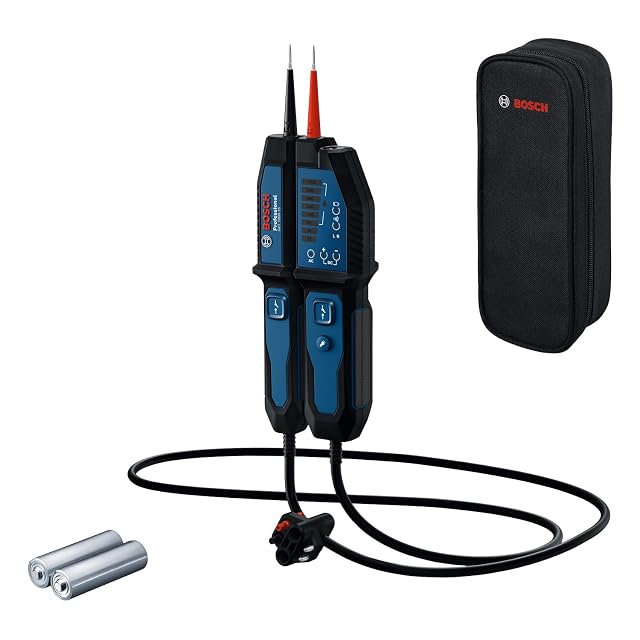
No self-test function, unlike the Bosch here
Specifications
Amazon reference
B01NCEILHK (identical on 5 markets)
EAN
4008224610148
Measurement category
CAT III stated
Illumination
8 LEDs from 6 to 400 V
Construction and safety
thermal overload protection
What gets asked here
Why does a two-pole tester beat a contactless pen?
It puts a real load across the two points it touches. A phantom voltage induced on a floating conductor collapses under that load, so a two-pole tester reports what a contactless pen cannot distinguish. Follow the manufacturer instructions and the rules that apply where you live.
What do eight LEDs give me?
A step scale from 6 to 400 V rather than a single lamp. Knowing that a circuit is at 230 V rather than 400 V, or at 24 V rather than dead, is information a single indicator cannot give.
What are the screw-on sleeves for?
They extend the probe tips so they reach the contacts inside a socket properly. Kopp states screw-on contact sleeves; PANCONTROL states the same, for the same reason.
Our score
7.0/ 10
The tester to actually own. A stated category, a step scale and thermal protection at twelve euros.
This one’s price among measuring instruments
A reference exists on these Amazon stores: France, Germany, Italy, Spain, United Kingdom. Listed is not the same as in stock — availability changes daily.
Details checked on August 31, 2026.
Who should pick this one, among measuring instruments
Everyday domestic checking, at the price where a tester stops being an excuse not to have one.
Amazon reports what buyers took in the month before this page was last checked: at least 50.
The figure is a floor, rounded by Amazon, and read through Keepa — it says what buyers picked, not what a maker claims.
Sources
Specifications: the manufacturer sheet for measuring instruments and the matching Amazon product page. Prices and availability: Keepa. Every figure on this page names its source.
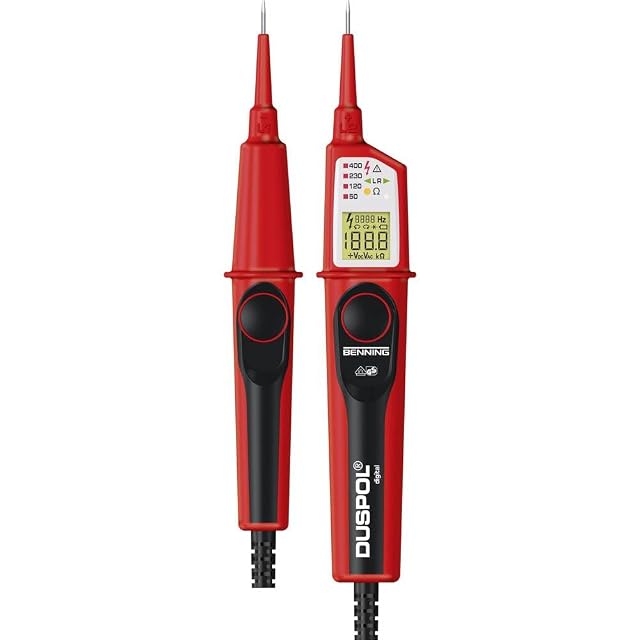
1–1000 V AC / 1200 V DC · True RMS · tested to DIN EN 61243-3, VDE 0682-401
The only tester here that names the standard it is approved to: DIN EN 61243-3 and VDE 0682-401:2015, with a 1–1000 V AC and 1200 V DC range and indication from 50 V even on flat batteries.
Best for: Photovoltaic, industrial and hybrid-vehicle work, where 1200 V DC is real and the approval matters.
CAT III 400 V · IP64 · 8 LEDs 6–400 V · green under 24 V, red from 50 V
A two-pole tester with a color-coded LED scale — green for extra-low voltage up to 24 V, red for dangerous voltage from 50 V — stated as CAT III 400 V and IP64.
Best for: Anyone who wants the safe-or-not judgment made by the instrument rather than by reading a number.