It loads the circuit, which is why it does not lie to you · review
PANCONTROL Two-pole tester with RCD trip, CAT III 400 V review
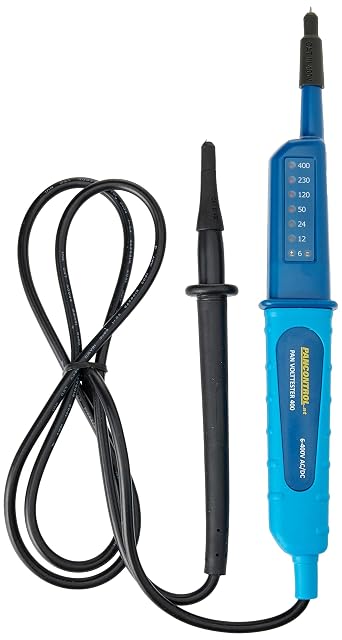
A two-pole tester with a color-coded LED scale — green for extra-low voltage up to 24 V, red for dangerous voltage from 50 V — stated as CAT III 400 V and IP64.
What the figures leave us with The best-specified of the 400 V testers here. Color coding and IP64 for two euros more than the PeakTech.
The same class of tester as its neighbors, with two details done better.
What the manufacturer publishes
Eight LEDs from 6 to 400 V AC/DC. For extra-low voltages up to 24 V the indication is green; for dangerous voltages from 50 V it is red. Screw-on contact sleeves for perfect contact in sockets. CAT III 400 V. Splash-proof and dust-protected to IP 64.
Reading a tester without reading it
A step scale tells you the voltage. A color tells you what to do about it. Under working conditions — one hand occupied, poor light, a board full of terminals — the second is faster and harder to get wrong. It is the same reasoning behind the audible threshold on the PeakTech, applied to the eye instead of the ear.
What the name implies and the listing does not say
The reference includes “FI”, the German designation for an RCD, which normally means the tester can trip one to check it works. Nothing in the listing describes that function, so it is not described here either.
Availability
Catalogued and unsold: the American Amazon shop lists the reference with nobody behind it.
Read from Keepa on the day this page was last revised; stock and price both move without notice.
What it has, and what it lacks
Strengths
States CAT III 400 V and IP64 — a higher ingress rating than the PeakTech
Color-coded scale: green below 24 V, red from 50 V, so the danger threshold is visible not calculated
Eight LEDs across AC and DC from 6 to 400 V
Screw-on contact sleeves for reliable contact in sockets
Compromises
Four hundred volts, like the PeakTech
Not found on the British or American markets
The listing does not describe the RCD trip function despite the model name
Specifications
Amazon reference
B00OF8HZ92 (identical on 6 markets)
EAN
0772040314514
Measurement category
CAT III 400 V
Ingress protection
IP64
Illumination
8 LEDs 6–400 V
Voltage measurement
green under 24 V, red from 50 V
What gets asked here
What does the color coding change?
The tester shows green up to 24 V and red from 50 V. That puts the hazard threshold into the display instead of into your head, which matters when the tester is being read quickly in a bad position.
What is IP64?
Dust-tight and protected against splashing water, per the manufacturer. It is a step above the IP54 stated by the PeakTech in this hub.
Does it test an RCD?
The model name suggests it, and the listing does not describe the function. Check the manual — we do not describe a capability we cannot source.
Our score
8.0/ 10
The best-specified of the 400 V testers here. Color coding and IP64 for two euros more than the PeakTech.
This one’s price among measuring instruments
A reference exists on these Amazon stores: France, Germany, Italy, Spain, United Kingdom, United States. Listed is not the same as in stock — availability changes daily.
Details checked on August 31, 2026.
Who should pick this one, among measuring instruments
Anyone who wants the safe-or-not judgment made by the instrument rather than by reading a number.
What buyers actually choose
Amazon reports what buyers took in the month before this page was last checked: at least 300.
The figure is a floor, rounded by Amazon, and read through Keepa — it says what buyers picked, not what a maker claims.
Sources
Specifications: the manufacturer sheet for measuring instruments and the matching Amazon product page. Prices and availability: Keepa. Every figure on this page names its source.
1–1000 V AC / 1200 V DC · True RMS · tested to DIN EN 61243-3, VDE 0682-401
The only tester here that names the standard it is approved to: DIN EN 61243-3 and VDE 0682-401:2015, with a 1–1000 V AC and 1200 V DC range and indication from 50 V even on flat batteries.
Best for: Photovoltaic, industrial and hybrid-vehicle work, where 1200 V DC is real and the approval matters.