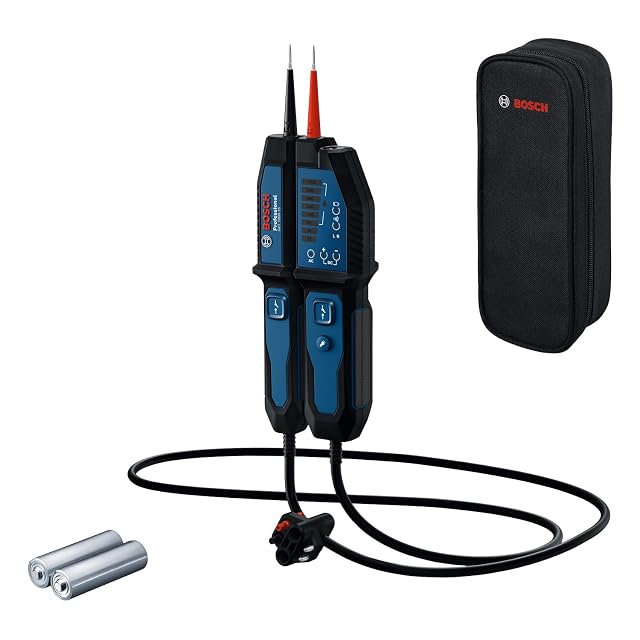
The only tester here that names the standard it is approved to: DIN EN 61243-3 and VDE 0682-401:2015, with a 1–1000 V AC and 1200 V DC range and indication from 50 V even on flat batteries.
What the figures leave us with The reference instrument of this hub. It names its standard, and it keeps indicating when its batteries do not.
The most expensive tester here, and the only one that names what it was approved against.
What the manufacturer publishes
Suited to electrical engineering, industry, maintenance, service fault-finding, photovoltaic and wind installations and hybrid vehicle technology. A voltage measuring range of 1 V to 1000 V AC and 1200 V DC, with voltage indication from 50 V even when the batteries are flat. Two-pole test method with a True-RMS digital display. Tested and approved to DIN EN 61243-3, VDE 0682-401:2015.
Why the flat-battery behavior is the specification to notice
Every other digital tester has a failure mode where the display is dark and the circuit is live. Designing the indication to survive dead cells removes it. It is not a convenience feature; it is the difference between an instrument that degrades and one that lies.
The standard, and what naming it is worth
Any maker can state a category. A named standard defines how the instrument was verified against it. BENNING gives both the standard and its year. Whether that justifies the price depends on what you are working on — for a photovoltaic string at 1000 V DC, it is not a difficult question.
Availability
Read on the day this page was built: $220 at the American Amazon shop.
Read from Keepa on the day this page was last revised; stock and price both move without notice.
Prices quoted in this text were read on 31 August 2026. The live price is at the top of the page.
What it has, and what it lacks
Strengths
Names its approval standards — DIN EN 61243-3 and VDE 0682-401:2015 — which nothing else on this site does
Indicates from 50 V even with flat batteries, so the failure mode is degraded rather than silent
The widest range here: 1 to 1000 V AC and up to 1200 V DC
True-RMS digital display alongside the two-pole indication
Stated as suited to photovoltaic, wind and hybrid vehicle work
Compromises
The most expensive tester here by a wide margin
Not found on the British or American markets
Digital display and batteries add states a purely passive tester does not have
Specifications
Amazon reference
DE B007TN55ZQ · US B007TN55ZQ · GB B07F27G7K4 · FR B07F27G7K4 · IT B07F27G7K4 · ES B07F27G7K4
EAN
4014651502635
Voltage measurement
1–1000 V AC / 1200 V DC
True-RMS
True RMS
Standard named
tested to DIN EN 61243-3, VDE 0682-401
What gets asked here
What is DIN EN 61243-3?
The standard for two-pole voltage detectors. BENNING states the instrument is tested and approved to it, together with VDE 0682-401:2015. We report that the manufacturer states it — this site is not a testing or certification body.
What does indication from 50 V with flat batteries mean?
The two-pole indication continues to work when the cells powering the digital display are dead. That removes the dangerous case where a dead battery makes a live circuit look dead.
Why 1200 V DC?
Photovoltaic strings and hybrid vehicle systems run at DC voltages far above domestic mains. BENNING lists both applications explicitly, and the 400 V testers in this hub do not cover them.
Our score
8.2/ 10
The reference instrument of this hub. It names its standard, and it keeps indicating when its batteries do not.
This one’s price among measuring instruments
A reference exists on these Amazon stores: France, Germany, Italy, Spain, United Kingdom, United States. Listed is not the same as in stock — availability changes daily.
Details checked on August 31, 2026.
Who should pick this one, among measuring instruments
Photovoltaic, industrial and hybrid-vehicle work, where 1200 V DC is real and the approval matters.
What buyers actually choose
Amazon reports what buyers took in the month before this page was last checked: at least 1,000.
The figure is a floor, rounded by Amazon, and read through Keepa — it says what buyers picked, not what a maker claims.
Sources
Specifications: the manufacturer sheet for measuring instruments and the matching Amazon product page. Prices and availability: Keepa. Every figure on this page names its source.
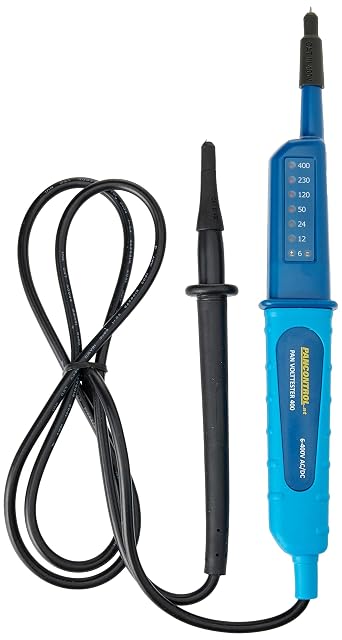
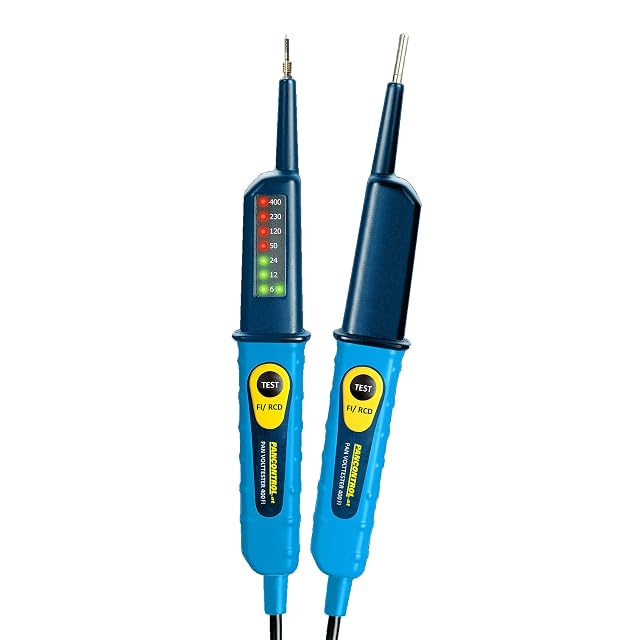
CAT III 400 V · IP64 · 8 LEDs 6–400 V · green under 24 V, red from 50 V
A two-pole tester with a color-coded LED scale — green for extra-low voltage up to 24 V, red for dangerous voltage from 50 V — stated as CAT III 400 V and IP64.
Best for: Anyone who wants the safe-or-not judgment made by the instrument rather than by reading a number.