Type K is a standard; the plug on the end is not always
The best temperature probes for 2026
A type K thermocouple is an international standard, so any type K probe reads correctly on any type K instrument — but the miniature flat plug that connects it is where fit fails, and polarity is set by the plug rather than by color convention alone. Probe style is chosen by the job: a bead for air, a flat pad for surfaces, a sheathed rod for immersion. We compare type and plug fit, probe styles, stated temperature ranges, cable length and heat resistance.
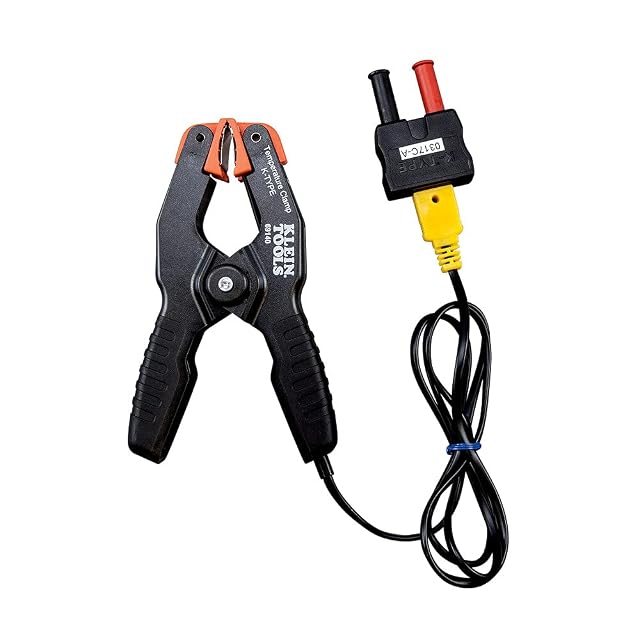
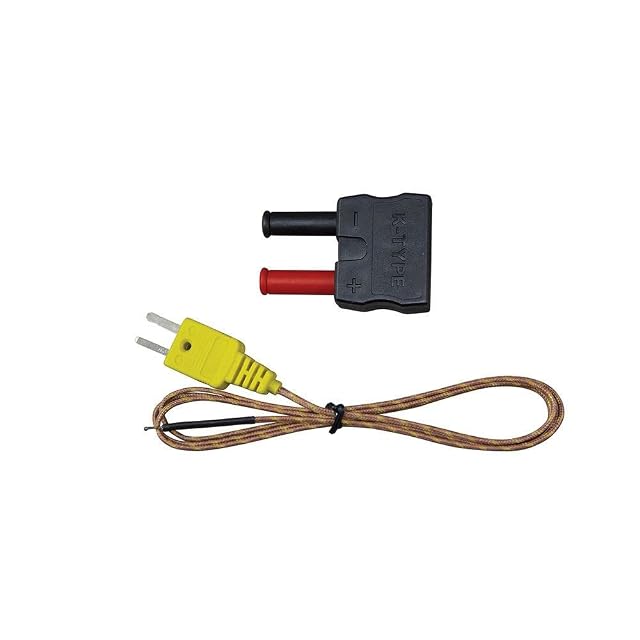
The genuine Klein pipe clamp — and the narrowest temperature range on this shelf, at the highest price of the two clamps.
Type and plug fit
Type K, stated. "Works with any digital multimeter or clamp meter that measures temperature", and Klein adds that its K-type accessories work with all Klein multimeters and clamp meters that measure temperature "as well as any other brand with meters that measure temperature". The banana plug adapter is NOT in the box: it is Cat. No. 69146, sold separately — which matters because this shelf's introduction says the plug is where fit fails
Probe style
A PIPE CLAMP, which is a fourth style this shelf's introduction does not name. It lists a bead for air, a flat pad for surfaces and a sheathed rod for immersion; a spring clamp that closes round a pipe reads the outside wall of a line you cannot immerse anything in. It is the dominant style in the American relevé for this shelf, because that is how a refrigeration circuit is diagnosed
Stated temperature range
−4 to 212 °F (−20 to 100 °C), stated. That is the NARROWEST range on this shelf: the published Taiss states −40 to 350 °C (-40 to 662 °F), the Nxtop 0 to 1100 °C (32 to 2012 °F), the Klein 69142 beside it 0 to 480 °C (32 to 896 °F), and the ZIBOO clamp that borrows this part number claims −40 to 200 °C (-40 to 392 °F). One hundred degrees Celsius is the top of it, which covers a heating flow and stops below a hot gas line
Stated accuracy
±2%, stated — and then the sentence that makes it honest: "Thermocouple accuracy is dependent on the accuracy of the meter being used." Two probes on this shelf publish a figure at all — this clamp and the ZIBOO — and both add that caveat. It is the right way to put it: a thermocouple generates a voltage, and what turns that voltage into a number is the instrument
Cable length
40 inches, 102 cm, flexible. The ZIBOO clamp states 39.78 inches for the same 102 cm (40.2 in), which is the same lead described to two decimal places. The published Taiss five-pack gives 3 m (10 ft), three times either clamp
Clamp capacity
Pipes from 1/4 to 1-3/8 inch diameter. The ZIBOO clamp claims 1/4 to 1 1/2 inch — an eighth of an inch more. Both listings then add "up to 35 cm (13.8 in)", which is not a pipe diameter at all and appears on both pages
Heat resistance
Not stated separately from the measuring range. Klein positions this as the accessory that "extend[s] working temperature ranges for Klein's HVAC Digital Multimeters and Clamp Meters", and names the rest of the family: high temperature thermocouple wire, temperature probe and banana plug adapter
Amazon reference
B07B2PPBRB
EAN
0092644690679
Type K, so it reads correctly on any type K meter
A clamp, which is what a pipe actually needs
A hundred degrees Celsius is the narrowest ceiling here
Best for: HVAC pipe temperatures on small-bore copper, read through a Klein or any other meter with a temperature function
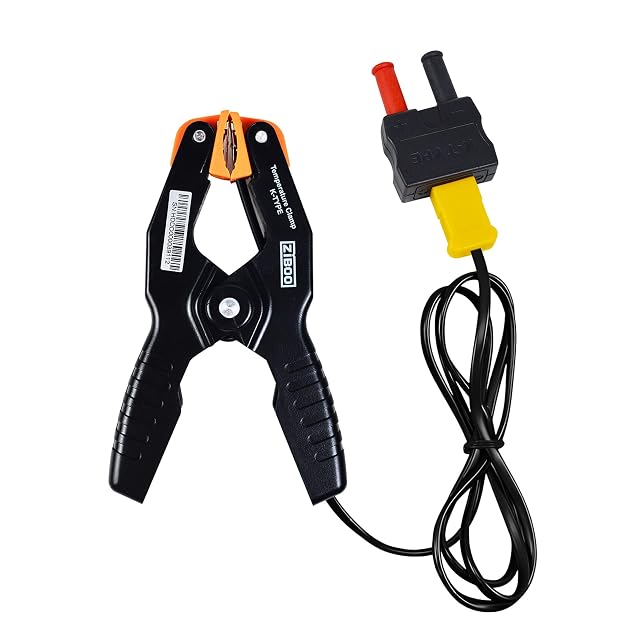
A clamp that carries Klein's part number in its own title and claims double the original's range for half the price.
Type and plug fit
Type K, stated, and the BANANA PLUG ADAPTER IS INCLUDED — which is the genuine advantage over the Klein 69140, where the adapter is Cat. No. 69146 and sold separately. ZIBOO then notes that the adapter is "also sold separately (Cat. No. 69146)", quoting Klein's catalog number for a part it has put in its own box
Probe style
A PIPE CLAMP, closing round pipes from 1/4 to 1 1/2 inch — an eighth of an inch more than the Klein 69140 claims. Like that clamp, it is a style this shelf's introduction does not name among its bead, pad and rod
Stated temperature range
−40 to 392 °F (−40 to 200 °C), claimed. The Klein 69140, whose part number is in this product's title, states −4 to 212 °F (−20 to 100 °C). That is NEARLY TWICE the span, and twice the ceiling, on a copy that costs $14.99 against $26.98. Nothing on either page explains the difference, and a clamp reading 200 °C (392 °F) would reach a hot gas discharge line the original cannot
Stated accuracy
±2%, the same figure the Klein 69140 gives, followed by the same sentence: "Thermocouple accuracy is dependent on the accuracy of the meter being used." The wording of this listing follows the Klein listing bullet for bullet — wide temperature range, versatile pipe clamp, flexible lead, universal compatibility, dependable accuracy — in the same order
Cable length
39.78 inches, 102 cm, flexible. The Klein 69140 states 40 inches for the same 102 cm (40.2 in). Thirty-nine point seven eight inches is 101.04 cm (39.8 in), so the figure has been converted from the metric and given to two decimals rather than measured
Clamp capacity
Pipes 1/4 to 1 1/2 inch, then "(up to 35 cm (13.8 in))" — the same parenthesis that appears on the Klein page, where it is equally wrong. One and a half inches is 38 Millimeters. Thirty-five centimeters is not a pipe this clamp or any other on this shelf would close around
Also stated
The reference field reads 69028+69146 — two Klein Tools catalog numbers concatenated, 69146 being the banana adapter. The title opens "ZIBOO 69140 K-Type Thermometer", and 69140 is the Klein part number of the clamp sitting next to it in this same relevé. The brand on the box is ZIBOO; the part numbers on the listing are all somebody else's
Amazon reference
B0DKFKSTNG
EAN
0736483405789
The banana adapter is in the box
Minus forty to two hundred degrees claimed, twice the Klein
It sells under another maker's part number
Best for: HVAC pipe work on a budget, where the adapter in the box and the wider claimed range are worth the unverified specification
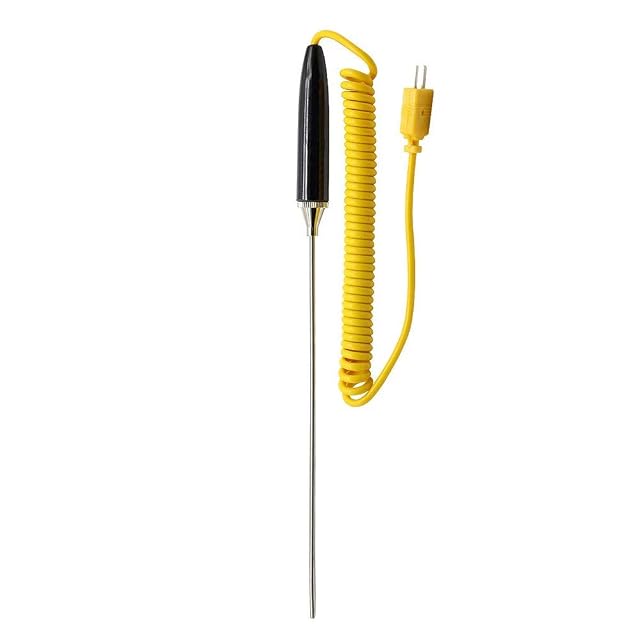
Klein's high-temperature thermocouple — 480 °C (896 °F), a coiled lead, and no stated accuracy or probe style.
Type and plug fit
Type K, stated, and the ADAPTER IS INCLUDED — "with Adapter" is in the product title. That puts it with the ZIBOO clamp and against the Klein 69140, where the adapter is a separate part number. "Works with any digital multimeter or clamp meter that measures temperature"
Stated temperature range
32 to 896 °F (0 to 480 °C), stated. Nearly FIVE TIMES the ceiling of Klein's own 69140 pipe clamp, which stops at 100 °C (212 °F) — and Klein says so directly: these accessories "extend working temperature ranges for Klein's HVAC Digital Multimeters and Clamp Meters". It does not go below freezing, which the two pipe clamps on this shelf both do
Probe style
NOT STATED. This shelf's introduction makes probe style the thing you choose by the job — a bead for air, a flat pad for surfaces, a sheathed rod for immersion — and this listing says only "High Temperature Thermocouple". There is no bead, no pad, no sheath and no tip dimension anywhere on the page, which is the one specification a buyer needs to know whether it will sit on a flue or in it
Stated accuracy
NOT PUBLISHED. The listing gives only the caveat without the figure: "Accuracy of the thermocouple is dependent on the accuracy of the meter being used." Both pipe clamps on this shelf state ±2% alongside that sentence; this one states the sentence alone, at the highest price of the three Klein parts
Cable length
A COILED lead, 3 feet — the only coiled lead on this shelf, and shorter than either pipe clamp’s meter. Coiled matters on a hot job: a straight lead draped across a flue collects heat along its length, while a coil keeps the cable off the work and pulls back out of the way
Heat resistance
Implied by the 480 °C (896 °F) measuring range and not stated separately for the lead. Klein lists "High Temperature Thermocouple Wire" as a DIFFERENT accessory in the same family, which suggests the wire on this part is not itself the high-temperature item
Also stated
11 grams, the lightest probe weight published on this shelf. Klein names the rest of the K-type family on this page — temperature pipe clamp, temperature probe, high temperature thermocouple wire and banana plug adapter — which is the clearest accessory map any maker on this shelf publishes
Amazon reference
B07B2TW23J
EAN
0092644690686
Four hundred and eighty degrees, five times Klein's own clamp
The adapter is in the box
No accuracy figure at all, at thirty dollars
Best for: Flue gases, hot gas lines and anything above the 100 °C (212 °F) ceiling of Klein's own pipe clamp
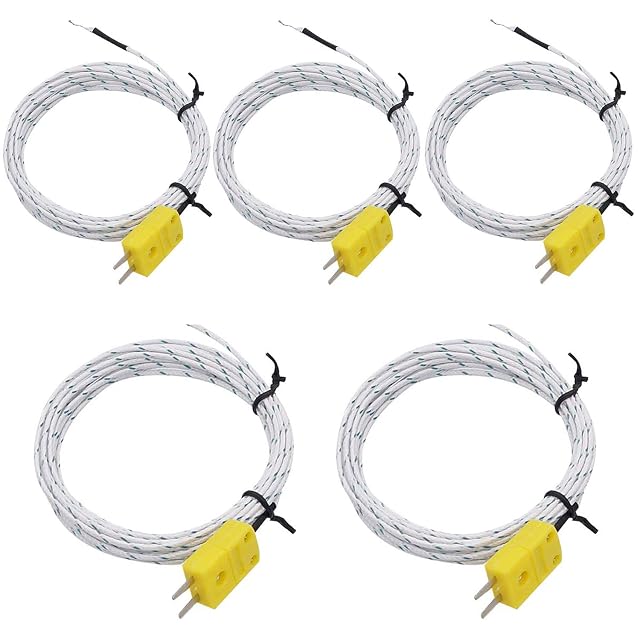
The cheapest probe on this shelf, the hottest, and the only one that publishes a dimension for its plug.
Type and plug fit
Type K with a MINIATURE K-TYPE CONNECTOR, and the fork terminal spacing is published: 5 mm (0.20 in), 0.197 inch. It is the ONLY probe on this shelf that gives a dimension for its plug, and this shelf's introduction says in so many words that "the miniature flat plug that connects it is where fit fails". A nine-dollar probe answers the shelf's stated failure point, and the twenty-seven and thirty-dollar Kleins do not
Probe style
A SHEATHED ROD, 3 mm (0.12 in) diameter by 200 mm (7.87 in) long — the immersion style this shelf's introduction names. Total length 29.5 cm (11.6 in) with the cable gland, so roughly 9 cm (3.5 in) of that is body rather than probe. It is the only product on this shelf whose probe geometry is fully dimensioned
Stated temperature range
0 to 1100 °C (32 to 2012 °F), stated. That is the HIGHEST range published by any probe on this shelf: the Klein 69142 reaches 480 °C (896 °F), the published Taiss 350 °C (662 °F), the ZIBOO clamp 200 °C (392 °F) and the Klein 69140 clamp 100 °C (212 °F). Only the Fieldpiece ST4 meter claims more, at 1300 °C (2372 °F), and that is the instrument's range rather than a probe's. Like the Klein 69142 it does not go below zero
Cable length
30 cm (11.8 in), 12 inches, stated "not stretched" — the SHORTEST on this shelf by a wide margin. The two pipe clamps give 102 cm (40.2 in), the Klein 69142 three feet, the published Taiss 3 m (10 ft). Thirty centimeters puts your hand about a foot from whatever is at 1100 degrees, which is the real limit of this probe and has nothing to do with its sensor
Stated accuracy
NOT PUBLISHED, and no tolerance class is named either. Only the two pipe clamps on this shelf publish a percentage at all; this one publishes nothing. At $8.99 that is the trade being offered, and the sentence both Klein clamps print applies here too whether or not it is written: what turns the junction voltage into a number is your meter
Heat resistance
Implied by the 1100 °C (2012 °F) range for the sheath, and unstated for the cable. The listing describes the materials only as "Electronic Parts, Plastic" and the color as yellow, which is the standard color coding for type K in American practice. A plastic-insulated 30 cm (11.8 in) lead is what sets the working distance, not the stainless rod
Also stated
78 grams, against 11 g (0.4 oz) for the Klein 69142. The listing is written as a parts-catalog entry rather than marketing — product name, model, type, color, material, range, weight, fork spacing, probe dimensions, total length, cable length, package contents — and that is why it publishes more dimensions than anything else on this shelf
Amazon reference
B07DNGWLFS
EAN
0703064924915
Eleven hundred degrees for nine dollars
The only plug dimension published on this shelf — 5 mm (0.20 in)
Thirty centimeters of cable, at 1100 degrees
Best for: Kiln, furnace, forge and flue work, where 1100 °C (2012 °F) is the specification and a 30 cm (11.8 in) cable is enough
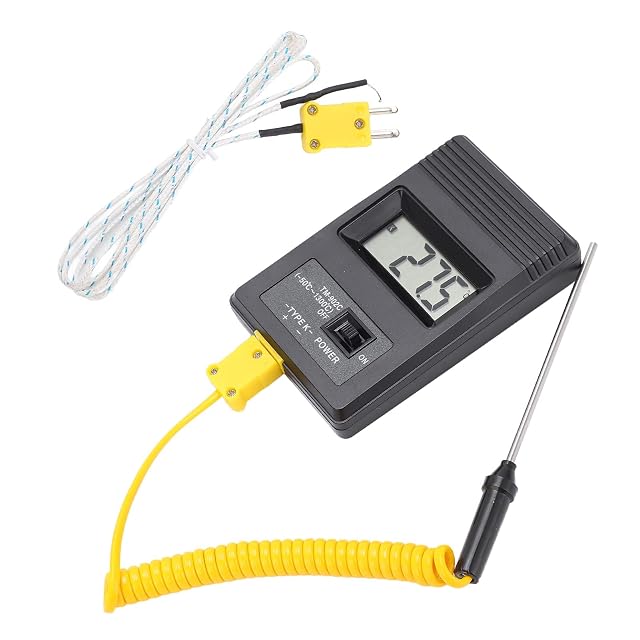
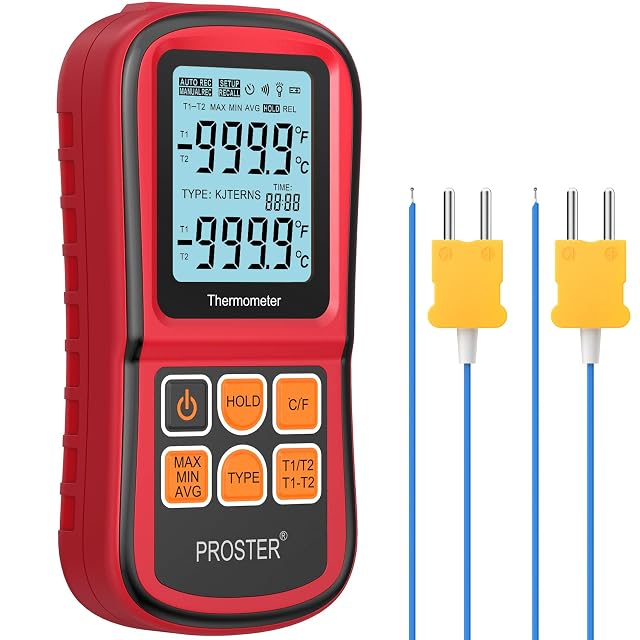
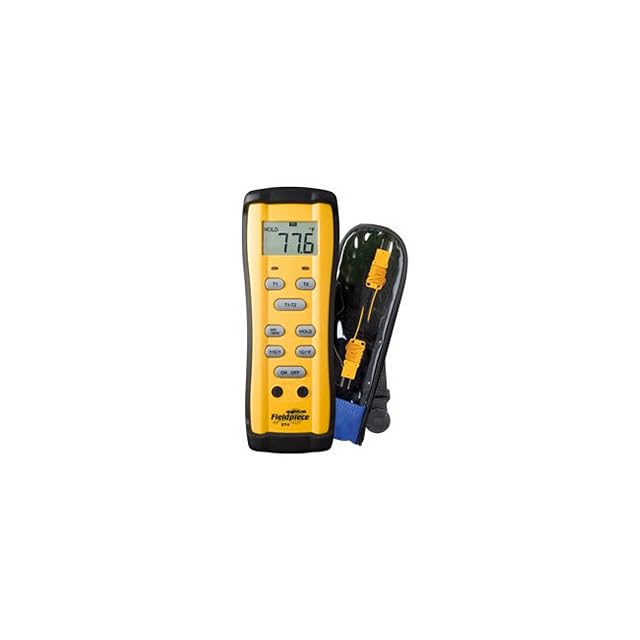
A two-channel delta-T instrument with its own beaded probes, and the only thing on this shelf you can calibrate.
Type and plug fit
TWO type K channels, with "wrap tab beaded thermocouples" included. Fieldpiece lists an optional ATWB1 wet bulb thermocouple as a further accessory. An LED indicates a DISENGAGED PROBE — a plug that has worked loose — which is the only answer on this shelf to the problem this shelf's introduction raises about plugs, approached from the instrument end rather than the probe end
Probe style
WRAP-TAB BEADED, supplied. A bead is the fast-response style this shelf's introduction assigns to air, and a wrap tab lets the same bead be strapped to a pipe or a fin. Two of them, because the instrument exists to read a difference
Stated temperature range
−58 to 2000 °F (−50 to 1300 °C), stated. That is the widest span on this shelf by a long way — 1350 Celsius degrees, against 1100 for the Nxtop probe, 480 for the Klein 69142 and 100 for the Klein 69140 clamp. It is the instrument's range; what any given reading can reach depends on the thermocouple fitted, and the supplied beads are not 1300 °C (2372 °F) parts
Stated accuracy
NOT PUBLISHED. What is published instead is more unusual: TWO FRONT-FACE CALIBRATION POTS, one per channel. This is the only instrument on this shelf that can be adjusted by its owner, which is a different proposition from a stated tolerance — it means the reading can be matched to a reference rather than trusted as supplied
Functions
Reads T1, T2 or T1−T2, with the difference "in big numbers on the LCD". Min/Max and Hold. Fieldpiece states "great temperature compensation for fast changing environments", which is the figure a two-channel meter lives or dies by and is given here as a claim rather than a number
Cable length
Not stated for the supplied thermocouples. No length is published for either of the two thermocouples it ships — the one figure of the hub’s five that this page omits
Construction and safety
A rugged rubber boot, and a clear-front case with the ANC6 magnetic hanger included. A magnetic hanger on an HVAC job is not a nicety: it puts the meter on the side of the unit at eye level while both hands are in the cabinet
Also stated
386 grams — five times the 78 g (2.8 oz) of the Nxtop, the next heaviest probe here. At $119 it is also the most expensive, and it is a different kind of purchase from the rest of the shelf: four of these five products are probes for a meter you already own, and this one is the meter
Amazon reference
B000OLCD9Q
EAN
0735090638122
Two channels and a direct T1−T2 reading
Two calibration pots — the only adjustable thing here
No accuracy figure at a hundred and nineteen dollars
Best for: Finding a temperature split across a coil, where the difference between two readings is the measurement and not either reading alone
A probe of one thermocouple type plugged into an input for another gives a wrong reading with no warning. The stated probe type is decisive, before the temperature range.
A contact probe measures where an infrared thermometer only sees the surface. The two are not interchangeable.
Tracking over time
A probe connected to a logger follows a change over hours. That is what a one-off measurement never shows.
Process control
Two probes let you measure a difference between inlet and outlet. It is often the difference that matters, not the absolute value.
What you gain and what you give up, on temperature probes
Response time against robustness
A fine probe reacts quickly and bends or breaks; a heavy one takes the punishment and takes time to settle.
Probe type against range
The various thermocouple and probe types cover different ranges. A probe outside its range gives an unusable value.
Contact probe against immersion
A surface probe measures a contact, an immersion probe measures a fluid. Using one in place of the other falsifies the measurement.
Frequent questions on temperature probes
Do all probes fit all instruments?
No: the probe type has to match the instrument's input. A probe of another type gives a false reading without flagging it.
How long should I wait for it to settle?
A heavy probe takes several tens of seconds. Reading too early gives a value still changing, not the real temperature.
Does a surface probe measure correctly?
Only in good contact and without cooling from the surrounding air. Poor contact gives a value that is systematically too low.
Can any probe be immersed?
Only probes designed for it, to the stated depth. Immersing beyond that floods the connection.
Does a probe need calibrating?
A check in a melting ice bath gives a simple reference point. A noticeable deviation means the probe needs replacing.
Does cable length influence the measurement?
On thermocouples, an extension has to be of the same metal, otherwise it creates a parasitic junction that falsifies the reading.
How should probes be stored?
Without tight kinks, connector protected. A thermocouple wire broken inside gives erratic readings.
Why does my probe take so long to settle?
A probe with a thick sheath has high inertia and takes a minute to follow a rapid change. Probes stated as fine respond in seconds, at the cost of greater fragility.
What stays with you, on temperature probes
The probe type has to match the instrument's input: another type gives a false reading without flagging it. Wait for it to settle, poor contact always gives a value that is too low — and a thermocouple extension has to be of the same metal.
Summed up: temperature probes
Temperature probes, side by side
There is no table here, and the reason is in the listings. The figure published most often across these 8 products is stated temperature range, given by 6 of them — short of the four in five a column needs to compare rather than to display gaps. Each product page says what its own maker published.
Where the figures are read
Specifications: manufacturer sheets for measuring instruments and the matching Amazon product pages. Prices and availability: Keepa.
Most recent revision in this category: October 8, 2026.