The only instrument in this hub that subtracts for you.
What the manufacturer publishes
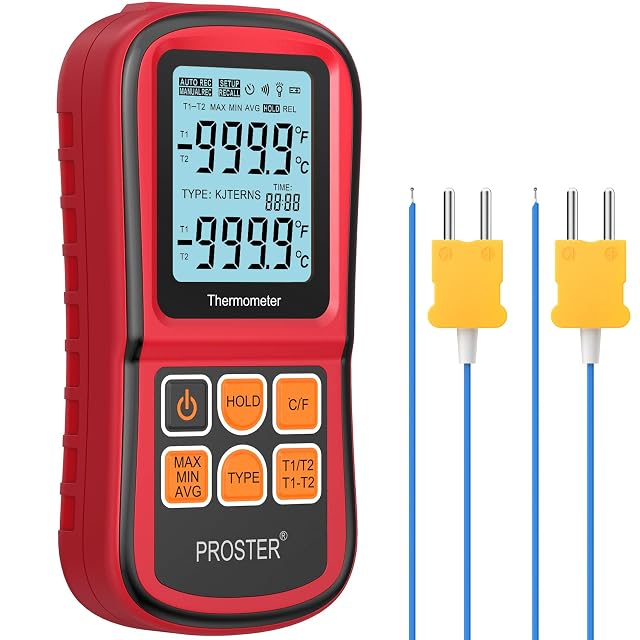
Use on liquids, steam and solid objects including aquariums and pools. Simultaneous measurement of two objects with two modes — T1/T2 and T1−T2 — plus maximum, minimum and average functions. Wide ranges: J type from −210 °C (-346 °F) to 1200 °C (2192 °F), K type from −200 °C (-328 °F) to 1372 °C (2502 °F), and T type over its own span. Supplied with two dual-channel type K probes.
Differential measurement is the normal case
Almost every practical temperature question is a comparison: across a heat exchanger, across a wall, before and after a valve. Taking two single readings a minute apart introduces the one variable you were trying to remove — time.
Two probes on one instrument remove it, and displaying the difference directly removes the arithmetic as well.
What is not stated
Accuracy. As with every probe in this hub, the listing gives ranges and functions and no tolerance.
Availability
Catalogued and unsold: the American Amazon shop lists the reference with nobody behind it.
Read from Keepa on the day this page was last revised; stock and price both move without notice.
What gets asked here
Why is a difference more useful than a temperature?
Because most diagnoses are differential. A radiator flow at 60 °C (140 °F) means nothing; a flow at 60 °C (140 °F) and a return at 58 °C (136 °F) means the radiator is not giving up its heat. A dual-channel instrument shows that gap directly, without arithmetic between two readings taken at different moments.
What is the difference between J, K and T types?
Different metal pairs with different ranges and sensitivities. Proster states J from −210 °C (-346 °F) to 1200 °C (2192 °F), K from −200 °C (-328 °F) to 1372 °C (2502 °F) and T over a narrower span — the instrument reads all three, which is unusual.
Why MAX, MIN and AVG?
Because a process moves. Watching a display for ten minutes and remembering the peak is not a measurement; capturing it is.
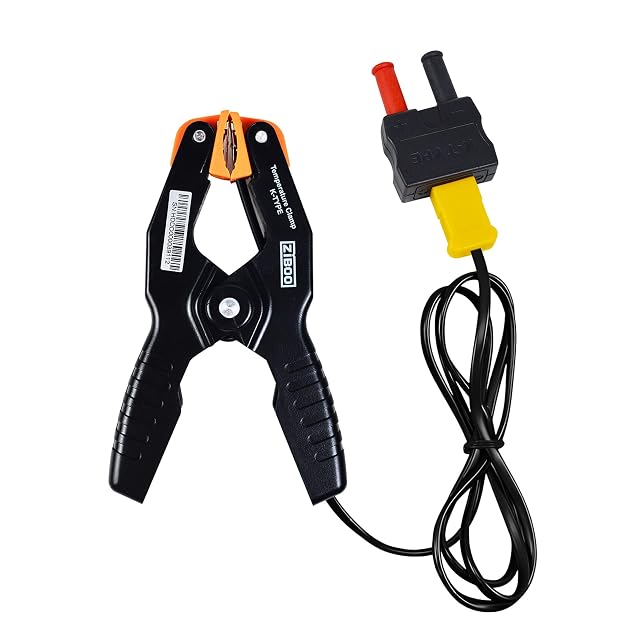
A clamp that carries Klein's part number in its own title and claims double the original's range for half the price.
Type and plug fit
Type K, stated, and the BANANA PLUG ADAPTER IS INCLUDED — which is the genuine advantage over the Klein 69140, where the adapter is Cat. No. 69146 and sold separately. ZIBOO then notes that the adapter is "also sold separately (Cat. No. 69146)", quoting Klein's catalog number for a part it has put in its own box
Probe style
A PIPE CLAMP, closing round pipes from 1/4 to 1 1/2 inch — an eighth of an inch more than the Klein 69140 claims. Like that clamp, it is a style this shelf's introduction does not name among its bead, pad and rod
Stated temperature range
−40 to 392 °F (−40 to 200 °C), claimed. The Klein 69140, whose part number is in this product's title, states −4 to 212 °F (−20 to 100 °C). That is NEARLY TWICE the span, and twice the ceiling, on a copy that costs $14.99 against $26.98. Nothing on either page explains the difference, and a clamp reading 200 °C (392 °F) would reach a hot gas discharge line the original cannot
Stated accuracy
±2%, the same figure the Klein 69140 gives, followed by the same sentence: "Thermocouple accuracy is dependent on the accuracy of the meter being used." The wording of this listing follows the Klein listing bullet for bullet — wide temperature range, versatile pipe clamp, flexible lead, universal compatibility, dependable accuracy — in the same order
Cable length
39.78 inches, 102 cm, flexible. The Klein 69140 states 40 inches for the same 102 cm (40.2 in). Thirty-nine point seven eight inches is 101.04 cm (39.8 in), so the figure has been converted from the metric and given to two decimals rather than measured
Clamp capacity
Pipes 1/4 to 1 1/2 inch, then "(up to 35 cm (13.8 in))" — the same parenthesis that appears on the Klein page, where it is equally wrong. One and a half inches is 38 Millimeters. Thirty-five centimeters is not a pipe this clamp or any other on this shelf would close around
Also stated
The reference field reads 69028+69146 — two Klein Tools catalog numbers concatenated, 69146 being the banana adapter. The title opens "ZIBOO 69140 K-Type Thermometer", and 69140 is the Klein part number of the clamp sitting next to it in this same relevé. The brand on the box is ZIBOO; the part numbers on the listing are all somebody else's
Amazon reference
B0DKFKSTNG
EAN
0736483405789
The banana adapter is in the box
Minus forty to two hundred degrees claimed, twice the Klein
It sells under another maker's part number
Best for: HVAC pipe work on a budget, where the adapter in the box and the wider claimed range are worth the unverified specification
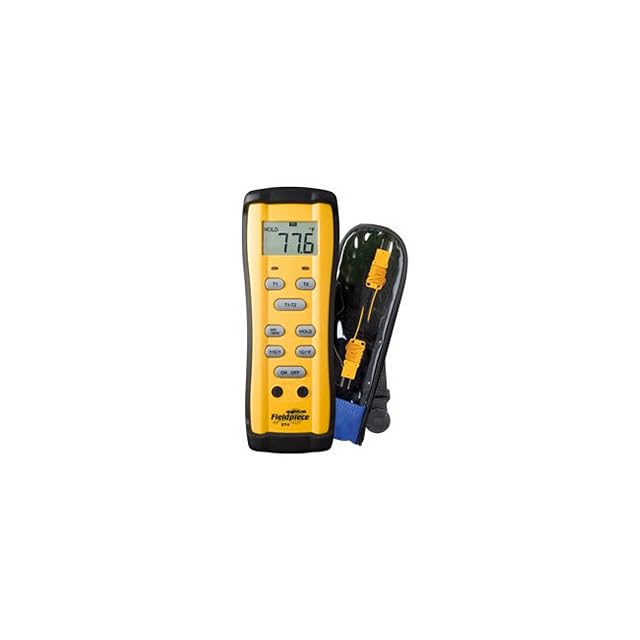
A two-channel delta-T instrument with its own beaded probes, and the only thing on this shelf you can calibrate.
Type and plug fit
TWO type K channels, with "wrap tab beaded thermocouples" included. Fieldpiece lists an optional ATWB1 wet bulb thermocouple as a further accessory. An LED indicates a DISENGAGED PROBE — a plug that has worked loose — which is the only answer on this shelf to the problem this shelf's introduction raises about plugs, approached from the instrument end rather than the probe end
Probe style
WRAP-TAB BEADED, supplied. A bead is the fast-response style this shelf's introduction assigns to air, and a wrap tab lets the same bead be strapped to a pipe or a fin. Two of them, because the instrument exists to read a difference
Stated temperature range
−58 to 2000 °F (−50 to 1300 °C), stated. That is the widest span on this shelf by a long way — 1350 Celsius degrees, against 1100 for the Nxtop probe, 480 for the Klein 69142 and 100 for the Klein 69140 clamp. It is the instrument's range; what any given reading can reach depends on the thermocouple fitted, and the supplied beads are not 1300 °C (2372 °F) parts
Stated accuracy
NOT PUBLISHED. What is published instead is more unusual: TWO FRONT-FACE CALIBRATION POTS, one per channel. This is the only instrument on this shelf that can be adjusted by its owner, which is a different proposition from a stated tolerance — it means the reading can be matched to a reference rather than trusted as supplied
Functions
Reads T1, T2 or T1−T2, with the difference "in big numbers on the LCD". Min/Max and Hold. Fieldpiece states "great temperature compensation for fast changing environments", which is the figure a two-channel meter lives or dies by and is given here as a claim rather than a number
Cable length
Not stated for the supplied thermocouples. No length is published for either of the two thermocouples it ships — the one figure of the hub’s five that this page omits
Construction and safety
A rugged rubber boot, and a clear-front case with the ANC6 magnetic hanger included. A magnetic hanger on an HVAC job is not a nicety: it puts the meter on the side of the unit at eye level while both hands are in the cabinet
Also stated
386 grams — five times the 78 g (2.8 oz) of the Nxtop, the next heaviest probe here. At $119 it is also the most expensive, and it is a different kind of purchase from the rest of the shelf: four of these five products are probes for a meter you already own, and this one is the meter
Amazon reference
B000OLCD9Q
EAN
0735090638122
Two channels and a direct T1−T2 reading
Two calibration pots — the only adjustable thing here
No accuracy figure at a hundred and nineteen dollars
Best for: Finding a temperature split across a coil, where the difference between two readings is the measurement and not either reading alone
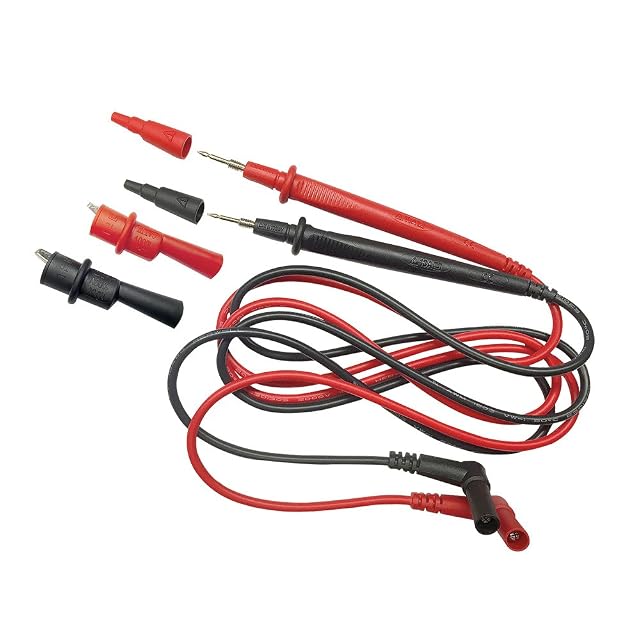
A plain rated pair — and the rating is the whole point, because the three European sets on this shelf publish none.
Stated rating
CATEGORY III 1000 V AND CATEGORY IV 600 V, stated in a bullet. This shelf's introduction is explicit about why that matters: "fitting unrated leads to a CAT III meter gives you a CAT III meter with unrated leads, and the manufacturer's rating for the pair is the lower of the two". The three European sets previously on this shelf publish no category at all; this is one of three sets here that reach CAT IV
Insulation
NOT NAMED. The listing says the leads are durable and says nothing about silicone or PVC — and this shelf's introduction makes that comparison one of its five: silicone stays flexible in the cold where PVC goes stiff and cracks. All three Klein sets share the omission, which is odd on a product whose own description stresses that it is designed by electricians for electricians
Plugs and tips
Right-angle, "standard banana-type inputs compatible with most multimeters and clamp meters". No tip length is published and the plugs are not described as shrouded. A right-angle plug is the detail that keeps a meter from being levered off a ledge by its own leads, and it is why these fit Klein's own lead storage compartments
Length
41 inches, 104 cm, stated. That sits below the published PeakTech's 120 cm (47.2 in) and well below the PUKAIBUL's 125 cm (49.2 in) on this shelf, and above the 3 ft (91 cm) of the two other Klein sets
Supplied
One pair of universal test leads and one set of REMOVABLE alligator clips. Removable is the useful word: the clips come off, so one purchase covers a probe measurement and a hands-free one. 91 grams
Also stated
The leads "are compatible with and fit the lead storage compartment on most Klein test and measurement products" — which is a specification about the METER rather than the lead, and the only one of its kind on this shelf. Klein also offers insulation resistance testing as an application of its heavy-duty sibling, the 69381
Amazon reference
B003U2GONM
EAN
0092644694103
CAT III 1000 V and CAT IV 600 V, both published
Removable alligator clips in the same purchase
The insulation material is never named
Best for: Replacing the leads on any meter with banana sockets, where the meter is rated and the leads must not drag it down
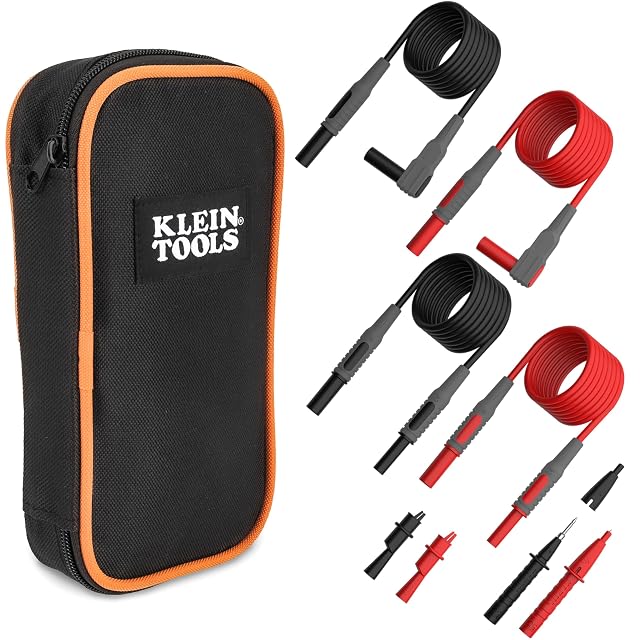
The only set here that extends: three feet of lead plus three feet of adapter, in a case you can wear.
Stated rating
CAT III 1000 V / CAT IV 600 V, stated — the same pairing as the two other Klein sets, and these three are the only CAT IV items on this shelf. The rating is given for the kit rather than itemized per part, which is worth noting on a set whose whole point is that the parts screw together
Length and reach
3-FOOT right-angle lantern-style leads PLUS 3-FOOT extension adapters — six feet, 183 cm, assembled. That is the longest reach on this shelf by a clear margin: the longest single lead here is the PUKAIBUL at 125 cm (49.2 in) and the published PeakTech is 120 cm (47.2 in). A meter hung on a magnet at the side of a cabinet while the probes reach the far end of a board is what this buys
Plugs and tips
Right-angle, LANTERN-STYLE tips, with removable threaded lead HEADS that connect either directly to the right-angle leads or to the extenders. A lantern tip is a sprung sleeve round the probe that grips a terminal rather than resting against it. No shrouding is described for the plugs
Insulation
NOT NAMED, as on both other Klein sets. This shelf's introduction compares silicone against PVC for cold flexibility, and this listing describes the case in more detail than the cable
Supplied
Two right-angle leads, two extenders, two removable lead heads, two screw-on alligator clips, and a carrying case with elastic straps for the heads, pockets for the leads and a BELT LOOP. Nine pieces and a case. 322 grams — the heaviest Klein item on this shelf
Also stated
Klein positions it as "an upgrade or replacement lead kit compatible with clamp meters, multimeters, or other test equipment with standard lead connections". The threaded heads are the mechanism that makes the kit modular: a clip, a probe head and an extender all take the same thread
Amazon reference
B0F167XRH8
EAN
0092644694837
Six feet of reach, the longest on this shelf
CAT III 1000 V and CAT IV 600 V
Fifty dollars, the most expensive of the three Klein sets here
Best for: A meter that has to stay put while the probes go somewhere else — a cabinet at head height, a board across a room
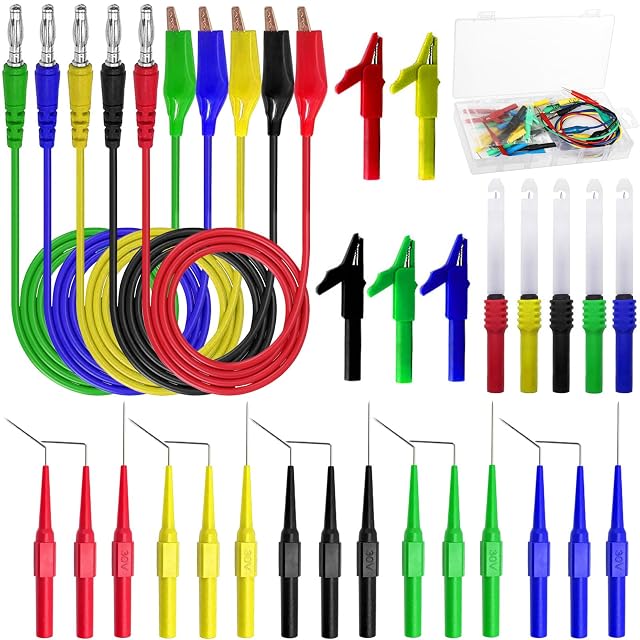
A kit built entirely around reading a connector from behind, rated 30 volts — the lowest on this shelf by a factor of thirty.
Stated rating
TWO RATINGS ON ONE PAGE. The back probes are stated for "testing up to 30 Volts for Connectors, Automotive Sensors and Fuel Injectors", and the alligator clips separately as "CATII 300Vac/15A". The description then gives "Rated Voltage: 30V" for the kit. Thirty volts is the LOWEST figure on this shelf by a factor of thirty, and it is the right one to believe: a kit is rated by its weakest part, and these are 0.07 mm (0.003 in) needles
Insulation
SOFT PVC, stated — "Cable Material: Soft PVC". It is the ONLY product on this shelf whose insulation is named as PVC, and this shelf's introduction says in so many words that silicone "stays flexible in the cold where PVC goes stiff and cracks". Five sets on this shelf name silicone; the three Klein sets name nothing; this one names the material the hub warns about
Probes and angles
15 BACK PROBE PINS in stainless steel, at THREE angles — 90°, 135° and straight — in five colors, with 0.07 mm (0.003 in) needle tips. Three angles is the specification that makes the kit: a connector you can reach from directly behind takes a straight pin, one in a loom against a bulkhead takes 90°, and 135° is for everything in between. No other product on this shelf offers an angle at all
Plugs and tips
4 mm (0.16 in) banana plugs, stated. Five banana-plug-to-alligator-clip leads, five WIRE PIERCING PROBES that connect to the banana leads, and five nickel-plated copper alligator clips with a maximum jaw opening of 15 mm (0.59 in). The piercing probes work through a white plastic case: the wire goes in the case and the probe pierces it, which keeps the pierced spot located and the needle supported
Length
39.37 inches, 1 meter, for each of the FIVE leads. Five leads rather than two is unusual on this shelf and it is deliberate: diagnosing a sensor often means holding a reference, a signal and a ground at once, across two instruments
Supplied
31 pieces: 15 back probe pins, 5 banana-to-clip leads, 5 wire piercing probes, 5 alligator clips, and a storage box. 230 grams, $20.37. Stated for "Automotive Diagnostics, Testing, and Repairing, but also used in Physics Laboratories, Service Shops, Schools, Homes, and Industries"
Amazon reference
B0CKZD44HL
EAN
0677998303682
Three probe angles, which nothing else here offers
Fifteen back probes, so a connector stays plugged in
Thirty volts, the lowest rating on this shelf
Best for: Automotive sensor and injector diagnosis, where the connector stays plugged in and the signal is a few volts