Test leads and probes
Linkhood Back probe kit, 31 pieces, 30 V
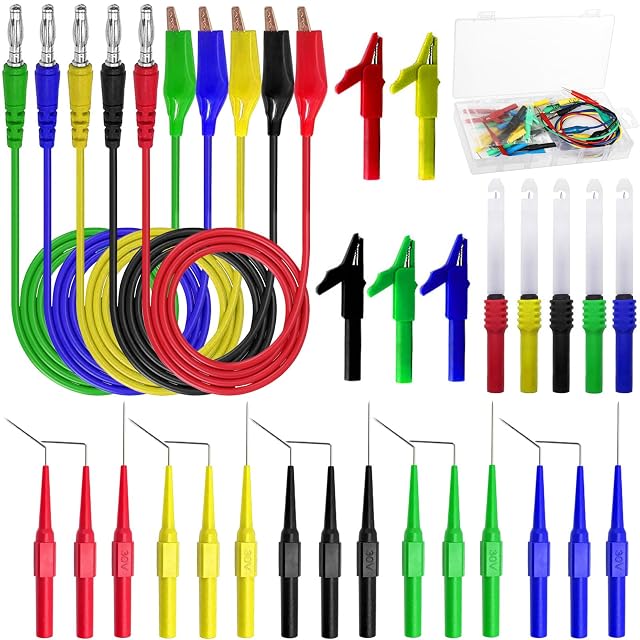
A kit built entirely around reading a connector from behind, rated 30 volts — the lowest on this shelf by a factor of thirty.
Specifications
- Stated rating
- TWO RATINGS ON ONE PAGE. The back probes are stated for "testing up to 30 Volts for Connectors, Automotive Sensors and Fuel Injectors", and the alligator clips separately as "CATII 300Vac/15A". The description then gives "Rated Voltage: 30V" for the kit. Thirty volts is the LOWEST figure on this shelf by a factor of thirty, and it is the right one to believe: a kit is rated by its weakest part, and these are 0.07 mm (0.003 in) needles
- Insulation
- SOFT PVC, stated — "Cable Material: Soft PVC". It is the ONLY product on this shelf whose insulation is named as PVC, and this shelf's introduction says in so many words that silicone "stays flexible in the cold where PVC goes stiff and cracks". Five sets on this shelf name silicone; the three Klein sets name nothing; this one names the material the hub warns about
- Probes and angles
- 15 BACK PROBE PINS in stainless steel, at THREE angles — 90°, 135° and straight — in five colors, with 0.07 mm (0.003 in) needle tips. Three angles is the specification that makes the kit: a connector you can reach from directly behind takes a straight pin, one in a loom against a bulkhead takes 90°, and 135° is for everything in between. No other product on this shelf offers an angle at all
- Plugs and tips
- 4 mm (0.16 in) banana plugs, stated. Five banana-plug-to-alligator-clip leads, five WIRE PIERCING PROBES that connect to the banana leads, and five nickel-plated copper alligator clips with a maximum jaw opening of 15 mm (0.59 in). The piercing probes work through a white plastic case: the wire goes in the case and the probe pierces it, which keeps the pierced spot located and the needle supported
- Length
- 39.37 inches, 1 meter, for each of the FIVE leads. Five leads rather than two is unusual on this shelf and it is deliberate: diagnosing a sensor often means holding a reference, a signal and a ground at once, across two instruments
- Supplied
- 31 pieces: 15 back probe pins, 5 banana-to-clip leads, 5 wire piercing probes, 5 alligator clips, and a storage box. 230 grams, $20.37. Stated for "Automotive Diagnostics, Testing, and Repairing, but also used in Physics Laboratories, Service Shops, Schools, Homes, and Industries"
- Amazon reference
- B0CKZD44HL
- EAN
- 0677998303682
What the maker puts in writing
- “31PCS BACK PROBE KIT: 15pcs Back Probe Pins & 5pcs Banana Plug to alligator clip circuit test wires (39.37inch), 5 pcs Wire Piercing Probes and 5 pcs Nickel-plated copper Alligator clips”
- “3 different probe angles ( 90°, 135°, Straight),5 colors stainless steel back probes ,0.07mm (0.003 in) needle , testing up to 30 Volts for Connectors, Automotive Sensors and Fuel Injectors”
- “Maximum opening: 15mm (0.59 in). Current Voltage: CATII 300Vac/15A” — for the clips
- “Rated Voltage: 30V · Cable length: 39.37 inch / 1m · Banana Plug Size: 4mm (0.16 in) · Cable Material: Soft PVC”
- 230 g (8.1 oz) · $20.37
Three angles, which nothing else here has
Ninety degrees. A hundred and thirty-five. Straight.
A connector you can reach from directly behind takes the straight pin. One pressed
against a bulkhead in a loom takes the ninety. And 135° is for everything in
between, which in a car is most of it.
Fifteen pins, five colors — because a three-wire sensor read with three identical
probes is a reading you cannot trust after the second swap.
No other product on this shelf offers an angle at all.
The connector stays plugged in
Which is the whole reason to own this.
A back probe slides into the rear of a connector alongside the existing wire and
touches the terminal. The circuit stays made, running and loaded.
That is the only condition in which a sensor fault shows itself. Unplug it and you
are measuring a disconnected wire.
Five piercing probes are in the box for connectors you cannot get behind — through
a white plastic case that locates the pierced spot and supports the needle.
Thirty volts, and it is not a typo
The page gives two ratings.
Thirty volts for the probes. CAT II 300 Vac 15 A for the alligator clips. And then
“Rated Voltage: 30V” for the kit.
A kit is rated by its weakest part, and the weakest part here is a 0.07 mm (0.003 in)
stainless needle with no insulation at the working end and no shrouding anywhere.
Thirty volts is the lowest figure on this shelf by a factor of thirty, and it
covers every automotive sensor, injector and bus signal there is.
Nothing in this box should go near a mains circuit.
Soft PVC, named
“Cable Material: Soft PVC.”
“Silicone insulation stays flexible in the cold where PVC goes stiff and cracks.”
It is the only product on this shelf that names PVC. Five sets here name
silicone, and the three Klein sets name nothing at all.
In a workshop toolbox that shows slowly. In a van in January it shows fast, at the
flex point nearest the plug.
Against which: a meter of lead, five of them, twenty dollars. A cracked lead here
is cheap to replace.
Inspect them along their whole length, as this shelf’s buying tip says.
Five leads, not two
Which looks like padding and is not.
Diagnosing a sensor means holding a reference, a signal and a ground at the same
time — often across two instruments.
Two leads make that a sequence of guesses.
Availability
On sale at around 20 € on the American Amazon store at the time of checking.
Prices and availability are what Keepa reported on the date this page was updated; both move.
Prices quoted in this text were read on 8 October 2026. The live price is at the top of the page.