Skip to content

Actron Automotive multimeter, 19 ranges review

An automotive meter built around the one specification car electronics actually need — a 10 MΩ input impedance.

What the figures leave us with A focused automotive meter at eleven dollars, built around the one figure car diagnosis actually needs: a 10 MΩ input impedance, stated, so the meter does not load a sensor line and invent a fault. Nineteen ranges, automatic polarity sensing and alligator clips all belong on a car rather than a bench. It publishes no measurement category, no voltage ceiling and no ampere figure, and the 9 V battery is not in the box.

What the maker puts in writing

  • “10 MΩ input impedance for proper testing of sensitive automotive computer circuits”
  • “19 ranges”
  • “Built-in automatic polarity sensing avoids reversed test lead hook-ups”
  • “automatic zero adjustment for volts, amps, and battery tests”
  • “use to test diodes, batteries (1.5V, 9V, 12V), fuses, switches, solenoids, and relays”
  • “9-volt battery power (battery not included)”
  • “Includes color-coded leads, alligator clips, foldout stand” · manual in English, Spanish and French
  • $10.99

NO measurement category. NO voltage ceiling. NO ampere figure. NO count.

Ten megohms is the whole point of it

And nothing else on this shelf publishes an input impedance.

A modern sensor line carries almost no current. A meter that draws some changes the voltage it is reading.

Put a low-impedance meter across a throttle position sensor and the line sags. You read a fault that is yours, and a healthy sensor goes in the bin.

Ten megohms draws a fraction of a microamp at five volts. The circuit does not notice.

Actron states the figure and states why.

Nineteen ranges is not a count

Which is worth separating, because the hub asks for the other one.

RANGES are the positions the dial selects. COUNTS are what the display resolves within a range.

A 2,000-count meter reads to 1,999. A 6,000-count meter reads to 5,999 — three times the resolution at the same range.

Nineteen ranges tells you how much the dial covers. It does not tell you how finely you can read it, and none of these four publishes a count.

Built for one hand in a loom

Automatic polarity sensing: reverse the leads and the sign changes rather than the reading failing.

Automatic zero on volts, amps and battery tests.

Alligator clips in the box, which free both hands while the engine runs.

A foldout stand. A backlit display. A hold button.

None of that is a specification. All of it is what the tool is for.

And why it was relevéd on the fuse shelf

Because of one word in its second bullet.

“Use to test diodes, batteries, FUSES, switches, solenoids, and relays.”

It tests fuses. It is not one.

Its own fuse, meanwhile, is not described anywhere on the page — only “overload protection”.

What eleven dollars leaves out

No measurement category, which the hub above says to read first.

No voltage ceiling at all, on a meter that measures AC voltage. Every other meter on this shelf that publishes a voltage states 600 V.

No ampere figure for the DC current it reads.

And no battery: nine volts, not included, alone among these four.

Availability

On sale at around 11 € on the American Amazon store at the time of checking.

Prices and availability are what Keepa reported on the date this page was updated; both move.

Prices quoted in this text were read on 8 October 2026. The live price is at the top of the page.
What it has, and what it lacks

Strengths

  • Ten megohms input impedance, stated — unique on this shelf
  • Nineteen ranges, the only range count published here
  • Automatic polarity sensing, so reversed leads still read
  • Automatic zero on volts, amps and battery tests
  • Alligator clips, which free both hands on a running engine
  • Battery tests called out at 1.5, 9 and 12 volts

Compromises

  • No measurement category and no voltage ceiling at all
  • No ampere figure for the DC current it measures
  • The 9 V battery is not in the box
  • No resistance ceiling published
  • No count and no true-RMS
  • Nothing published about its own fuse, on a page that tests fuses

Specifications

Measurement categoryNOT PUBLISHED. No CAT II, III or IV appears anywhere on this listing, which this shelf's introduction calls the specification to read first. In fairness to the tool, it is sold for automotive work at 12 V, where mains transient categories do not describe the hazard — but it also measures AC voltage, and the page gives no voltage ceiling at all
Voltage measurementAC and DC, stated, with no maximum published. That is the gap on this page: every other meter on this shelf that publishes a voltage states 600 V. Battery tests are called out at 1.5 V, 9 V and 12 V, which is where this meter is meant to live
Current measurementDC current, stated, with no ampere figure. Three of the four American meters on this shelf read DC current only; the Klein MM450 is the exception
Functions19 RANGES, stated — the only range count published anywhere on this shelf. AC and DC voltage, DC current, resistance; tests for diodes, batteries, FUSES, switches, solenoids and relays. The word "fuses" in that list is the reason this line was relevéd on the multimeter-fuses shelf: it TESTS them. A hold button retains the reading, and there is a low-battery indicator and overload protection
True-RMSNOT PUBLISHED, and the ranging is manual across those 19 ranges. What it does have instead is AUTOMATIC POLARITY SENSING — reverse the leads and the sign changes rather than the reading failing — and automatic zero adjustment for volts, amps and battery tests. On a car, where you are often reaching into a loom with one hand, polarity sensing is the feature you notice
Display countNOT PUBLISHED, as on the MM325, the MM450 and the KAIWEETS KM100 written beside it. It publishes a RANGE count instead — 19 — which is a different thing: ranges are what the dial selects, counts are what the display can resolve
FuseNOT PUBLISHED. Overload protection is stated; nothing says whether the current input is fused or with what. The page lists fuse TESTING among its functions and its own fuse nowhere
Construction and safety10 MΩ INPUT IMPEDANCE, stated "for proper testing of sensitive automotive computer circuits". That is the specification this whole tool is built around and no other meter on this shelf publishes it: a low-impedance meter draws enough current from a sensor line to change the voltage it is reading, which is how a healthy sensor gets replaced. A backlit LCD, a foldout stand, and a downloadable manual with test procedures in English, Spanish and French
SuppliedColor-coded leads, alligator clips, a foldout stand and a quick-start guide. The 9 V battery is explicitly NOT INCLUDED — the only meter on this shelf sold without its cell, at $10.99, the cheapest here. The alligator clips matter on a car: they free both hands while the engine runs
Amazon referenceB0006V2BP0
EAN0021467076650

Where this one lands in its group

At $11, it is the 1 cheapest of the 7 models in this category published here.

  • Cheapest in the group$11
  • Median$25
  • Dearest in the group$75

What gets asked here

Why does a 10 MΩ input impedance matter on a car?

Because a modern sensor line carries almost no current, and a meter that draws some changes the voltage it is trying to read. Put a low-impedance meter across a throttle position sensor and you load the line, the voltage sags, and you diagnose a fault that is yours. Ten megohms draws a fraction of a microamp at five volts, which the circuit does not notice. Actron states the figure and states why — "for proper testing of sensitive automotive computer circuits" — and no other meter on this shelf publishes an input impedance at all.

Nineteen ranges or how many counts?

They are not the same measurement and this page gives the first. Ranges are the positions the dial selects — so many volts DC, so many ohms, and so on. Counts are what the display can resolve within a range: a 2,000-count meter reads to 1,999, a 6,000-count meter to 5,999, which is three times the resolution at the same range. This shelf's introduction asks for counts, and neither it nor the MM325, the MM450 or the KAIWEETS KM100 publishes one. Nineteen ranges tells you how much the dial covers, not how finely you can read it.

Is a meter with no stated CAT rating safe to use?

It is a question to settle against the work, not against the price. This is sold as an automotive tool: 12 V systems, battery tests at 1.5, 9 and 12 V, sensor circuits. At those voltages the mains transient categories this shelf's introduction describes do not describe the hazard. The problem is that the page also offers AC voltage measurement and never states a ceiling, so nothing tells you where the tool stops. Follow the manufacturer's instructions for the work you are doing, and for anything on a mains installation use a meter whose category is printed.

Against the measuring instruments in the same bracket

Same category, nearby prices, between measuring instruments. What remains is the specifications every one publishes — half empty, a column is no use.

Model Price Voltage measurementCurrent measurementFunctions
Actron Automotive multimeter, 19 ranges $11 AC and DC, stated, with no maximum published. That is the gap on this page: every other meter on this shelf that publishes a voltage states 600 V. Battery tests are called out at 1.5 V, 9 V and 12 V, which is where this meter is meant to liveDC current, stated, with no ampere figure. Three of the four American meters on this shelf read DC current only; the Klein MM450 is the exception19 RANGES, stated — the only range count published anywhere on this shelf. AC and DC voltage, DC current, resistance; tests for diodes, batteries, FUSES, switches, solenoids and relays. The word "fuses" in that list is the reason this line was relevéd on the multimeter-fuses shelf: it TESTS them. A hold button retains the reading, and there is a low-battery indicator and overload protection
KAIWEETS CAT III 600 V multimeter, double fused $12 AC and DC, stated, at CAT III 600 V. This shelf's buying tip insists the category and the voltage are one specification rather than two, and this is the only listing on this shelf that gives them as one: CAT III AND 600 V, in the same phraseDC ONLY, and the listing says so outright: "DC current (Can not for AC current)". No ampere figure is published. That is the limit of the instrument and it is stated in a bullet rather than buried — which is more than can be said for a good deal of this shelfAC and DC voltage, DC current, resistance, continuity and diode measurement, with a DATA HOLD and a backlight. No resistance ceiling is published — the MM325 states 2 MΩ, the MM450 50 MΩ, the published coczow 20 MΩ. A rotary switch sets the range, and the listing asks you to check it is in the right position, so the ranging is manual
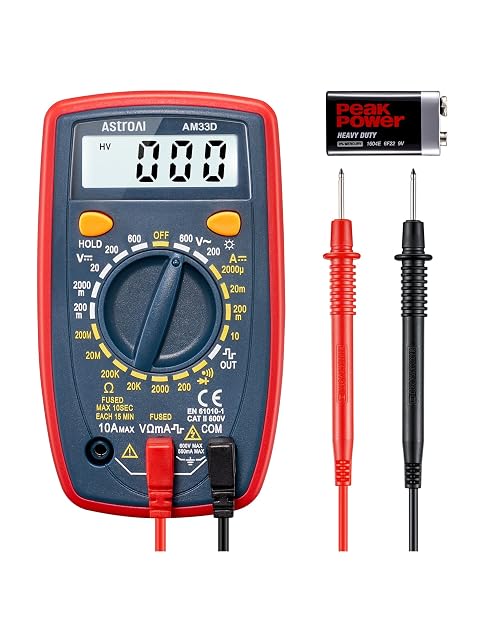
AstroAI Digital multimeter with ceramic fuses $15 AC/DC voltageDC currentresistance · diode
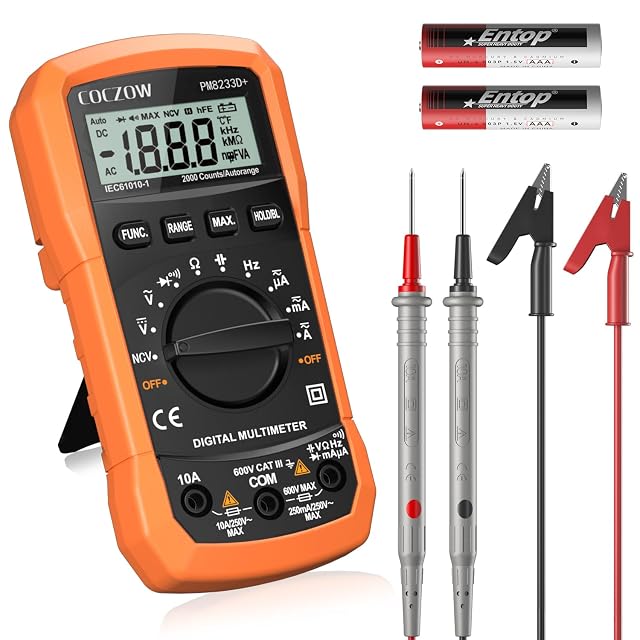
coczow CAT III digital multimeter $25 600 V AC/DC10 Aauto power-off

What the models do not share, in measuring instruments

  • If price decides: this model, at $11.

This one’s price among measuring instruments

Details checked on October 8, 2026.

Who should pick this one, among measuring instruments

Car and bench electrical diagnosis, where the circuits are 12 V and the sensors must not be loaded by the meter

Accessories stated to fit this instrument

Listed because the accessory names this instrument itself.

Sources

Specifications: the manufacturer sheet for measuring instruments and the matching Amazon product page. Prices and availability: Keepa. Every figure on this page names its source.

The method applied to these measuring instruments