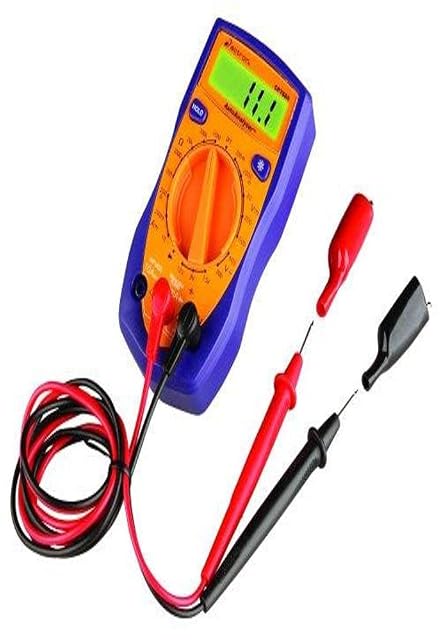
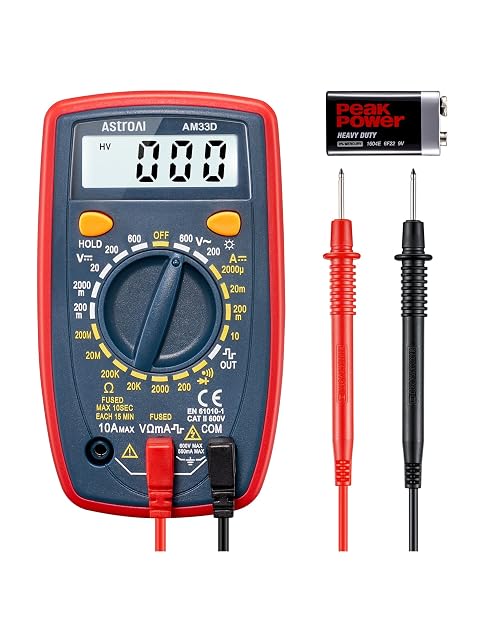
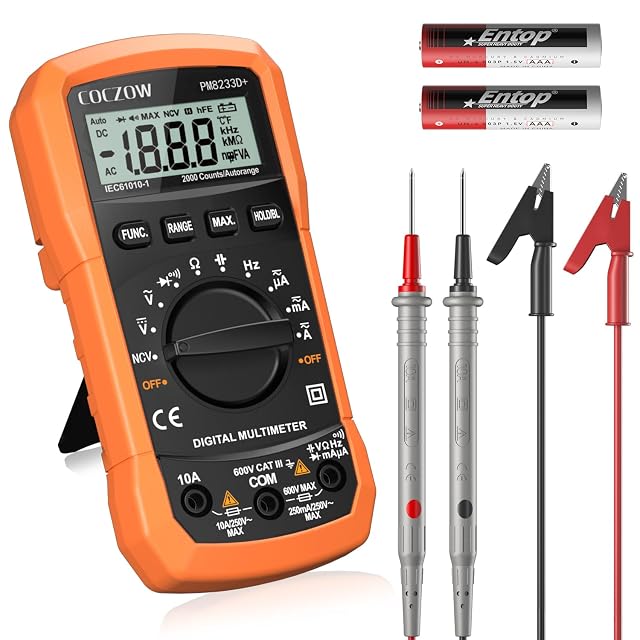
A true-RMS meter with 6000-count resolution and a wide function list — voltage, current, resistance, temperature, diode, continuity, capacitance and frequency — with probe caps included.
What the figures leave us with The most capable meter here on paper, and true-RMS is the upgrade that matters. The unpublished category is the disappointment.
The function list of a much more expensive instrument.
What the manufacturer publishes
A multimeter for household repairs and measurements at voltages up to 600 V, for socket outlets and appliances, with 6000-count measuring resolution. AC and DC voltage, AC and DC current, resistance, temperature, diode, continuity, capacitance and frequency. True RMS, stated as enabling precise values even under fluctuating voltage, with a hold function. A well-readable illuminated display, automatic switch-off after 15 minutes, a battery warning, and protective caps on the probe tips.
Where true-RMS stops being a marketing word
Almost nothing in a modern building draws a sine wave. LED drivers, switched-mode supplies, dimmers and motor drives all chop the waveform, and an averaging meter reading them is not slightly wrong — it is systematically low. If the meter will ever be pointed at anything electronic, this is the specification that decides whether its numbers mean anything.
The probe caps
Small, and a genuine safety feature: caps that shroud all but the last few millimeters of the tip reduce the chance of bridging two terminals with a slip. They are normally an accessory and they are included here.
Availability
No such listing: the American Amazon shop answers the reference with a search box rather than a page.
Read from Keepa on the day this page was last revised; stock and price both move without notice.
What it has, and what it lacks
Strengths
True RMS, stated as giving precise values on fluctuating voltage — the meaningful upgrade in this hub
6000-count resolution, more than double the 3.5-digit meters here
Measures temperature, capacitance and frequency as well as the basics
Automatic range selection, so the dial does not have to be guessed
Protective caps on the probe tips, which is a real safety detail
Compromises
No measurement category published
Not found on the American market
Auto power-off after 15 minutes can interrupt a long observation
Specifications
Amazon reference
B0H6FKXFPJ (identical on 5 markets)
EAN
4007123689118
True-RMS
True RMS
Display count
6000 counts
Voltage measurement
600 V
Functions
temperature, capacitance and frequency
What gets asked here
What does true-RMS actually change?
An averaging meter assumes a clean sine wave and scales its reading accordingly. Anything switched — a dimmer, an LED driver, a variable-speed drive, an inverter — is not a clean sine wave, and an averaging meter reads low, sometimes by a lot. A true-RMS meter computes the real effective value. Brennenstuhl states true RMS for precise values under fluctuating voltage.
What are 6000 counts?
The highest number the display can show before it changes range — here 5999. More counts means finer resolution within a range: 6000 counts reads 599.9 V where a 2000-count meter reads 600 V.
What category is it rated to?
The listing does not state one, despite the meter being positioned for household voltages up to 600 V. Read the manual.
Our score
7.8/ 10
The most capable meter here on paper, and true-RMS is the upgrade that matters. The unpublished category is the disappointment.
This one’s price among measuring instruments
A reference exists on these Amazon stores: France, Germany, Italy, Spain, United Kingdom. Listed is not the same as in stock — availability changes daily.
Details checked on August 31, 2026.
Who should pick this one, among measuring instruments
Household and light installation work where waveforms are not clean and the reading has to be right.
Accessories stated to fit this instrument
Listed because the accessory names this instrument itself.
Specifications: the manufacturer sheet for measuring instruments and the matching Amazon product page. Prices and availability: Keepa. Every figure on this page names its source.
19 RANGES, the only range count published on this shelf · 10 MΩ input impedance, stated for automotive computer circuits · automatic POLARITY sensing · automatic zero on volts, amps and battery tests · battery tests at 1.5, 9 and 12 V · the ONLY meter on this shelf sold WITHOUT its battery · NO measurement category
An automotive meter built around the one specification car electronics actually need — a 10 MΩ input impedance.
Best for: Car and bench electrical diagnosis, where the circuits are 12 V and the sensors must not be loaded by the meter
AC/DC voltage · DC current · resistance · diode · double ceramic fuse
A compact meter whose distinguishing specification is its protection: a double ceramic fuse stated as flame-retardant, plus a silicone sleeve, at fourteen euros.
Best for: A first multimeter for household and hobby electronics, chosen for its fusing rather than its features.