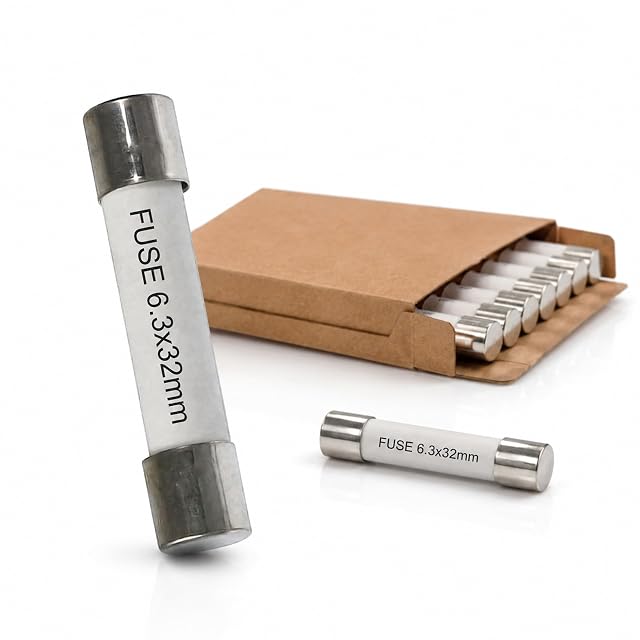
PeakTech Fast-acting fuse, 0.5 A, 6.3 × 32 mm (0.25 × 1.26 in)
The instrument-grade format: 6.3 × 32 mm (0.25 × 1.26 in) at a rated 690 V, super fast-acting, which is what a properly specified meter current input takes.
PeakTech Fast-acting fuse, 0.5 A, 6.3 × 32 mm (0.25 × 1.26 in)
The instrument-grade format: 6.3 × 32 mm (0.25 × 1.26 in) at a rated 690 V, super fast-acting, which is what a properly specified meter current input takes.
Amazon reference
B07SQQXXP3 (identical on 5 markets)
EAN
4250569402852
Stated dimension or range
6.3 × 32 mm (0.25 × 1.26 in)
Fuse rating
500 mA · 690 V rated · super fast-acting (FF)
A 690 V rating, far above the 250 V of the general-purpose fuses here
The 6.3 × 32 mm (0.25 × 1.26 in) format used by instrument current inputs
One value only — 500 mA, which fits the low current range and not the 10 A input
Best for: The meter whose manual specifies exactly this — and it should be checked, not assumed.
The fuse format that instrument manuals actually specify.
What the manufacturer publishes
A fine fuse in 6.3 × 32 mm (0.25 × 1.26 in). A rated current of 500 mA. A rated voltage of 690 V. Super fast-acting (FF) characteristic.
Why 690 V and not 250 V
The voltage rating of a fuse is not about the circuit it normally sits in. It is about what it must interrupt when it fails — and in a multimeter, that is the case where the probes are across a live supply with the meter set to measure current.
Clearing that fault means breaking an arc. A fuse rated for 250 V cannot reliably break an arc at 400 V, and the fault continues through the fuse that was supposed to stop it. That is the whole reason instrument fuses exist as a separate product at a separate price.
Match the value, not just the format
Most meters have two current inputs and two different fuses. Replacing the wrong one leaves the fault, and leaves you thinking the meter is broken.
Availability
No such listing: the American Amazon shop answers the reference with a search box rather than a page.
Read from Keepa on the day this page was last revised; stock and price both move without notice.
What gets asked here
Why is the voltage rating so much higher?
Because of what a meter fuse has to interrupt. Connected across a supply on the current range, the fuse must clear the fault without the arc re-striking across the gap it just made. A higher voltage rating is what makes that possible, and it is why instrument fuses cost more than equipment fuses.
What does FF mean?
Super fast-acting. Instrument inputs specify it because the protection has to open before the meter's shunt is damaged, not after.
Is 500 mA the right value for my meter?
Only if the manual says so. Most meters have two current inputs — a milliamp range and a 10 A range — with a different fuse in each. Check which one you blew.
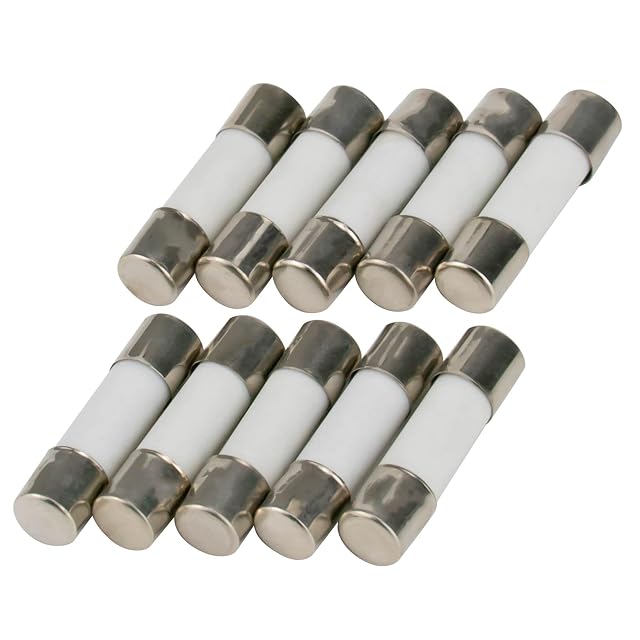
Ten ceramic fuses with all four specifications stated — size, current, voltage and characteristic — which is the only way a replacement fuse can be chosen.
Amazon reference
B0CVXQGP7P (identical on 5 markets)
EAN
4053171962161
Stated dimension or range
5 × 20 mm (0.20 × 0.79 in) ceramic
Fuse rating
10 A / 250 V · time-delay (T)
All four figures published: 5 × 20 mm (0.20 × 0.79 in), 10 A, 250 V, time-delay
Ceramic bodies, which is what a meter's current input normally specifies
A 250 V rating is below what many meters specify for the current input
Best for: The meter whose manual specifies exactly 5 × 20 mm (0.20 × 0.79 in), 10 A, 250 V, time-delay — and no other.
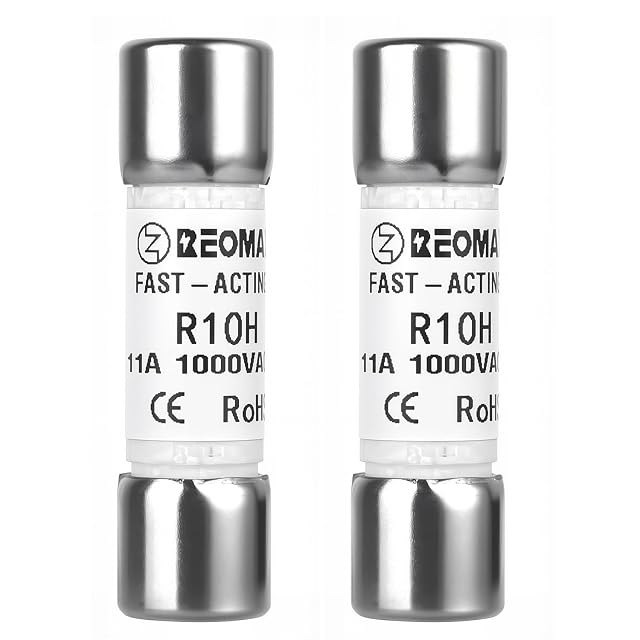
The cheapest 1000 V fuse per piece on this shelf, and the only one that names the part number it replaces.
Stated dimension or range
10 mm (0.39 in) × 38 mm (1.50 in), stated, and then repeated in inches as 0.41" × 1.50". That is the high-energy instrument format, the same as the Klein on this shelf — and more than the Fluke page gives, which publishes no fuse dimensions at all
Current rating
11 A, stated, matching the Fluke and differing from the Klein's 10 A. The listing adds a sentence the other two do not: "Always verify these specifications match your meter's original fuse before installation. Using an incorrect fuse can be a serious safety hazard" — which is this shelf's buying tip, written by the seller
Voltage rating
1000 V AC and DC, stated. Both polarities named, which the other two leave implicit. No fuse previously published on this shelf is rated above 690 V
Breaking characteristic
Fast-acting, stated, with the reason given: "rapid protection for your meter's sensitive internal circuitry (and for you) in case of accidental overload". No breaking capacity in kiloamps is published
Body type
NOT PUBLISHED. Five long bullets and a page of prose, and nowhere does it say ceramic or glass. The shelf's tag line is that a glass fuse in a meter specifying ceramic is not a substitute, and this is a 1000 V part — which is precisely where the distinction bites
Supplied
TWO fuses, $11.69, so $5.85 each — the cheapest 1000 V piece on this shelf. The Fluke five-pack is $8.48 each and the single Klein is $15.99. For a drawer that wants one spare rather than four, a pair is the sensible quantity
Also stated
A direct replacement for multimeter fuse part number 803293, and stated to suit meters from Fluke, Amprobe, BK Precision and Klein Tools that specify an 11 A / 1000 V fuse, with "check your meter's manual to confirm". It is the only fuse on this shelf that names the part number it stands in for, and it names BRANDS rather than models
Amazon reference
B0G8WXL5S7
EAN
0716841567298
Five eighty-five a fuse, the cheapest 1000 V part here
Dimensions in millimeters and in inches
No body material: ceramic or glass is never said
Best for: Keeping spares for an 11 A / 1000 V current input, where the manual gives a part number rather than a brand
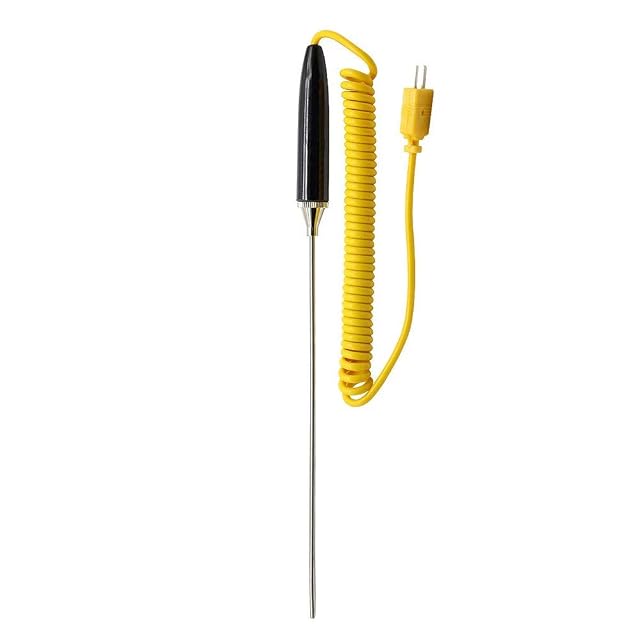
The cheapest probe on this shelf, the hottest, and the only one that publishes a dimension for its plug.
Type and plug fit
Type K with a MINIATURE K-TYPE CONNECTOR, and the fork terminal spacing is published: 5 mm (0.20 in), 0.197 inch. It is the ONLY probe on this shelf that gives a dimension for its plug, and this shelf's introduction says in so many words that "the miniature flat plug that connects it is where fit fails". A nine-dollar probe answers the shelf's stated failure point, and the twenty-seven and thirty-dollar Kleins do not
Probe style
A SHEATHED ROD, 3 mm (0.12 in) diameter by 200 mm (7.87 in) long — the immersion style this shelf's introduction names. Total length 29.5 cm (11.6 in) with the cable gland, so roughly 9 cm (3.5 in) of that is body rather than probe. It is the only product on this shelf whose probe geometry is fully dimensioned
Stated temperature range
0 to 1100 °C (32 to 2012 °F), stated. That is the HIGHEST range published by any probe on this shelf: the Klein 69142 reaches 480 °C (896 °F), the published Taiss 350 °C (662 °F), the ZIBOO clamp 200 °C (392 °F) and the Klein 69140 clamp 100 °C (212 °F). Only the Fieldpiece ST4 meter claims more, at 1300 °C (2372 °F), and that is the instrument's range rather than a probe's. Like the Klein 69142 it does not go below zero
Cable length
30 cm (11.8 in), 12 inches, stated "not stretched" — the SHORTEST on this shelf by a wide margin. The two pipe clamps give 102 cm (40.2 in), the Klein 69142 three feet, the published Taiss 3 m (10 ft). Thirty centimeters puts your hand about a foot from whatever is at 1100 degrees, which is the real limit of this probe and has nothing to do with its sensor
Stated accuracy
NOT PUBLISHED, and no tolerance class is named either. Only the two pipe clamps on this shelf publish a percentage at all; this one publishes nothing. At $8.99 that is the trade being offered, and the sentence both Klein clamps print applies here too whether or not it is written: what turns the junction voltage into a number is your meter
Heat resistance
Implied by the 1100 °C (2012 °F) range for the sheath, and unstated for the cable. The listing describes the materials only as "Electronic Parts, Plastic" and the color as yellow, which is the standard color coding for type K in American practice. A plastic-insulated 30 cm (11.8 in) lead is what sets the working distance, not the stainless rod
Also stated
78 grams, against 11 g (0.4 oz) for the Klein 69142. The listing is written as a parts-catalog entry rather than marketing — product name, model, type, color, material, range, weight, fork spacing, probe dimensions, total length, cable length, package contents — and that is why it publishes more dimensions than anything else on this shelf
Amazon reference
B07DNGWLFS
EAN
0703064924915
Eleven hundred degrees for nine dollars
The only plug dimension published on this shelf — 5 mm (0.20 in)
Thirty centimeters of cable, at 1100 degrees
Best for: Kiln, furnace, forge and flue work, where 1100 °C (2012 °F) is the specification and a 30 cm (11.8 in) cable is enough