Sixty fuses, twelve values, and one sentence that decides whether they belong in your meter.
What the manufacturer publishes
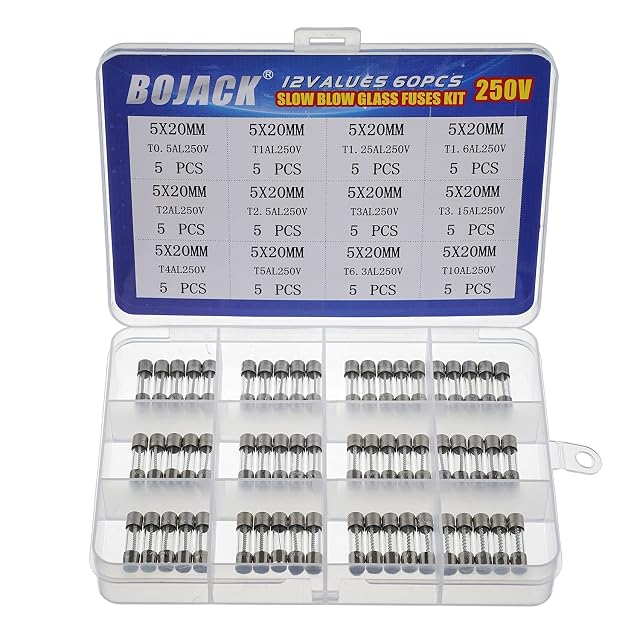
A high-quality slow-blow glass fuse assortment kit. A fuse voltage of 250 V. Fuse dimensions of 5 × 20 mm (0.20 × 0.79 in). Twelve values, sixty pieces, time-delay characteristic.
Read this before fitting one to a multimeter
Glass and ceramic fuses of the same current rating are not interchangeable in a meter’s current input. Ceramic sand-filled bodies are specified there because they interrupt a high-energy fault; glass ones are not built for that duty.
If your instrument manual specifies ceramic — and most do — these are not the part, however well the current matches.
Where they are exactly right
Everywhere else. Equipment fuses, appliance boards, audio, low-energy secondaries. And glass has one genuine advantage: you can see the element, so diagnosis takes a second rather than a continuity test.
Availability
Read on the day this page was built: $10 at the American Amazon shop.
Read from Keepa on the day this page was last revised; stock and price both move without notice.
Prices quoted in this text were read on 31 August 2026. The live price is at the top of the page.
What gets asked here
Can these go in my multimeter?
Only if the manual specifies a glass fuse of exactly this size, current, voltage and characteristic. Many meters specify ceramic at a higher voltage, in which case these are the wrong part regardless of the current match.
Why are glass fuses sold at all then?
Because most fuses in most equipment are not in a high-energy position. In a mains transformer secondary, a speaker crossover or an appliance control board, a glass fuse is exactly right, and you can see at a glance whether it has blown.
Is an assortment a good idea?
On a bench, yes — the right value is there when something blows at nine at night. The risk is that having twelve values encourages fitting the closest rather than the correct one.
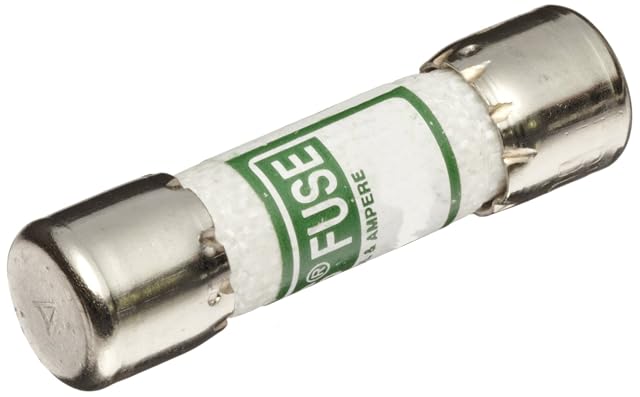
The Fluke part, five to a pack — and the only fuse on this shelf whose own page never states its size.
Current rating
11 A nominal, stated. This shelf's introduction asks for the current rating first among the electrical figures, and this is one of two things the page is clear about. It matches the YUNFOOK and differs from the Klein's 10 A, which is exactly the kind of difference this shelf's buying tip warns not to paper over
Voltage rating
1000 V, stated as "maximum voltage to ground: 1000V". That wording is more precise than the bare figure the other two give, and it is the right way to state it: what a fuse in a current input has to withstand is the potential between the input and earth
Breaking characteristic
Fast-acting, stated in the title. No breaking capacity in kiloamps is published, and neither of the other two American fuses on this shelf publishes one either
Stated dimension or range
NOT PUBLISHED. This shelf's introduction names dimensions as the FIRST of the four things a manufacturer specifies about this component, and the only dimensions on this page are the BLISTER's — 19.05 × 13.716 × 0.508 cm (7.5 × 5.4 × 0.2 in). The Klein and the YUNFOOK both state 10 × 38 mm (0.39 × 1.50 in); this page leaves a buyer to work it out from the part number
Body type
NOT PUBLISHED. Nothing on the page says ceramic or glass. The shelf's tag line is that a glass fuse in a meter specifying ceramic is not a substitute, and this is a 1000 V part — the energy level at which the distinction stops being academic
Supplied
FIVE fuses, $42.42, so $8.48 each. That sits between the YUNFOOK at $5.85 and the Klein at $15.99. A five-pack is the right quantity for a bench that blows them: the fuse in a current input is the component that goes when somebody probes a live circuit in the 10 A socket
Also stated
Country of origin: United States. The four bullets on this listing are generic catalog fields — "Product Type: Precision Measuring", "Package Dimensions", "Country Of Origin", "Package Quantity: 1" — rather than anything about the fuse. The whole specification is in the title and a two-line description
Amazon reference
B00937V94W
EAN
0009596904600
Eight forty-eight a fuse, five in the pack
The voltage stated properly, as potential to ground
No dimensions on the page — the hub asks for them first
Best for: A workshop running Fluke meters, where the part number in the manual is the specification and spares are kept by the handful
The only fuse here that states dimensions, current, voltage and body material — and the most expensive per piece by a wide margin.
Body type
FAST-ACTING CERAMIC, stated in so many words. This shelf's introduction says ceramic sand-filled bodies are specified where the meter must interrupt a high-energy fault and that a glass fuse of the same current rating does not do the same job. Of the three American fuses on this shelf, this is the ONLY one that puts its body material in writing
Stated dimension or range
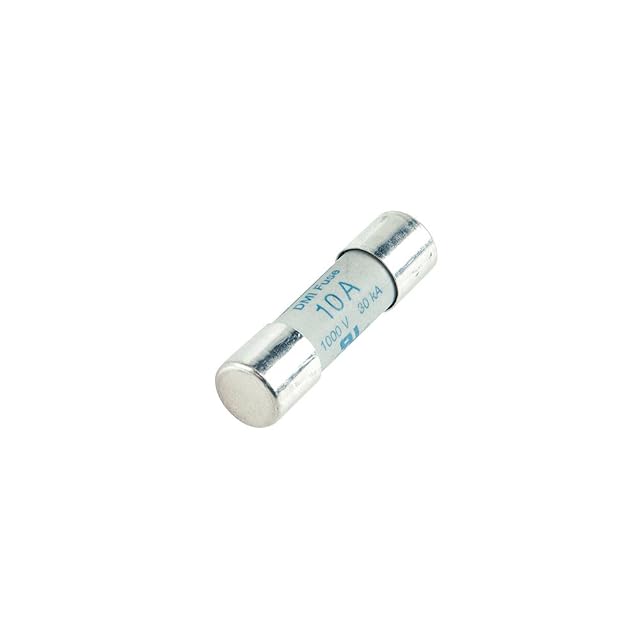
10 × 38 mm (0.39 × 1.50 in), stated in the product title. That is the high-energy instrument format — markedly larger than the 5 × 20 mm (0.20 × 0.79 in) and 6.3 × 32 mm (0.25 × 1.26 in) bodies of the three fuses already published here
Current rating
10 A, stated. The two other American fuses on this shelf are both 11 A, so this is the only 10 A part of the three — and this shelf's introduction is explicit that you replace with the exact part the manual specifies, not with the fuse that fits
Voltage rating
1000 V, stated. No fuse previously published on this shelf is rated above 690 V. A 1000 V rating is what a CAT III or CAT IV current input needs, and it is the figure that most often differs between the right fuse and the one that fits the holder
Breaking characteristic
Fast-acting, stated. Klein adds that it "reduces the risk of internal arc flashes during operation" — which is the whole purpose this shelf's introduction describes: a fuse in a current input is a safety component before it is a consumable
Supplied
ONE fuse, at $15.99. That is the most expensive piece on this shelf by a long way: the YUNFOOK two-pack works out at $5.85 each and the Fluke five-pack at $8.48 each. Klein states compatibility with its MM600, MM700 and MM720 meters, and notes Cat. No. 69035 as a companion part
Also stated
Klein also claims "long-lasting performance" and "reliable and safe", which say nothing measurable. Two of the seven bullets on this listing are of that kind — and on a safety component, the four numbers matter and the adjectives do not
Amazon reference
B01JBMZ3B8
EAN
0092644690341
Says it is ceramic, which the other two never do
All four of the hub's numbers published
Fifteen ninety-nine for a single fuse
Best for: A Klein MM600, MM700 or MM720 whose current input has blown, where the manual names this part number
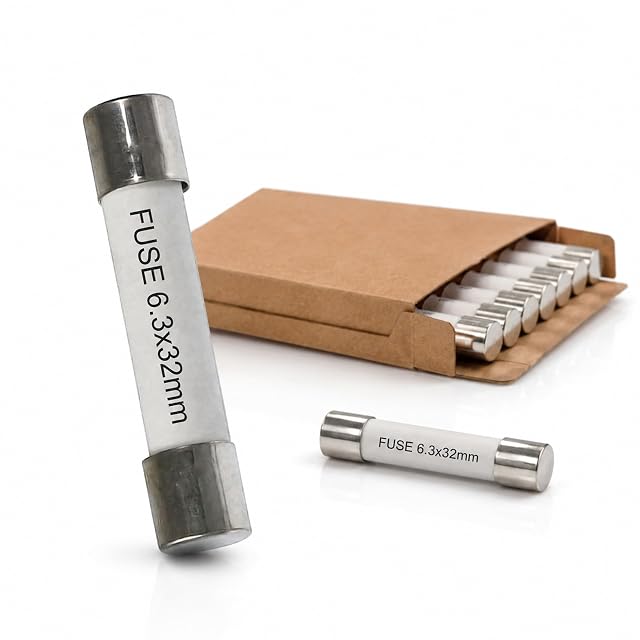
The instrument-grade format: 6.3 × 32 mm (0.25 × 1.26 in) at a rated 690 V, super fast-acting, which is what a properly specified meter current input takes.
Amazon reference
B07SQQXXP3 (identical on 5 markets)
EAN
4250569402852
Stated dimension or range
6.3 × 32 mm (0.25 × 1.26 in)
Fuse rating
500 mA · 690 V rated · super fast-acting (FF)
A 690 V rating, far above the 250 V of the general-purpose fuses here
The 6.3 × 32 mm (0.25 × 1.26 in) format used by instrument current inputs
One value only — 500 mA, which fits the low current range and not the 10 A input
Best for: The meter whose manual specifies exactly this — and it should be checked, not assumed.
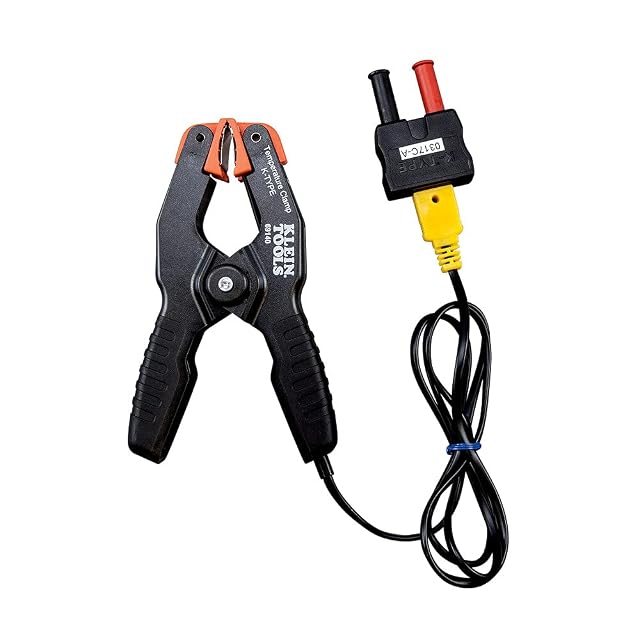
The genuine Klein pipe clamp — and the narrowest temperature range on this shelf, at the highest price of the two clamps.
Type and plug fit
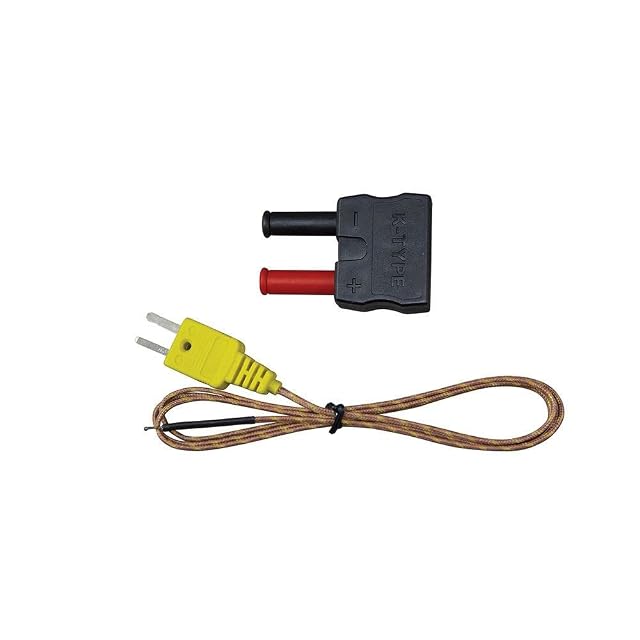
Type K, stated. "Works with any digital multimeter or clamp meter that measures temperature", and Klein adds that its K-type accessories work with all Klein multimeters and clamp meters that measure temperature "as well as any other brand with meters that measure temperature". The banana plug adapter is NOT in the box: it is Cat. No. 69146, sold separately — which matters because this shelf's introduction says the plug is where fit fails
Probe style
A PIPE CLAMP, which is a fourth style this shelf's introduction does not name. It lists a bead for air, a flat pad for surfaces and a sheathed rod for immersion; a spring clamp that closes round a pipe reads the outside wall of a line you cannot immerse anything in. It is the dominant style in the American relevé for this shelf, because that is how a refrigeration circuit is diagnosed
Stated temperature range
−4 to 212 °F (−20 to 100 °C), stated. That is the NARROWEST range on this shelf: the published Taiss states −40 to 350 °C (-40 to 662 °F), the Nxtop 0 to 1100 °C (32 to 2012 °F), the Klein 69142 beside it 0 to 480 °C (32 to 896 °F), and the ZIBOO clamp that borrows this part number claims −40 to 200 °C (-40 to 392 °F). One hundred degrees Celsius is the top of it, which covers a heating flow and stops below a hot gas line
Stated accuracy
±2%, stated — and then the sentence that makes it honest: "Thermocouple accuracy is dependent on the accuracy of the meter being used." Two probes on this shelf publish a figure at all — this clamp and the ZIBOO — and both add that caveat. It is the right way to put it: a thermocouple generates a voltage, and what turns that voltage into a number is the instrument
Cable length
40 inches, 102 cm, flexible. The ZIBOO clamp states 39.78 inches for the same 102 cm (40.2 in), which is the same lead described to two decimal places. The published Taiss five-pack gives 3 m (10 ft), three times either clamp
Clamp capacity
Pipes from 1/4 to 1-3/8 inch diameter. The ZIBOO clamp claims 1/4 to 1 1/2 inch — an eighth of an inch more. Both listings then add "up to 35 cm (13.8 in)", which is not a pipe diameter at all and appears on both pages
Heat resistance
Not stated separately from the measuring range. Klein positions this as the accessory that "extend[s] working temperature ranges for Klein's HVAC Digital Multimeters and Clamp Meters", and names the rest of the family: high temperature thermocouple wire, temperature probe and banana plug adapter
Amazon reference
B07B2PPBRB
EAN
0092644690679
Type K, so it reads correctly on any type K meter
A clamp, which is what a pipe actually needs
A hundred degrees Celsius is the narrowest ceiling here
Best for: HVAC pipe temperatures on small-bore copper, read through a Klein or any other meter with a temperature function
Klein's high-temperature thermocouple — 480 °C (896 °F), a coiled lead, and no stated accuracy or probe style.
Type and plug fit
Type K, stated, and the ADAPTER IS INCLUDED — "with Adapter" is in the product title. That puts it with the ZIBOO clamp and against the Klein 69140, where the adapter is a separate part number. "Works with any digital multimeter or clamp meter that measures temperature"
Stated temperature range
32 to 896 °F (0 to 480 °C), stated. Nearly FIVE TIMES the ceiling of Klein's own 69140 pipe clamp, which stops at 100 °C (212 °F) — and Klein says so directly: these accessories "extend working temperature ranges for Klein's HVAC Digital Multimeters and Clamp Meters". It does not go below freezing, which the two pipe clamps on this shelf both do
Probe style
NOT STATED. This shelf's introduction makes probe style the thing you choose by the job — a bead for air, a flat pad for surfaces, a sheathed rod for immersion — and this listing says only "High Temperature Thermocouple". There is no bead, no pad, no sheath and no tip dimension anywhere on the page, which is the one specification a buyer needs to know whether it will sit on a flue or in it
Stated accuracy
NOT PUBLISHED. The listing gives only the caveat without the figure: "Accuracy of the thermocouple is dependent on the accuracy of the meter being used." Both pipe clamps on this shelf state ±2% alongside that sentence; this one states the sentence alone, at the highest price of the three Klein parts
Cable length
A COILED lead, 3 feet — the only coiled lead on this shelf, and shorter than either pipe clamp’s meter. Coiled matters on a hot job: a straight lead draped across a flue collects heat along its length, while a coil keeps the cable off the work and pulls back out of the way
Heat resistance
Implied by the 480 °C (896 °F) measuring range and not stated separately for the lead. Klein lists "High Temperature Thermocouple Wire" as a DIFFERENT accessory in the same family, which suggests the wire on this part is not itself the high-temperature item
Also stated
11 grams, the lightest probe weight published on this shelf. Klein names the rest of the K-type family on this page — temperature pipe clamp, temperature probe, high temperature thermocouple wire and banana plug adapter — which is the clearest accessory map any maker on this shelf publishes
Amazon reference
B07B2TW23J
EAN
0092644690686
Four hundred and eighty degrees, five times Klein's own clamp
The adapter is in the box
No accuracy figure at all, at thirty dollars
Best for: Flue gases, hot gas lines and anything above the 100 °C (212 °F) ceiling of Klein's own pipe clamp