Skip to content

The best infrared thermometers for 2026

The specification that decides whether a reading means anything is the distance-to-spot ratio: at 12:1, a measurement from 1.2 m (4 ft) averages everything inside a 10 cm (3.9 in) circle, so a small hot component reads cool because the surroundings are included. Adjustable emissivity is the second: polished metal reflects rather than emits, and a thermometer fixed at 0.95 reads it badly. We compare distance-to-spot ratio, temperature range, manufacturer-stated accuracy, emissivity adjustment, and single or dual-laser aiming.

The models we recommend

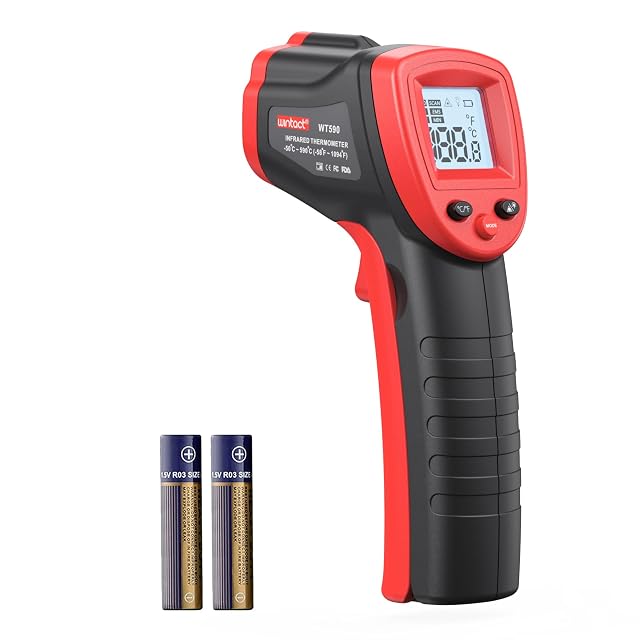
  1. Wintact Infrared thermometer, −50 to 590 °C (-58 to 1094 °F)

    12:1 distance-to-spot · −50 to 590 °C (-58 to 1094 °F) · emissivity adjustable 0.10–1.00

    A 12:1 infrared thermometer covering −50 to 590 °C (-58 to 1094 °F), with emissivity adjustable across the full 0.10 to 1.00 range — the setting that decides whether a reading on shiny metal means anything.

    Best for: Anyone measuring metal, foil or glossy surfaces, where a fixed-emissivity thermometer is simply wrong.

    6.9/10

    ≈ $19

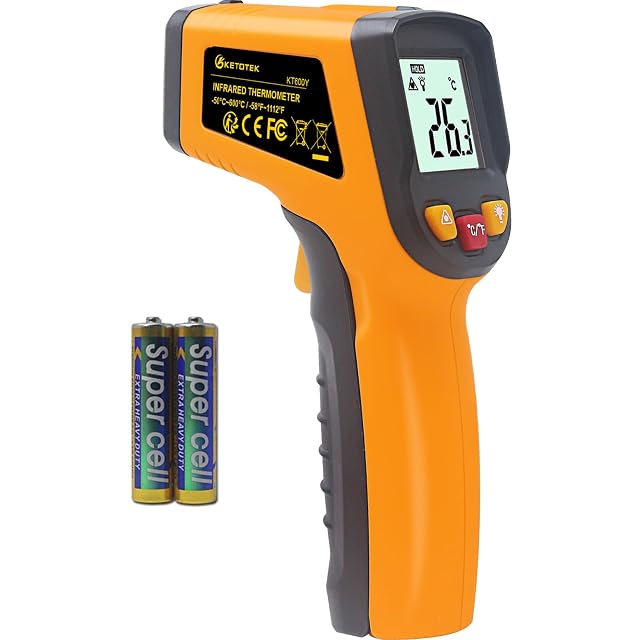
  2. KETOTEK Infrared thermometer, fixed emissivity 0.95

    12:1 · −50 to 600 °C (-58 to 1112 °F) · emissivity FIXED at 0.95 · under 500 ms

    A −50 to 600 °C (-58 to 1112 °F) thermometer with a response under 500 ms, and an emissivity fixed at 0.95 — stated plainly, which makes clear what it can and cannot be pointed at.

    Best for: Painted, plastered, plastic and organic surfaces — everything that is genuinely close to 0.95.

    8.1/10

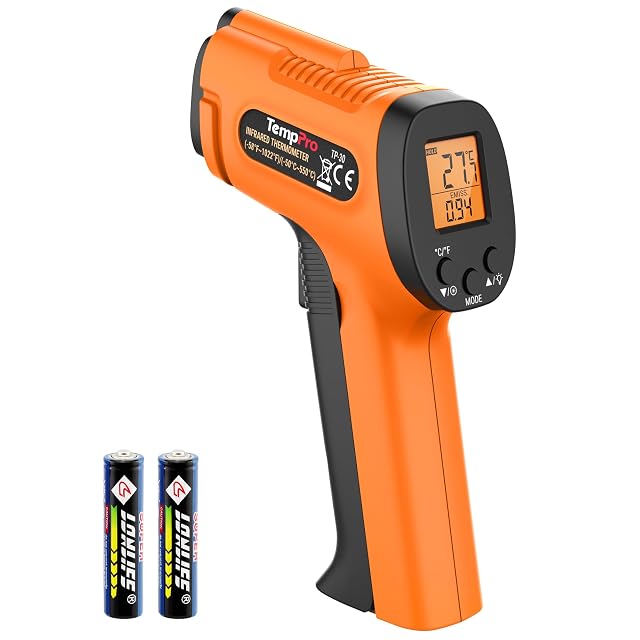
  3. TempPro Laser infrared thermometer, ± 1.5% stated

    12:1 · −50 to 550 °C (-58 to 1022 °F) · ± 1.5% stated · 0.1 °C (32 °F) resolution · 500 ms

    The only thermometer in this hub that publishes an accuracy figure — ± 1.5% — alongside a 0.1 °C (32 °F) resolution and a stated 20 cm (7.9 in) working distance for a 1.6 cm (0.6 in) spot.

    Best for: Anyone who wants a published tolerance rather than a range and a ratio.

    8.1/10

Need by need, within infrared thermometers

Covering a wide temperature span

The measuring range is a hard limit. Outside it, the instrument shows nothing usable.

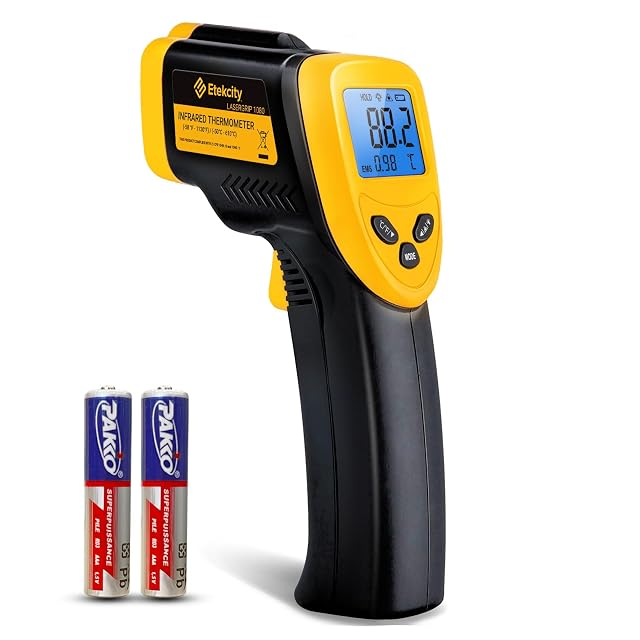
Etekcity Lasergrip 1080

Measuring from a distance

The distance-to-spot ratio decides the area covered at a given distance. The higher it is, the smaller the zone you can measure from far away.

Etekcity Lasergrip 1080

Aiming at a small spot from a distance

An eight-to-one distance ratio measures a twenty-five-centimeter patch at two meters, far more than the part you meant. The stated distance-to-spot ratio decides what is really measured.

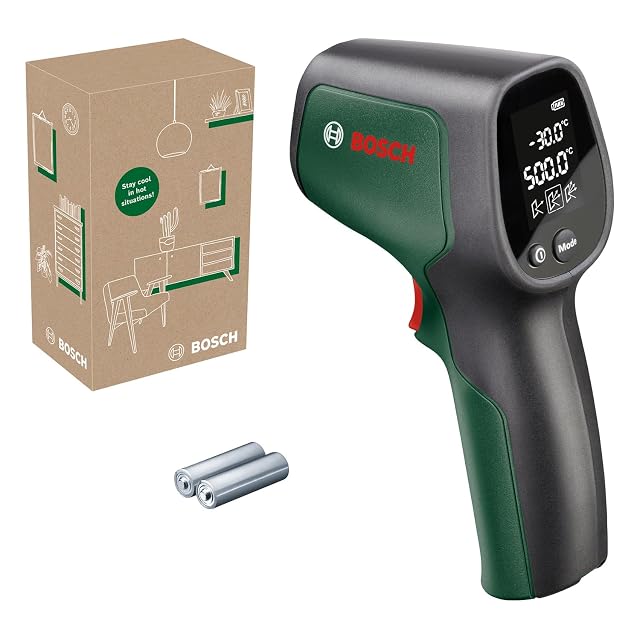
Bosch UniversalTemp

Who each family suits, across infrared thermometers

Thermal diagnosis
Spotting a hot point or a cold zone takes a few seconds. The most frequent use.
Kitchen and process
Contactless measurement of a cooking surface is immediate. It says nothing about the temperature inside.
Shiny surfaces
Polished metal reflects the surroundings and gives a false value. A matt sticker on the area settles the problem.

What you gain and what you give up, on infrared thermometers

Distance against the area measured
The further away you are, the wider the averaged area. A measurement from a distance gives the average of a surface, not the temperature of a point.
Fixed emissivity against adjustable
A fixed emissivity suits common matt surfaces; an adjustment lets you measure correctly on other materials. Without it, the deviation can be large.
Surface measurement against core temperature
The instrument measures the surface alone. For a core temperature you need a contact probe, without exception.

Frequent questions on infrared thermometers

Does the instrument measure the core temperature?

Never: it reads the surface alone. A contact probe is needed for an internal temperature.

What does the distance-to-spot ratio mean?

The ratio between the measuring distance and the diameter of the area read. At a long distance, the instrument averages a wide surface.

Why is the reading wrong on shiny metal?

A shiny surface has a low emissivity and reflects the temperature of its surroundings. A matt sticker on the area corrects the problem.

Should the emissivity be set?

On common matt surfaces the default value is fine. On other materials, a setting is needed for a correct reading.

Does the laser pointer do the measuring?

No: it only shows where to aim. The area actually measured is far wider than the red dot.

Does the instrument work through glass?

No: glass reflects infrared. You measure the pane, not what is behind it.

Should the instrument acclimatize?

An instrument moving from a cold outside to a warm inside gives false readings until it stabilizes.

Does the laser dot show the measured point?

It shows the center, not the area: the measured zone is a disc whose diameter grows with distance. On a small component you move closer rather than aim better.

What stays with you, on infrared thermometers

The instrument reads the surface alone, never the core temperature — and the laser pointer aims, it does not measure: the area read is far wider. On shiny metal, stick on a matt patch, and glass reflects infrared instead of letting it through.

Summed up: infrared thermometers

  • Highest figure for stated temperature range: Wintact WT320 (−50 to 590 °C (-58 to 1094 °F)).
  • Highest figure for emissivity: KETOTEK KT600Y (emissivity FIXED at 0.95).

The full table of infrared thermometers

A column is raised only if four instruments in five publish the value. Below that, it would be measuring the silence of the manuals.

ModelPriceStated temperature rangeDistance-to-spot ratioEmissivity
Wintact WT320$19−50 to 590 °C (-58 to 1094 °F)12:1 distance-to-spotemissivity adjustable 0.10–1.00
Bosch UniversalTemp—−30 to +500 °C (932 °F)—three emissivity settings by material
Etekcity Lasergrip 1080—−50 to 610 °C (-58 to 1130 °F)12:1emissivity 0.1–1.0
KETOTEK KT600Y—−50 to 600 °C (-58 to 1112 °F)12:1emissivity FIXED at 0.95
TempPro T08656—−50 to 550 °C (-58 to 1022 °F)12:1—

Where the figures are read

Specifications: manufacturer sheets for measuring instruments and the matching Amazon product pages. Prices and availability: Keepa. Every figure in this table names its source.

Most recent revision in this category: August 31, 2026.

The method applied to infrared thermometers

Prices quoted in these summaries are dated readings. The live price is shown next to each product.