The distance-to-spot ratio decides what you actually measured · review
Bosch Infrared thermometer with three emissivity presets review
A thermometer that replaces a continuous emissivity dial with three presets chosen by material — a middle path between a fixed value and a number most people never set.
What the figures leave us with The usability choice: emissivity handled by material rather than by number. Fewer published specifications than anything cheaper here.
An instrument designed around the setting nobody adjusts.
What the manufacturer publishes
A measuring range of −30 °C (-22 °F) to +500 °C (932 °F) for the surface temperature of everyday objects. Aim, press the trigger and read. More precise measurement by switching between three emissivity settings according to material. Bosch also lists sustainability features for this reference.
Three presets instead of a dial
Emissivity is the single most important setting on an infrared thermometer and the one least often touched. A continuous scale from 0.1 to 1.0 assumes the owner knows the value for painted steel, and most do not. Three material-based presets make the correction a choice between things you can see rather than numbers you have to look up.
That is a genuine design decision, and it costs capability: no preset will match bare polished metal, which the adjustable thermometers here can be set for.
What is not on the page
No distance-to-spot ratio and no accuracy. Both appear on thermometers costing half as much in this same hub, and both are the figures that let a reading be interpreted.
Availability
Read on the day this page was built: $68 at the American Amazon shop.
Read from Keepa on the day this page was last revised; stock and price both move without notice.
Prices quoted in this text were read on 31 August 2026. The live price is at the top of the page.
What it has, and what it lacks
Strengths
Three emissivity settings selected by material, so the correction is made without knowing what emissivity means
A −30 °C (-22 °F) to +500 °C (932 °F) range covering household and building work
Simple aim-and-trigger operation
On sale across all six markets
Compromises
Three presets are coarser than the 0.1 to 1.0 adjustment of the cheaper thermometers here
No accuracy figure and no distance-to-spot ratio published
The narrowest temperature range in this hub
Specifications
Amazon reference
B0CFVZQFZ5 (identical on 6 markets)
EAN
4053423245318
Stated temperature range
−30 to +500 °C (932 °F)
Emissivity
three emissivity settings by material
What gets asked here
Are three presets enough?
For the surfaces most people measure — walls, radiators, windows, appliances — yes, and they will actually be used. A continuous 0.1 to 1.0 adjustment is more capable and, in practice, is left at its default by most owners.
What is the distance-to-spot ratio?
Not stated in this listing, where all four cheaper thermometers here publish 12:1. It is the specification that determines what area a reading covers, and its absence is a real gap.
What accuracy does Bosch state?
None in this listing. Only the TempPro in this hub publishes a figure.
Our score
8.1/ 10
The usability choice: emissivity handled by material rather than by number. Fewer published specifications than anything cheaper here.
This one’s price among measuring instruments
A reference exists on these Amazon stores: France, Germany, Italy, Spain, United Kingdom, United States. Listed is not the same as in stock — availability changes daily.
Details checked on August 31, 2026.
Who should pick this one, among measuring instruments
Household and building use by someone who will never set an emissivity number by hand.
What buyers actually choose
Amazon reports what buyers took in the month before this page was last checked: at least 400.
The figure is a floor, rounded by Amazon, and read through Keepa — it says what buyers picked, not what a maker claims.
Sources
Specifications: the manufacturer sheet for measuring instruments and the matching Amazon product page. Prices and availability: Keepa. Every figure on this page names its source.
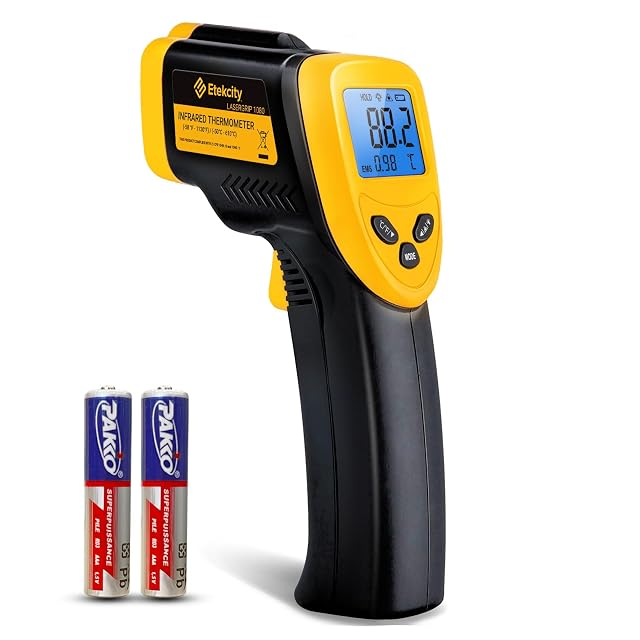
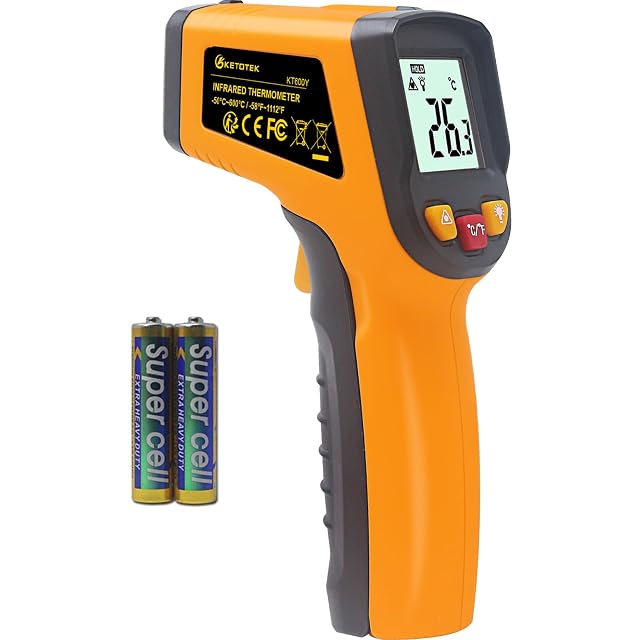
12:1 · −50 to 600 °C (-58 to 1112 °F) · emissivity FIXED at 0.95 · under 500 ms
A −50 to 600 °C (-58 to 1112 °F) thermometer with a response under 500 ms, and an emissivity fixed at 0.95 — stated plainly, which makes clear what it can and cannot be pointed at.
Best for: Painted, plastered, plastic and organic surfaces — everything that is genuinely close to 0.95.
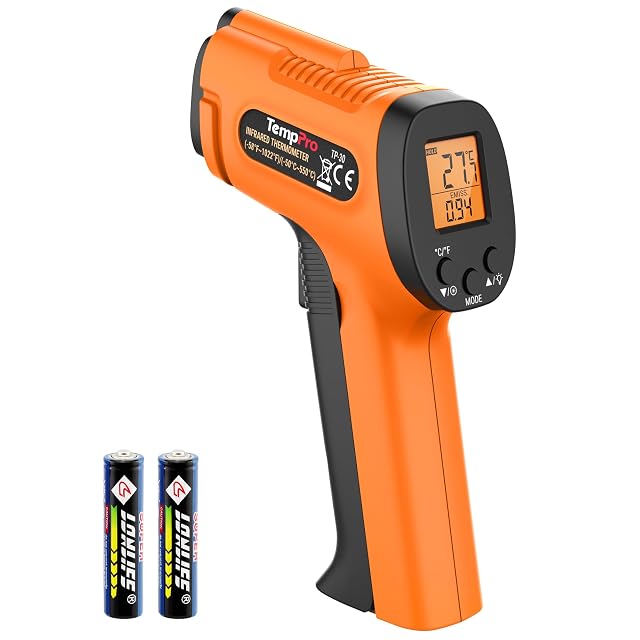
12:1 · −50 to 550 °C (-58 to 1022 °F) · ± 1.5% stated · 0.1 °C (32 °F) resolution · 500 ms
The only thermometer in this hub that publishes an accuracy figure — ± 1.5% — alongside a 0.1 °C (32 °F) resolution and a stated 20 cm (7.9 in) working distance for a 1.6 cm (0.6 in) spot.
Best for: Anyone who wants a published tolerance rather than a range and a ratio.