Gravity needs no batteries and never needs recalibrating
The best mason lines and plumb bobs for 2026
A plumb bob is the oldest instrument on this site and the only one that cannot go out of adjustment: it reports vertical by hanging. Weight sets how quickly it settles — a heavy bob steadies faster and swings less in a draft. Braided line resists the stretch that makes a twisted line sag differently at each setting, and bright colors stay visible against rubble. We compare line construction, strength and stretch, visibility, bob weight and point, and retracting reels.
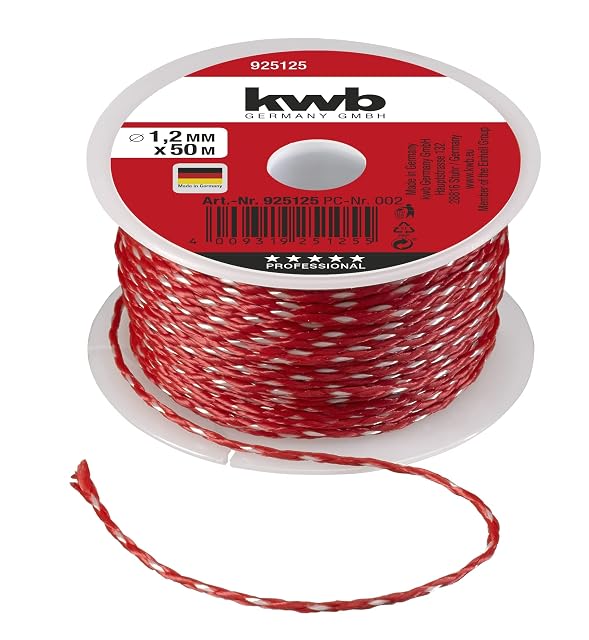
The only line here that publishes its strength: 22 decanewtons breaking, about 4.75 kg (10.5 lb) continuous — the figures that decide how hard it can be tensioned.
Amazon reference
B00TEAM5TG (identical on 6 markets)
EAN
4009319251253
Stated dimension or range
50 m (164 ft) × 1.2 mm (0.05 in)
Mechanism and finish
braided nylon
Stated tension
22 daN
Stated weight
~4.75 kg (10.5 lb) working load
Publishes both a breaking load (22 daN) and a continuous working load (about 4.75 kg (10.5 lb))
Braided rather than twisted, which resists the stretch that makes a line sag differently at each setting
Line only — no plumb bob
Best for: Setting out brickwork, paving and tiling, where the line is tensioned between two points and has to stay straight.
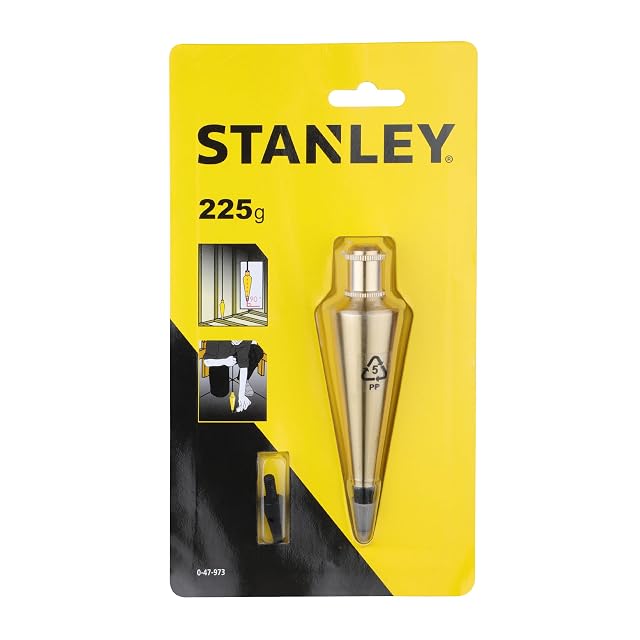
The only bob here that says how long it takes to stop — and the only one you can hammer into a ceiling.
Measuring mode
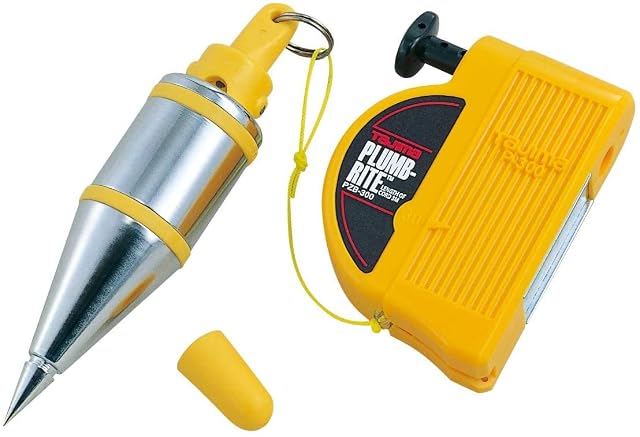
Quick-stabilizing: the 10-ounce bob steadies WITHIN 6 SECONDS, stated. It is the only settling time published on this shelf. This shelf's introduction says weight sets how quickly a bob settles and the buying tip says to let it stop on its own rather than steadying it by hand — a published six seconds is what makes that instruction bearable, because the alternative is standing there not knowing whether to wait longer
Reference and mounting
THREE fixings in one head, stated: a setting pin for wood and drywall, a strong magnet for steel surfaces, and a hook for nails or studs. No other bob on this shelf offers more than two, and most offer none at all — a bare bob is tied to a nail somebody else put in
Functions
An AUTO-RETRACTING PIN STRIKER, stated for use with a hammer for overhead setting. That is the unusual one: you hold the setter against a ceiling and strike it, the pin drives in, and the striker retracts out of the way — so a plumb line can be dropped from a ceiling without first fitting a nail with a free hand you do not have
Stated dimension or range
10 oz / 300 g, published in both units, with a 14.5 ft self-retracting line. Ten ounces is the middle of this shelf, which runs from 5 oz to 21 oz
Body and fittings
A self-retracting line, stated for quick easy storage. Two bobs on this shelf retract; the rest use a hand reel, a card or nothing. The line construction is not stated — four listings on this shelf state braided, and this is not one of them
Also stated
Commercial grade for long-lasting durability, and described in the maker's own text as a compact and light-duty version. No tip material, no tip guard and no replaceable tip is published
Amazon reference
B001S2QNNW
EAN
0049296055066
Six seconds to steady, the only settling time here
A setting pin, a magnet AND a hook in one head
The line construction is not stated
Best for: Overhead setting from a ceiling or a steel beam, where the fixing is the hard part
The only bobs here with spare points — which is the part of a plumb bob that actually wears out.
Supplied
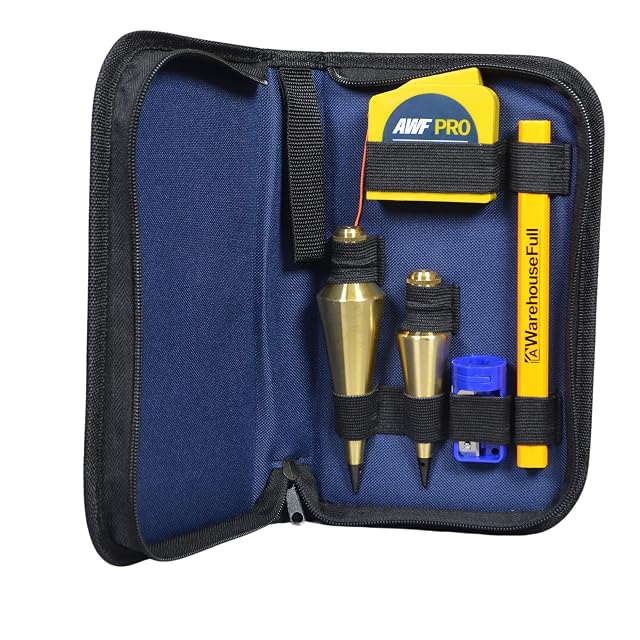
An 8 oz bob, a 16 oz bob, a retractable line reel, two pencils, a pencil sharpener and a blue zipped carry case — stated. Two weights in one kit is unique on this shelf: a light bob settles slower but reaches further up a wall before it fouls, and a heavy one holds still in a draft
Material
SOLID BRASS, stated, precision made. It is the only brass on this shelf — the rest are steel, plated or chromed — and brass matters for a specific reason: it is denser than steel, so a brass bob of the same weight is smaller and swings in less air, and it does not rust at all rather than resisting rust
Functions
FOUR replaceable steel tips — two per bob, one of them hidden in the cap — with caps and tips interchangeable between the two sizes. Nobody else on this shelf sells a spare tip of any kind, and the tip is the part that goes: a point dropped onto concrete rolls over, and a rolled point puts the bob off center
Body and fittings
A reel with approximately 14 feet of bright orange BRAIDED nylon cord, RARE-EARTH magnets to attach it to steel or iron, and a fold-out bracket to hang it on a nail, screw or tack. A locking lever holds the cord; press again and the line self-retracts
Scale
The cord attaches by removing a screw-in cap, threading the cord through the center opening and knotting it — stated. Center threading is what keeps a bob hanging true, and a screw cap is what lets a worn cord be replaced rather than retied around a hook
Also stated
A specialty sharpener designed for cutting CARPENTER pencils, which is a different cone from a round pencil and is the reason an ordinary sharpener destroys a flat pencil. No settling time and no bob dimensions are published
Amazon reference
B074SW83JH
EAN
0855493007698
Four replaceable steel tips, unique on this shelf
Solid brass: denser than steel and it cannot rust
Fifty dollars, the most expensive thing on this shelf
Best for: Owning one kit for years, where a blunted point would otherwise end the tool
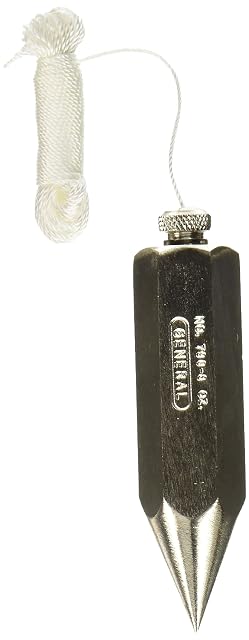
The only plumb bob on this shelf measured against a published specification — and the cheapest bob on it.
Also stated
Conforms to government specification GGG-P-501e, stated — the US federal specification for plumb bobs, which fixes the form, the weight tolerance and the finish. It is the ONLY standard cited anywhere on this shelf and the only one in the American chantier for this site: every other bob here is sold on its material and its weight, with nothing against which either is checked
Stated dimension or range
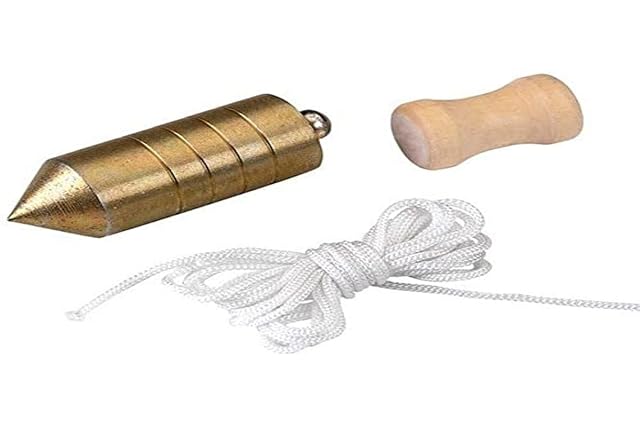
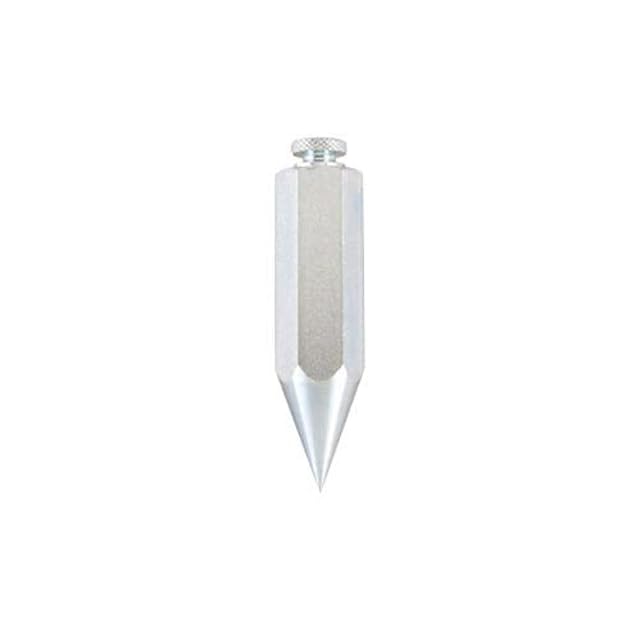
8 oz, 4 inches long and 7/8 inches wide — the only bob DIMENSIONS published on this shelf. Length and width matter on a bob: a long thin bob hangs closer to a wall before it fouls, and a short wide one has more surface for a draft to push
Material
A hexagonal body of COLD-DRAWN steel, nickel plated to prevent rust. Cold-drawn rather than cast or turned from bar: the grain runs along the body, which is why a cold-drawn bob survives being dropped on its side. Hexagonal, stated, which also means it will not roll off a board
Body and fittings
A removable cord cap for easy cord replacement, sized for 3/32 inch cords. A named cord size is unusually practical: it means a replacement can be bought by specification rather than by trying it
Supplied
A 10-foot 3 mm (0.12 in) BRAIDED cord and the removable cap. Ten feet is the shortest line on this shelf — the retracting reels carry 14 and 14.5 feet and the mason's line reel carries 250 — but it is braided, which this shelf's introduction says resists the stretch that makes a twisted line sag differently at each setting
Measuring mode
No settling time is published, and this shelf's introduction says weight sets how quickly a bob settles. Eight ounces is the middle-light end of this shelf, which runs 5 to 21 oz; one maker here publishes six seconds for a ten-ounce bob
Amazon reference
B00004T7TI
EAN
0038728426154
The only published standard on this shelf: GGG-P-501e
The only published bob dimensions: 4 in by 7/8 in
Ten feet of cord, the shortest line here
Best for: A bob that has to be the right shape and weight, bought once and kept in a toolbox
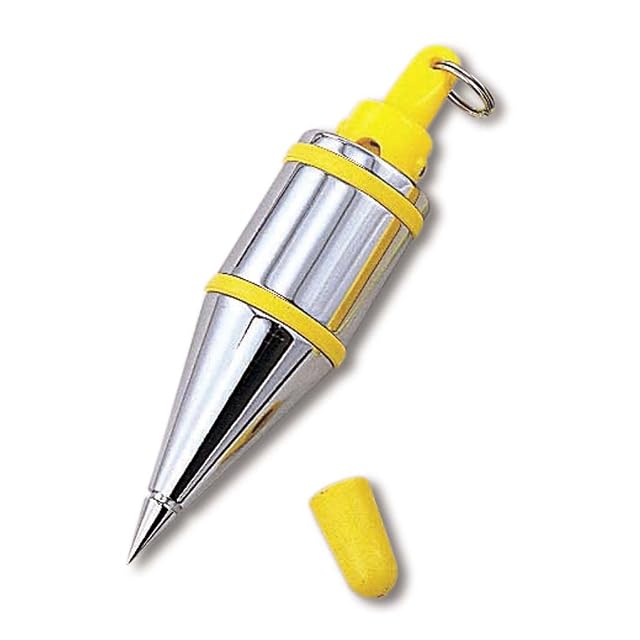
The heaviest bob here, and the only one with bumpers to stop it marking the wall it hangs against.
Stated dimension or range
21 oz / 600 g — the heaviest bob on this shelf, where the lightest is 5 oz: a factor of four. This shelf's introduction says weight sets how quickly a bob settles and how little it swings in a draft, which makes this the bob for an open site, a stairwell or a long drop
Measuring mode
Quick-stabilizing: stops wobble AND SPIN within 6 seconds, stated. The same figure as the maker's 10-ounce bob on this shelf, which is the interesting part — doubling the weight does not halve the time, because the design rather than the mass is doing the work. Spin is the half nobody else mentions: a bob that has stopped swinging can still be rotating, and a rotating bob with an off-center tip traces a circle
Body and fittings
EMBEDDED SIDE BUMPERS, stated to protect both the bob and the work surfaces. Nobody else on this shelf has them, and they solve a real problem twice: a 600 g (21.2 oz) steel bob swinging into a finished wall marks it, and the same impact chips the bob's own plating
Functions
A thick ELASTOMER TIP GUARD, stated to keep the tip safe and secure. The tip is what a bob dies of — one drop rolls the point over — and a guard is the other answer to that problem; the brass kit on this shelf answers it with four spare tips instead
Material
Chrome plated to resist rust and corrosion, stated. Chrome is harder than nickel and resists the chip that starts the rust — which matters more on a 600 g (21.2 oz) bob, because a heavier bob hits harder when it is dropped
Supplied
A snap ring as standard, to connect and disconnect from a plumb line, stated. A snap ring rather than a knot means the same bob moves between a short line and a long one in seconds. NO LINE IS SUPPLIED — this is a bob, not a kit, and the shelf carries 250 ft of braided mason's line for under nine dollars
Amazon reference
B00023S4SK
EAN
0049296054267
Twenty-one ounces: the steadiest bob on this shelf
Six seconds, and it stops SPIN as well as swing
No line supplied at all
Best for: A long drop outdoors or in a draft, where a light bob never stops swinging
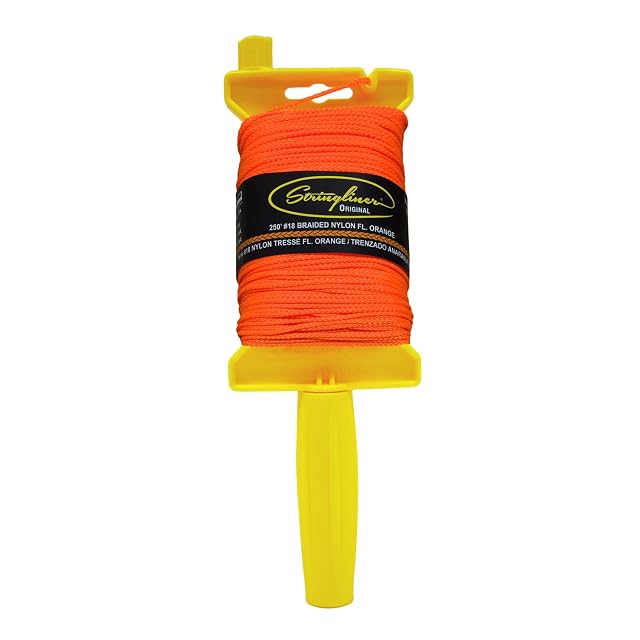
The only actual line on a shelf called mason lines and plumb bobs — braided, orange, two hundred and fifty feet.
Stated dimension or range
250 FEET per reel, three reels. Every other product on this shelf carries between 10 and 14.5 feet of cord and six of the seven are bobs — so this is the only line on the shelf in any meaningful sense, and it carries seventeen times the length of the longest bob cord here
Material
BRAIDED, stated in the title, and ORANGE. Both are the things this shelf's introduction asks for: braided line resists the stretch that makes a twisted line sag differently at each setting, and bright colors stay visible against rubble. A twisted line also unwinds under tension and rolls a brick course off true as it does
Body and fittings
A line reel handle of durable polyethylene, stated, with the line securing in a convenient notch. It is a hand reel rather than a retracting one — the notch is what stops the line unwinding in a bag, and it is the whole mechanism
Supplied
Three reels at eight dollars seventy-nine — about two dollars ninety a reel of 250 ft. Three is the right number for a trade that loses line: one on the job, one in the van, one cut short and still useful
Also stated
TWO bullet points, and that is the whole listing. No breaking strain, no diameter, no material beyond braided, and no stretch figure — this shelf's introduction compares line STRENGTH and STRETCH, and neither appears
Functions
Not published: no twine size, no number, no weight. Mason's line is normally specified by a number — a #18 or #21 — which sets its diameter and breaking strain, and this listing gives none
Amazon reference
B0F2BCLTMQ
EAN
5061094333707
250 feet, where every bob here carries ten to fifteen
Braided, which the hub intro says resists stretch
Two bullet points, and that is the whole listing
Best for: Setting out brickwork, fencing or a long datum, where a bob's ten feet of cord is nothing
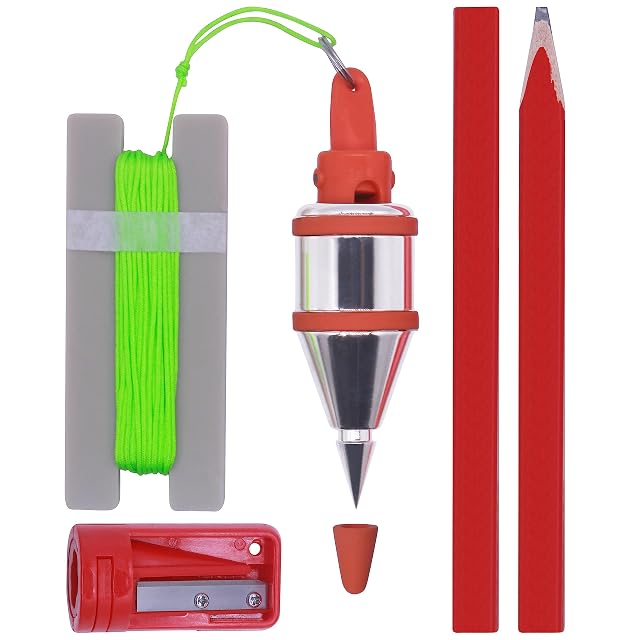
Sixteen feet of braided line, which is more than any other bob here carries — wound on a card rather than a reel.
Stated dimension or range
8 oz / 227 g, with 16 FT (5 m (16 ft)) of nylon braided line. Sixteen feet is the longest bob line on this shelf — the retracting reels carry 14 and 14.5 ft and a steel bob ships 10 ft — and on a stairwell or a two-story drop that difference is the whole job
Material
High-quality steel, stated corrosion-resistant, with a sharp point for calibration. NYLON BRAIDED line, stated — which this shelf's introduction says resists the stretch that makes a twisted line sag differently at each setting
Functions
A FAST Stabilizing DEVICE at the end of the bob, stated to speed up the stabilization of the line. No time is given — the Tajima bobs on this shelf publish six seconds — but the feature is the same idea: this shelf's introduction says weight sets how quickly a bob settles, and a damping device is the other way to get there without adding mass
Body and fittings
A safety cap over the point, stated to make it safer to use, and an anti-slip band at the waist of the bob to prevent it slipping off the line. The cap is the same answer to the same problem as the elastomer tip guard on another bob here: the point is what a plumb bob dies of
Supplied
The bob, a line board holding the 16 ft of braided line, TWO pencils and a sharpener. The line board is a card rather than a reel: the line is unwound by hand and rewound by hand, and the board can be held or weighted down to fix the top of the line, which is how HCCMLOVE describes using it
Reference and mounting
Nylon clips to adjust the line length for different heights, stated. No magnet, no pin and no hook: the top of the line is fixed by holding the board or weighting it, which is the simplest arrangement on this shelf and the least secure
Amazon reference
B0C86R3MNR
EAN
0765365646538
Sixteen feet of line, the longest bob cord on this shelf
Braided nylon, which resists stretch
A line board, not a reel: wound and unwound by hand
Best for: A tall drop on a budget, where sixteen feet of line matters more than a reel to wind it on
The lightest bob here, and the only one sold for the job a surveyor actually keeps one for: centering a tripod.
Stated dimension or range
5 oz — the lightest bob on this shelf, where the heaviest is 21 oz. Light is the right choice for a tripod hook, where the bob hangs a few inches and settles in a moment; this shelf's introduction says a heavy bob steadies faster and swings less in a draft, and both of those matter on a long drop rather than a short one
Functions
Stated to be used with JOHNSON TRIPODS to center them while using optical and laser instruments. It is the only bob on this shelf sold for that job, and it is the job a surveyor keeps a bob for: an instrument reads angles from wherever its tripod actually stands, so a theodolite or a level over a station mark has to be positioned by dropping a point from its own center
Material
A hexagonal MACHINED steel body with a corrosion-resistant plated finish, stated. Machined rather than cold-drawn — which is the other bob on this shelf — means turned to shape, so the concentricity of the point to the body is a machining tolerance rather than a drawing one
Body and fittings
A hexagonal body stated to prevent it rolling off, and a removable cap stated to allow quick, easy and accurate Centered string installation. Centered is the operative word: a bob whose string is not on the axis hangs at a slight angle and its point lands beside the truth
Supplied
The bob. No line, no reel and no case — so the string is bought separately, and the cap is what makes that a specified job rather than a knot round a hook
Also stated
Named for foundation contractors, excavation contractors and surveyors, for lining up and transferring points. No settling time, no dimensions, no tip guard and no spare tip is published
Amazon reference
B00002N7U8
EAN
0049448050000
Five ounces, which is right for a tripod hook
The only bob here stated for centering a tripod
No line supplied at all
Best for: Centering a tripod over a station mark, and transferring points indoors
Who each family suits, across mason lines and plumb bobs
Masonry
A taut line gives the alignment of a whole course. It is the reference tool, ahead of any laser.
Plumb
A plumb bob gives absolute vertical, independently of any setting. Nothing here can go out of adjustment.
Windy outdoors
A light plumb bob swings endlessly. Mass is what makes working outside possible.
What you gain and what you give up, on mason lines and plumb bobs
Plumb bob against laser
The plumb bob never goes out of adjustment and takes time to settle; the laser is instant and can be wrong without saying so.
A heavy bob settles fast and pulls the line
A heavy bob settles quickly and resists wind, and becomes awkward to carry and to hang.
Fine line against visibility
A fine line sags less and is hard to see; a thick colored line is spotted from a distance and catches the wind.
Frequent questions on mason lines and plumb bobs
Can a plumb bob be wrong?
No: it indicates vertical by gravity. It is the only instrument in the range that cannot go out of adjustment.
How long should I wait for it to settle?
Until the swinging stops completely. A heavy bob settles markedly faster than a light one.
How do I tension a mason's line?
Firmly, with tensioners or pins. A slack line sags in the middle and the alignment goes wrong exactly where it matters most.
Does the line sag?
Always a little under its own weight. Over a long span, an intermediate support or a second check is called for.
Does wind get in the way much?
A light plumb bob becomes unusable outside. A heavy bob and an improvised shelter make working possible.
Should I prefer a laser?
The laser is instant and can be out of adjustment without you knowing. The plumb bob is slow and beyond dispute: the two complement each other.
How do I store a line?
Wound on its reel, dry. A knotted or damp line loses its regularity and its strength.
Is a plumb bob still worth having against a laser?
It never fails, needs no battery and gives absolute vertical, which no self-leveling device beats. It does need time to settle in a draft.
What stays with you, on mason lines and plumb bobs
A plumb bob cannot be wrong: it is the only instrument in the range that never goes out of adjustment, and the laser can be, without saying so. Wait until the swinging stops completely, and a slack line sags in the middle — exactly where the alignment matters.
Summed up: mason lines and plumb bobs
The full table of mason lines and plumb bobs
A column is raised only if four instruments in five publish the value. Below that, it would be measuring the silence of the manuals.
A hexagonal body of COLD-DRAWN steel, nickel plated to prevent rust. Cold-drawn rather than cast or turned from bar: the grain runs along the body, which is why a cold-drawn bob survives being dropped on its side. Hexagonal, stated, which also means it will not roll off a board
A hexagonal MACHINED steel body with a corrosion-resistant plated finish, stated. Machined rather than cold-drawn — which is the other bob on this shelf — means turned to shape, so the concentricity of the point to the body is a machining tolerance rather than a drawing one
BRAIDED, stated in the title, and ORANGE. Both are the things this shelf's introduction asks for: braided line resists the stretch that makes a twisted line sag differently at each setting, and bright colors stay visible against rubble. A twisted line also unwinds under tension and rolls a brick course off true as it does
High-quality steel, stated corrosion-resistant, with a sharp point for calibration. NYLON BRAIDED line, stated — which this shelf's introduction says resists the stretch that makes a twisted line sag differently at each setting
Chrome plated to resist rust and corrosion, stated. Chrome is harder than nickel and resists the chip that starts the rust — which matters more on a 600 g (21.2 oz) bob, because a heavier bob hits harder when it is dropped
SOLID BRASS, stated, precision made. It is the only brass on this shelf — the rest are steel, plated or chromed — and brass matters for a specific reason: it is denser than steel, so a brass bob of the same weight is smaller and swings in less air, and it does not rust at all rather than resisting rust
Specifications: manufacturer sheets for measuring instruments and the matching Amazon product pages. Prices and availability: Keepa. Every figure in this table names its source.
Most recent revision in this category: October 8, 2026.