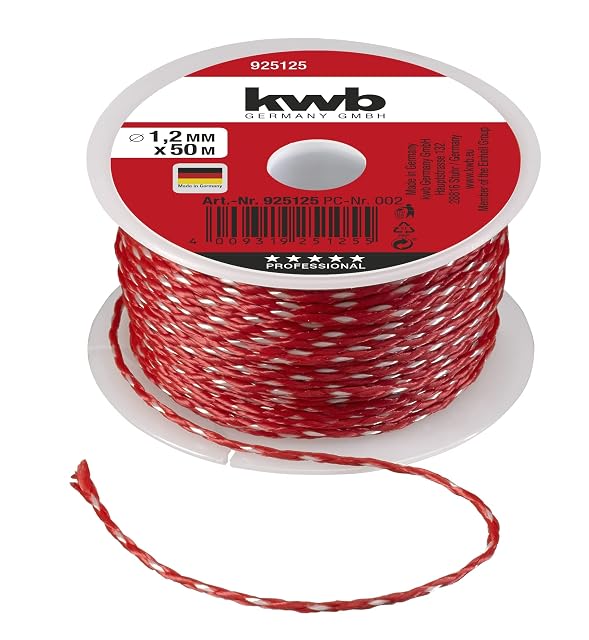
kwb Braided mason line, 50 m (164 ft) × 1.2 mm (0.05 in)
The only line here that publishes its strength: 22 decanewtons breaking, about 4.75 kg (10.5 lb) continuous — the figures that decide how hard it can be tensioned.
kwb Braided mason line, 50 m (164 ft) × 1.2 mm (0.05 in)
The only line here that publishes its strength: 22 decanewtons breaking, about 4.75 kg (10.5 lb) continuous — the figures that decide how hard it can be tensioned.
Amazon reference
B00TEAM5TG (identical on 6 markets)
EAN
4009319251253
Stated dimension or range
50 m (164 ft) × 1.2 mm (0.05 in)
Mechanism and finish
braided nylon
Stated tension
22 daN
Stated weight
~4.75 kg (10.5 lb) working load
Publishes both a breaking load (22 daN) and a continuous working load (about 4.75 kg (10.5 lb))
Braided rather than twisted, which resists the stretch that makes a line sag differently at each setting
Line only — no plumb bob
Best for: Setting out brickwork, paving and tiling, where the line is tensioned between two points and has to stay straight.
The only line in this hub whose strength is published.
What the manufacturer publishes
A building line measuring 50 m (164 ft) × 1.2 mm (0.05 in) in red, in braided nylon. Stated as ideal as a plumb line or paving line for leveling in bricklaying and terrace construction, or as a tile line. A load capacity of 22 daN and a continuous load capacity of about 4.75 kg (10.5 lb).
Why the numbers are worth having
A setting-out line does its job by being straight, and a line is straight only under tension. Under-tension it and everything you set from it follows the sag; over-tension it and it breaks at the pin, usually at the far end of a long run.
Two published figures make that judgment possible instead of a guess.
Where a line beats an instrument
Between two points a laser already established, a line holds the geometry while you work along it, without a tripod to knock and no batteries. Every trade that lays anything in a straight line still uses one.
Availability
Read on the day this page was built: $23 at the American Amazon shop.
Read from Keepa on the day this page was last revised; stock and price both move without notice.
Prices quoted in this text were read on 31 August 2026. The live price is at the top of the page.
What gets asked here
Why does line strength matter?
Because a line is only straight if it is tight, and tight means tensioned close to what it can take. Knowing the working load is what stops you either sagging the line or snapping it at the far end where you cannot see it.
Braided or twisted?
Braided line stretches less and stays round, so it lies consistently. A twisted line elongates under tension and does so differently each time, which is exactly the error a setting-out line exists to eliminate.
Why red?
Contrast against soil, sand and rubble. A white line disappears against fresh mortar and sand; red does not.
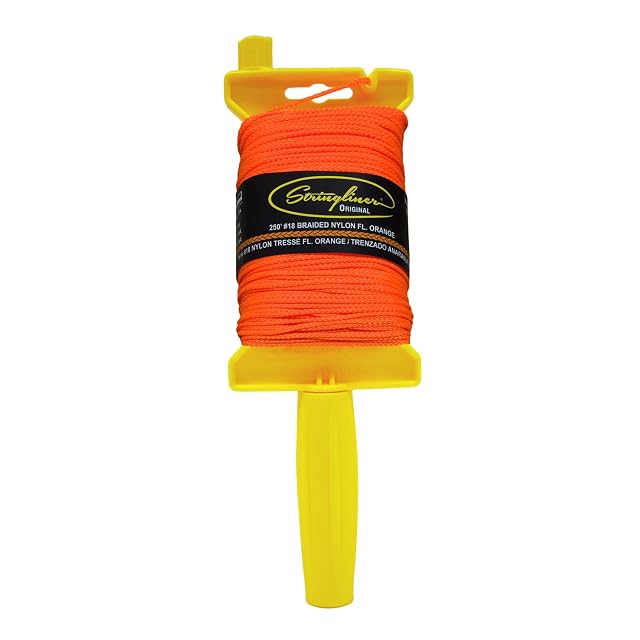
The only actual line on a shelf called mason lines and plumb bobs — braided, orange, two hundred and fifty feet.
Stated dimension or range
250 FEET per reel, three reels. Every other product on this shelf carries between 10 and 14.5 feet of cord and six of the seven are bobs — so this is the only line on the shelf in any meaningful sense, and it carries seventeen times the length of the longest bob cord here
Material
BRAIDED, stated in the title, and ORANGE. Both are the things this shelf's introduction asks for: braided line resists the stretch that makes a twisted line sag differently at each setting, and bright colors stay visible against rubble. A twisted line also unwinds under tension and rolls a brick course off true as it does
Body and fittings
A line reel handle of durable polyethylene, stated, with the line securing in a convenient notch. It is a hand reel rather than a retracting one — the notch is what stops the line unwinding in a bag, and it is the whole mechanism
Supplied
Three reels at eight dollars seventy-nine — about two dollars ninety a reel of 250 ft. Three is the right number for a trade that loses line: one on the job, one in the van, one cut short and still useful
Also stated
TWO bullet points, and that is the whole listing. No breaking strain, no diameter, no material beyond braided, and no stretch figure — this shelf's introduction compares line STRENGTH and STRETCH, and neither appears
Functions
Not published: no twine size, no number, no weight. Mason's line is normally specified by a number — a #18 or #21 — which sets its diameter and breaking strain, and this listing gives none
Amazon reference
B0F2BCLTMQ
EAN
5061094333707
250 feet, where every bob here carries ten to fifteen
Braided, which the hub intro says resists stretch
Two bullet points, and that is the whole listing
Best for: Setting out brickwork, fencing or a long datum, where a bob's ten feet of cord is nothing
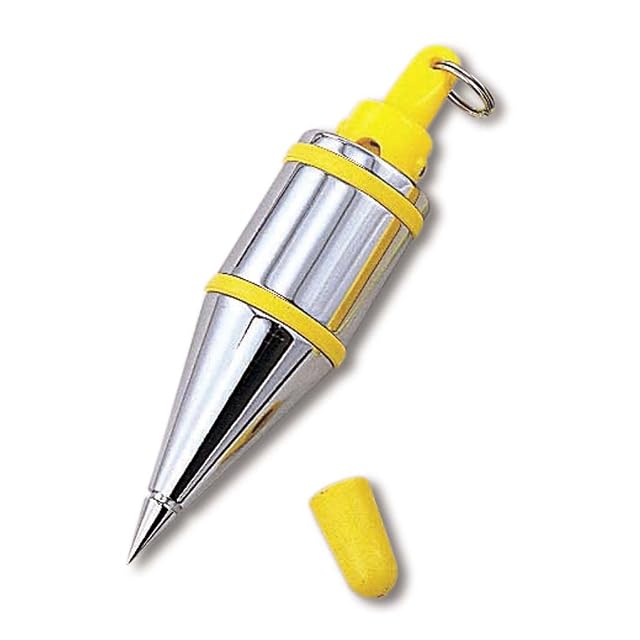
The heaviest bob here, and the only one with bumpers to stop it marking the wall it hangs against.
Stated dimension or range
21 oz / 600 g — the heaviest bob on this shelf, where the lightest is 5 oz: a factor of four. This shelf's introduction says weight sets how quickly a bob settles and how little it swings in a draft, which makes this the bob for an open site, a stairwell or a long drop
Measuring mode
Quick-stabilizing: stops wobble AND SPIN within 6 seconds, stated. The same figure as the maker's 10-ounce bob on this shelf, which is the interesting part — doubling the weight does not halve the time, because the design rather than the mass is doing the work. Spin is the half nobody else mentions: a bob that has stopped swinging can still be rotating, and a rotating bob with an off-center tip traces a circle
Body and fittings
EMBEDDED SIDE BUMPERS, stated to protect both the bob and the work surfaces. Nobody else on this shelf has them, and they solve a real problem twice: a 600 g (21.2 oz) steel bob swinging into a finished wall marks it, and the same impact chips the bob's own plating
Functions
A thick ELASTOMER TIP GUARD, stated to keep the tip safe and secure. The tip is what a bob dies of — one drop rolls the point over — and a guard is the other answer to that problem; the brass kit on this shelf answers it with four spare tips instead
Material
Chrome plated to resist rust and corrosion, stated. Chrome is harder than nickel and resists the chip that starts the rust — which matters more on a 600 g (21.2 oz) bob, because a heavier bob hits harder when it is dropped
Supplied
A snap ring as standard, to connect and disconnect from a plumb line, stated. A snap ring rather than a knot means the same bob moves between a short line and a long one in seconds. NO LINE IS SUPPLIED — this is a bob, not a kit, and the shelf carries 250 ft of braided mason's line for under nine dollars
Amazon reference
B00023S4SK
EAN
0049296054267
Twenty-one ounces: the steadiest bob on this shelf
Six seconds, and it stops SPIN as well as swing
No line supplied at all
Best for: A long drop outdoors or in a draft, where a light bob never stops swinging
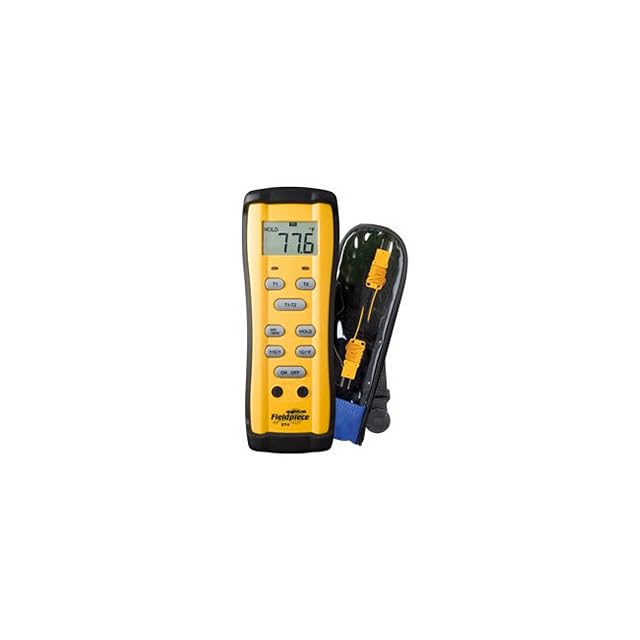
A two-channel delta-T instrument with its own beaded probes, and the only thing on this shelf you can calibrate.
Type and plug fit
TWO type K channels, with "wrap tab beaded thermocouples" included. Fieldpiece lists an optional ATWB1 wet bulb thermocouple as a further accessory. An LED indicates a DISENGAGED PROBE — a plug that has worked loose — which is the only answer on this shelf to the problem this shelf's introduction raises about plugs, approached from the instrument end rather than the probe end
Probe style
WRAP-TAB BEADED, supplied. A bead is the fast-response style this shelf's introduction assigns to air, and a wrap tab lets the same bead be strapped to a pipe or a fin. Two of them, because the instrument exists to read a difference
Stated temperature range
−58 to 2000 °F (−50 to 1300 °C), stated. That is the widest span on this shelf by a long way — 1350 Celsius degrees, against 1100 for the Nxtop probe, 480 for the Klein 69142 and 100 for the Klein 69140 clamp. It is the instrument's range; what any given reading can reach depends on the thermocouple fitted, and the supplied beads are not 1300 °C (2372 °F) parts
Stated accuracy
NOT PUBLISHED. What is published instead is more unusual: TWO FRONT-FACE CALIBRATION POTS, one per channel. This is the only instrument on this shelf that can be adjusted by its owner, which is a different proposition from a stated tolerance — it means the reading can be matched to a reference rather than trusted as supplied
Functions
Reads T1, T2 or T1−T2, with the difference "in big numbers on the LCD". Min/Max and Hold. Fieldpiece states "great temperature compensation for fast changing environments", which is the figure a two-channel meter lives or dies by and is given here as a claim rather than a number
Cable length
Not stated for the supplied thermocouples. No length is published for either of the two thermocouples it ships — the one figure of the hub’s five that this page omits
Construction and safety
A rugged rubber boot, and a clear-front case with the ANC6 magnetic hanger included. A magnetic hanger on an HVAC job is not a nicety: it puts the meter on the side of the unit at eye level while both hands are in the cabinet
Also stated
386 grams — five times the 78 g (2.8 oz) of the Nxtop, the next heaviest probe here. At $119 it is also the most expensive, and it is a different kind of purchase from the rest of the shelf: four of these five products are probes for a meter you already own, and this one is the meter
Amazon reference
B000OLCD9Q
EAN
0735090638122
Two channels and a direct T1−T2 reading
Two calibration pots — the only adjustable thing here
No accuracy figure at a hundred and nineteen dollars
Best for: Finding a temperature split across a coil, where the difference between two readings is the measurement and not either reading alone
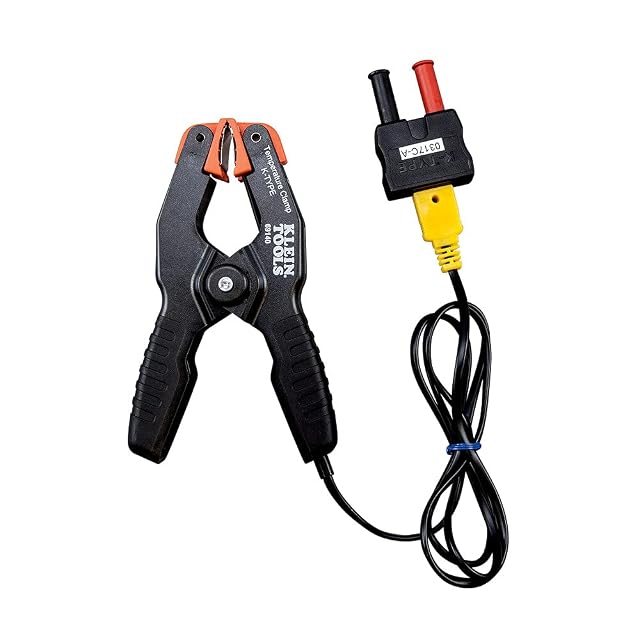
The genuine Klein pipe clamp — and the narrowest temperature range on this shelf, at the highest price of the two clamps.
Type and plug fit
Type K, stated. "Works with any digital multimeter or clamp meter that measures temperature", and Klein adds that its K-type accessories work with all Klein multimeters and clamp meters that measure temperature "as well as any other brand with meters that measure temperature". The banana plug adapter is NOT in the box: it is Cat. No. 69146, sold separately — which matters because this shelf's introduction says the plug is where fit fails
Probe style
A PIPE CLAMP, which is a fourth style this shelf's introduction does not name. It lists a bead for air, a flat pad for surfaces and a sheathed rod for immersion; a spring clamp that closes round a pipe reads the outside wall of a line you cannot immerse anything in. It is the dominant style in the American relevé for this shelf, because that is how a refrigeration circuit is diagnosed
Stated temperature range
−4 to 212 °F (−20 to 100 °C), stated. That is the NARROWEST range on this shelf: the published Taiss states −40 to 350 °C (-40 to 662 °F), the Nxtop 0 to 1100 °C (32 to 2012 °F), the Klein 69142 beside it 0 to 480 °C (32 to 896 °F), and the ZIBOO clamp that borrows this part number claims −40 to 200 °C (-40 to 392 °F). One hundred degrees Celsius is the top of it, which covers a heating flow and stops below a hot gas line
Stated accuracy
±2%, stated — and then the sentence that makes it honest: "Thermocouple accuracy is dependent on the accuracy of the meter being used." Two probes on this shelf publish a figure at all — this clamp and the ZIBOO — and both add that caveat. It is the right way to put it: a thermocouple generates a voltage, and what turns that voltage into a number is the instrument
Cable length
40 inches, 102 cm, flexible. The ZIBOO clamp states 39.78 inches for the same 102 cm (40.2 in), which is the same lead described to two decimal places. The published Taiss five-pack gives 3 m (10 ft), three times either clamp
Clamp capacity
Pipes from 1/4 to 1-3/8 inch diameter. The ZIBOO clamp claims 1/4 to 1 1/2 inch — an eighth of an inch more. Both listings then add "up to 35 cm (13.8 in)", which is not a pipe diameter at all and appears on both pages
Heat resistance
Not stated separately from the measuring range. Klein positions this as the accessory that "extend[s] working temperature ranges for Klein's HVAC Digital Multimeters and Clamp Meters", and names the rest of the family: high temperature thermocouple wire, temperature probe and banana plug adapter
Amazon reference
B07B2PPBRB
EAN
0092644690679
Type K, so it reads correctly on any type K meter
A clamp, which is what a pipe actually needs
A hundred degrees Celsius is the narrowest ceiling here
Best for: HVAC pipe temperatures on small-bore copper, read through a Klein or any other meter with a temperature function
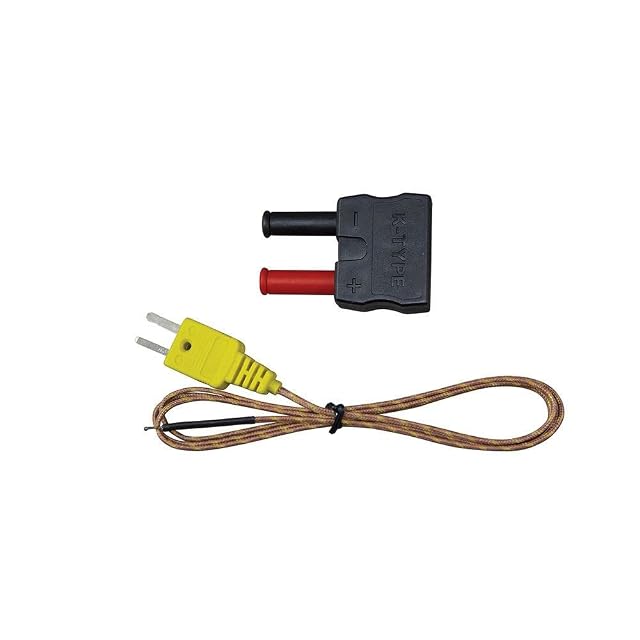
Klein's high-temperature thermocouple — 480 °C (896 °F), a coiled lead, and no stated accuracy or probe style.
Type and plug fit
Type K, stated, and the ADAPTER IS INCLUDED — "with Adapter" is in the product title. That puts it with the ZIBOO clamp and against the Klein 69140, where the adapter is a separate part number. "Works with any digital multimeter or clamp meter that measures temperature"
Stated temperature range
32 to 896 °F (0 to 480 °C), stated. Nearly FIVE TIMES the ceiling of Klein's own 69140 pipe clamp, which stops at 100 °C (212 °F) — and Klein says so directly: these accessories "extend working temperature ranges for Klein's HVAC Digital Multimeters and Clamp Meters". It does not go below freezing, which the two pipe clamps on this shelf both do
Probe style
NOT STATED. This shelf's introduction makes probe style the thing you choose by the job — a bead for air, a flat pad for surfaces, a sheathed rod for immersion — and this listing says only "High Temperature Thermocouple". There is no bead, no pad, no sheath and no tip dimension anywhere on the page, which is the one specification a buyer needs to know whether it will sit on a flue or in it
Stated accuracy
NOT PUBLISHED. The listing gives only the caveat without the figure: "Accuracy of the thermocouple is dependent on the accuracy of the meter being used." Both pipe clamps on this shelf state ±2% alongside that sentence; this one states the sentence alone, at the highest price of the three Klein parts
Cable length
A COILED lead, 3 feet — the only coiled lead on this shelf, and shorter than either pipe clamp’s meter. Coiled matters on a hot job: a straight lead draped across a flue collects heat along its length, while a coil keeps the cable off the work and pulls back out of the way
Heat resistance
Implied by the 480 °C (896 °F) measuring range and not stated separately for the lead. Klein lists "High Temperature Thermocouple Wire" as a DIFFERENT accessory in the same family, which suggests the wire on this part is not itself the high-temperature item
Also stated
11 grams, the lightest probe weight published on this shelf. Klein names the rest of the K-type family on this page — temperature pipe clamp, temperature probe, high temperature thermocouple wire and banana plug adapter — which is the clearest accessory map any maker on this shelf publishes
Amazon reference
B07B2TW23J
EAN
0092644690686
Four hundred and eighty degrees, five times Klein's own clamp
The adapter is in the box
No accuracy figure at all, at thirty dollars
Best for: Flue gases, hot gas lines and anything above the 100 °C (212 °F) ceiling of Klein's own pipe clamp