Skip to content

Fieldpiece Dual type K thermometer, T1, T2 and T1−T2

A two-channel delta-T instrument with its own beaded probes, and the only thing on this shelf you can calibrate.

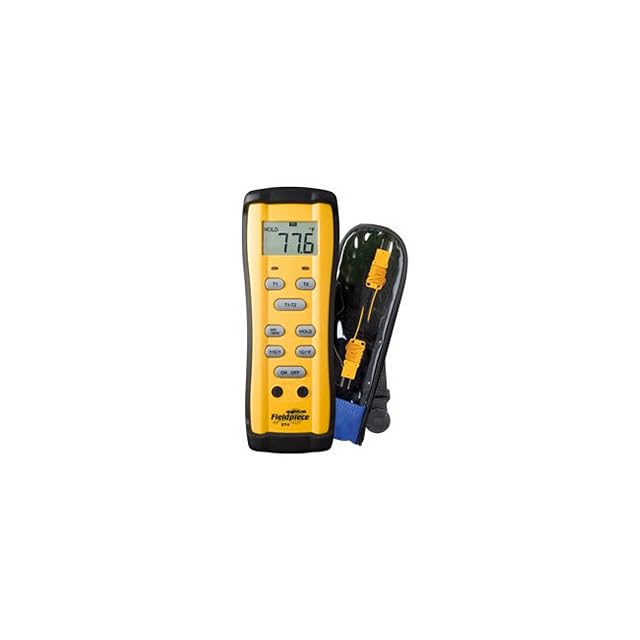
Fieldpiece ST4 dual temperature meter with rubber boot and two thermocouples

Fieldpiece Dual type K thermometer, T1, T2 and T1−T2

A two-channel delta-T instrument with its own beaded probes, and the only thing on this shelf you can calibrate.

Type and plug fit
TWO type K channels, with "wrap tab beaded thermocouples" included. Fieldpiece lists an optional ATWB1 wet bulb thermocouple as a further accessory. An LED indicates a DISENGAGED PROBE — a plug that has worked loose — which is the only answer on this shelf to the problem this shelf's introduction raises about plugs, approached from the instrument end rather than the probe end
Probe style
WRAP-TAB BEADED, supplied. A bead is the fast-response style this shelf's introduction assigns to air, and a wrap tab lets the same bead be strapped to a pipe or a fin. Two of them, because the instrument exists to read a difference
Stated temperature range
−58 to 2000 °F (−50 to 1300 °C), stated. That is the widest span on this shelf by a long way — 1350 Celsius degrees, against 1100 for the Nxtop probe, 480 for the Klein 69142 and 100 for the Klein 69140 clamp. It is the instrument's range; what any given reading can reach depends on the thermocouple fitted, and the supplied beads are not 1300 °C (2372 °F) parts
Stated accuracy
NOT PUBLISHED. What is published instead is more unusual: TWO FRONT-FACE CALIBRATION POTS, one per channel. This is the only instrument on this shelf that can be adjusted by its owner, which is a different proposition from a stated tolerance — it means the reading can be matched to a reference rather than trusted as supplied
Functions
Reads T1, T2 or T1−T2, with the difference "in big numbers on the LCD". Min/Max and Hold. Fieldpiece states "great temperature compensation for fast changing environments", which is the figure a two-channel meter lives or dies by and is given here as a claim rather than a number
Cable length
Not stated for the supplied thermocouples. No length is published for either of the two thermocouples it ships — the one figure of the hub’s five that this page omits
Construction and safety
A rugged rubber boot, and a clear-front case with the ANC6 magnetic hanger included. A magnetic hanger on an HVAC job is not a nicety: it puts the meter on the side of the unit at eye level while both hands are in the cabinet
Also stated
386 grams — five times the 78 g (2.8 oz) of the Nxtop, the next heaviest probe here. At $119 it is also the most expensive, and it is a different kind of purchase from the rest of the shelf: four of these five products are probes for a meter you already own, and this one is the meter
Amazon reference
B000OLCD9Q
EAN
0735090638122
  • Two channels and a direct T1−T2 reading
  • Two calibration pots — the only adjustable thing here
  • No accuracy figure at a hundred and nineteen dollars

Best for: Finding a temperature split across a coil, where the difference between two readings is the measurement and not either reading alone

≈ $119
Check price on Amazon
Specifications

Type and plug fit
TWO type K channels, with "wrap tab beaded thermocouples" included. Fieldpiece lists an optional ATWB1 wet bulb thermocouple as a further accessory. An LED indicates a DISENGAGED PROBE — a plug that has worked loose — which is the only answer on this shelf to the problem this shelf's introduction raises about plugs, approached from the instrument end rather than the probe end
Probe style
WRAP-TAB BEADED, supplied. A bead is the fast-response style this shelf's introduction assigns to air, and a wrap tab lets the same bead be strapped to a pipe or a fin. Two of them, because the instrument exists to read a difference
Stated temperature range
−58 to 2000 °F (−50 to 1300 °C), stated. That is the widest span on this shelf by a long way — 1350 Celsius degrees, against 1100 for the Nxtop probe, 480 for the Klein 69142 and 100 for the Klein 69140 clamp. It is the instrument's range; what any given reading can reach depends on the thermocouple fitted, and the supplied beads are not 1300 °C (2372 °F) parts
Stated accuracy
NOT PUBLISHED. What is published instead is more unusual: TWO FRONT-FACE CALIBRATION POTS, one per channel. This is the only instrument on this shelf that can be adjusted by its owner, which is a different proposition from a stated tolerance — it means the reading can be matched to a reference rather than trusted as supplied
Functions
Reads T1, T2 or T1−T2, with the difference "in big numbers on the LCD". Min/Max and Hold. Fieldpiece states "great temperature compensation for fast changing environments", which is the figure a two-channel meter lives or dies by and is given here as a claim rather than a number
Cable length
Not stated for the supplied thermocouples. No length is published for either of the two thermocouples it ships — the one figure of the hub’s five that this page omits
Construction and safety
A rugged rubber boot, and a clear-front case with the ANC6 magnetic hanger included. A magnetic hanger on an HVAC job is not a nicety: it puts the meter on the side of the unit at eye level while both hands are in the cabinet
Also stated
386 grams — five times the 78 g (2.8 oz) of the Nxtop, the next heaviest probe here. At $119 it is also the most expensive, and it is a different kind of purchase from the rest of the shelf: four of these five products are probes for a meter you already own, and this one is the meter
Amazon reference
B000OLCD9Q
EAN
0735090638122

What the maker puts in writing

  • “Dual Temperature Meter, -58 to 2000F(-50 to 1300C)”
  • “measures two temperatures simultaneously using the included K-Type, wrap tab beaded thermocouples”
  • “Read T1, T2, or T1-T2” · displayed “in big numbers on the LCD screen”
  • “Features two front face calibration pots”
  • “LED indicates disengaged probe”
  • “Great temperature compensation for fast changing environments”
  • “clear front case with Magnetic hanger model ANC6” · rubber boot · 386 g (13.6 oz) · $119

NO accuracy figure. NO lead length. The compensation claim carries no number.

It exists to read a difference

Which is why two channels matter more than either channel.

A split taken one probe at a time is two measurements separated by however long it took you to move the probe.

In that gap a compressor cycles and a fan stages up, and the difference you calculate is one that never existed.

T1 and T2 read at the same instant, and T1−T2 on the display.

The subtraction also cancels whatever offset the two channels share — which is why a delta read this way is better than either absolute figure.

The only thing on this shelf you can calibrate

Two front-face pots, one per channel.

Nothing else here can be adjusted at all: a probe has a tolerance or it has nothing.

The real use is not making the absolute numbers right. It is matching the two channels to EACH OTHER, which an ice bath does for both at once, and which is exactly what a delta-T instrument needs most.

An LED for a loose plug

Approached from the instrument end, this is the shelf’s own opening problem.

“The miniature flat plug that connects it is where fit fails.”

Four products on this shelf answer that with an adapter, a connector spacing, or nothing.

This one watches for it and lights up.

Two thousand Fahrenheit is the meter’s number

Not the beads’.

The listing states the instrument’s range and separately describes the included wrap-tab beaded thermocouples, which are HVAC parts with plastic-insulated leads.

Reaching 1300 °C (2372 °F) means fitting a thermocouple built for it — the sheathed 1100 °C (2012 °F) rod on this shelf, for instance — and checking the plug fits.

Read the top of the range as what the electronics will display.

And the thing it never quantifies

“Great temperature compensation for fast changing environments.”

Cold-junction compensation is the whole art of a thermocouple instrument: the reading is a voltage difference between the hot junction and the meter’s own terminals, so when the meter itself warms up or cools down the figure moves.

A two-channel meter in a plant room gets exactly that treatment.

It is the number this instrument should publish, and it is a claim instead.

Availability

On sale at around 119 € on the American Amazon store at the time of checking.

Prices and availability are what Keepa reported on the date this page was updated; both move.

Prices quoted in this text were read on 8 October 2026. The live price is at the top of the page.

What gets asked here

Why buy a two-channel meter instead of two readings with one probe?

Because a temperature split taken one probe at a time is two measurements separated by however long it took you to move. On a coil, a duct or a heat exchanger the conditions drift in that gap — a compressor cycles, a fan stages up — and the difference you calculate is not a difference that ever existed. Two channels read simultaneously and the instrument shows T1−T2 directly. It also cancels most of the error: whatever offset both channels share disappears from the subtraction, which is why a delta read this way is better than either absolute figure.

What do the calibration pots do, and should I touch them?

They let you adjust each channel so its reading matches a reference — an ice bath at 0 °C (32 °F), boiling water at your altitude, or a calibrated instrument. Nothing else on this shelf can be adjusted at all. Whether to touch them depends on having something to adjust against: turning a pot to make a number look right is worse than leaving it alone. The genuine use is matching the two channels to EACH OTHER, which is what a delta-T instrument needs most and which an ice bath will do for both at once.

Does it really read to 2000 °F?

The instrument does. The supplied beaded thermocouples do not, and the listing does not claim they do — it states the meter's range and separately describes the included probes. A beaded wrap-tab thermocouple with plastic-insulated leads is an HVAC part, good for a few hundred degrees. Reaching 1300 °C (2372 °F) means fitting a thermocouple built for it, such as the sheathed 1100 °C (2012 °F) rod elsewhere on this shelf, and checking the plug fits. Read the top of this range as what the electronics will display, not as what arrives in the box.

All temperature probes