Test leads and probes
Eiranoly Silicone lead pair, CAT II 1000 V, 103 cm (40.6 in)
The cheapest set on this shelf, the only one that publishes a temperature range — and the only CAT II leads with a 1000 V figure beside it.
Specifications
- Stated rating
- CAT II 1000 V, 20 A, stated. That is the point to read carefully, because the buying tip on the multimeter shelf of this site puts it exactly: the category and the voltage are one specification, not two, and the higher-looking number is not the safer tool. CAT II 1000 V is a LOWER category than the CAT III 1000 V of the PUKAIBUL at $9.99 and the CAT III 1000 V / CAT IV 600 V of the three Klein sets — and fitting these to a CAT III meter gives you, per this shelf's introduction, a CAT II pairing
- Insulation
- DOUBLE-INSULATED SILICONE, with the only OPERATING TEMPERATURE RANGE published anywhere on this shelf: −58 °F to +392 °F, −50 °C to +200 °C (392 °F). This shelf's introduction compares silicone against PVC for cold flexibility and no other listing here puts a number on it — the Fluke says "remain flexible in cold temperatures" without one
- Length
- 40.5 inches, 103 cm, stated. Mid-length for this shelf: shorter than the PUKAIBUL's 125 cm (49.2 in) and the published PeakTech's 120 cm (47.2 in), a centimeter under the Klein 69410's 104 cm (40.9 in), longer than the 91 cm (35.8 in) of the two other Klein sets
- Plugs and tips
- Gold-plated ULTRA-SHARP probes, stated to pierce wire insulation or reach a solder joint on a dense board, and "a universal 4.2mm (0.17 in)(0.16inch) banana plug". Two figures that do not agree: 0.16 inch is 4.06 mm (0.16 in), and the standard every other listing on this shelf names is 4 mm (0.16 in). A plug genuinely 4.2 mm (0.17 in) across would be a tight fit in a 4 mm (0.16 in) socket; the likeliest reading is that this is a standard 4 mm (0.16 in) plug described loosely
- Supplied
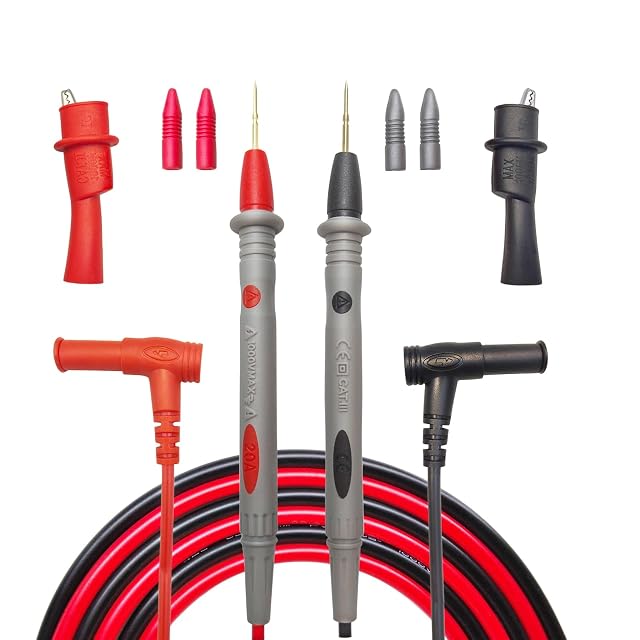
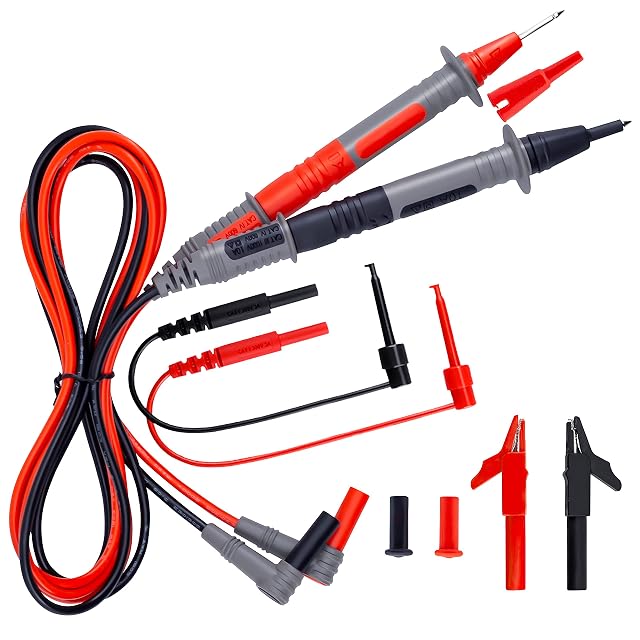
- One red lead, one black lead, one red clip, one black clip and FOUR probe safety covers — two more than needed, and the listing explains why: "customers have reported that they are easily lost, so we've included 2 extra probe covers". That is the only listing on this shelf that changed its contents because of what buyers said. 77 grams, the lightest set on this shelf
- Also stated
- Compatible with "almost all mainstream brands of multimeters and clamp meters such as Fluke, AstroAI, INNOVA, Klein Tools". Stated to be tangle-resistant and stretch-resistant. At $6.79 it is the cheapest item on this shelf
- Amazon reference
- B0FC9K5VTY
- EAN
- 0607601283025
What the maker puts in writing
- “Complies with CAT II 1000V, 20A safety standards”
- “uses a universal 4.2mm (0.17 in)(0.16inch) banana plug, perfectly compatible with almost all mainstream brands of multimeters and clamp meters such as Fluke, AstroAI, INNOVA, Klein Tools” — AstroAI and Klein Tools both have digital multimeters on this site
- “Made of high-quality double-insulated silicone, the cable is 40.5 inches (103 cm) long and maintains extraordinary flexibility even in extreme temperatures (operating temperature range is -58℉/-50℃ to +392℉/+200℃)”
- “hard and highly conductive gold-plated ultra-sharp probes”
- “4x probe safety covers (customers have reported that they are easily lost, so we’ve included 2 extra probe covers)”
- 77 g (2.7 oz) · $6.79
The only temperature range on this shelf
Minus fifty to plus two hundred Celsius.
Nobody else publishes one. The Fluke says its leads “remain flexible in cold
temperatures” and stops.
The figure matters at one end. Leads that live in a van in winter are coiled and
uncoiled well below freezing, which is where PVC cracks at the plug and a cheap
compound goes rigid.
A stated minus fifty is a real answer to what this shelf’s introduction raises.
And then the category, which needs reading twice
CAT II 1000 V.
Not CAT III 1000 V, which is the PUKAIBUL on this shelf at $9.99. Not CAT III
1000 V / CAT IV 600 V, which is all three Klein sets.
CAT II is socket-outlet level. CAT III is the fixed installation. CAT IV is the
origin of the supply.
The voltage is a separate limit, and the big number next to the low category is
how this gets misread.
“The manufacturer’s rating for the pair is the lower of the two.”
Fit these to a CAT III meter and you have a CAT II pairing.
Four millimeters, or four point two
“A universal 4.2mm (0.17 in)(0.16inch) banana plug.”
Nought point one six of an inch is 4.06 mm (0.16 in). The standard every other listing here
names is 4 mm (0.16 in).
Two of the three figures on the page point at an ordinary 4 mm (0.16 in) plug, and the third
would not fit one.
Loose wording, almost certainly. Nothing on the page says so.
Four caps, because two get lost
“Customers have reported that they are easily lost, so we’ve included 2 extra
probe covers to prevent loss.”
That is the only listing on this shelf whose contents changed because of what
buyers said.
Two leads, two clips, four caps, seventy-seven grams, six dollars seventy-nine.
The cheapest thing on this shelf, and the lightest.
Availability
On sale at around 7 € on the American Amazon store at the time of checking.
Prices and availability are what Keepa reported on the date this page was updated; both move.
Prices quoted in this text were read on 8 October 2026. The live price is at the top of the page.
What gets asked here
Is CAT II 1000 V better or worse than CAT III 600 V?
Worse, for most electrical work, and this is the confusion the buying tip on the multimeter shelf of this site exists to clear up. The category describes WHERE in an installation the tool is safe: CAT II is appliance and socket-outlet level, CAT III is the fixed installation and distribution level, CAT IV is the origin of the supply. The voltage is a second, separate limit. A CAT III 600 V instrument is built to survive a far bigger transient than a CAT II 1000 V one, because the energy available at a distribution board dwarfs the energy at a socket. For a consumer unit, buy CAT III. These are CAT II.
Does a 4.2 mm (0.17 in) plug fit a 4 mm (0.16 in) socket?
The number as printed would not, which is why it is almost certainly loose wording rather than a measurement. A 4 mm (0.16 in) banana plug is an international standard and the listing also gives 0.16 inch, which is 4.06 mm (0.16 in), and says the plug is "universal" and fits Fluke, AstroAI, INNOVA and Klein meters. Two of the three figures on the page point at a standard 4 mm (0.16 in) plug. If it genuinely mattered — a very tight socket, or a meter you cannot afford to damage — ask the seller, because nothing on the page resolves it.
What does the published temperature range actually tell me?
That somebody measured the cable rather than describing it. Minus fifty to plus two hundred Celsius is the span over which the silicone stays serviceable, and it is the only such figure on this shelf — the Fluke says its leads "remain flexible in cold temperatures" and leaves it there. In practice the number matters at one end: leads that live in a van in winter are being asked to coil and uncoil at well below freezing, which is where PVC cracks at the plug and cheap compounds go rigid. A stated minus fifty is a real answer to the thing this shelf's introduction raises.