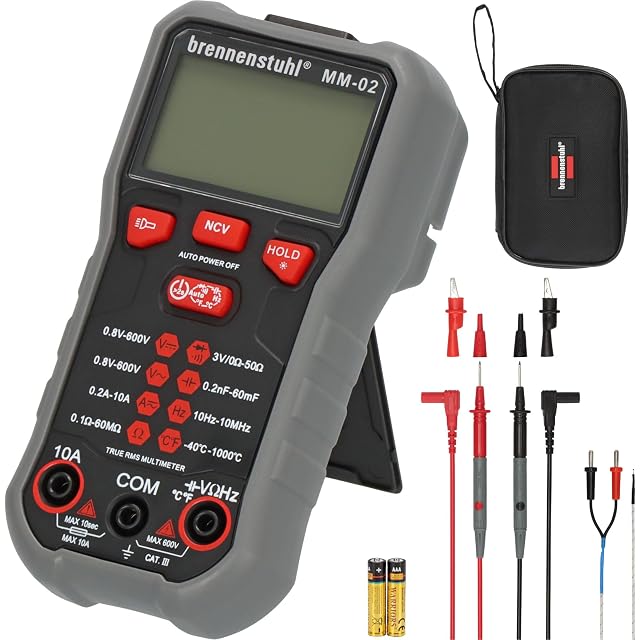
What the figures leave us with The best specified meter on this shelf and the one worth the money if you measure AC current: true-RMS, auto-ranging, 10 A in both polarities, 50 MΩ, temperature with the probe in the box, and a two-meter drop rating in a pocket body. The omission is conspicuous for a $74.50 instrument — the only CAT rating on the page belongs to the caps on its test leads, not to the meter, and nothing is published about its input fuses.
What the maker puts in writing
“Auto-ranging and True Root Mean Squared (TRMS) technology”
“Measures AC/DC voltage up to 600V, 10A AC/DC current, 50MΩ resistance”
“continuity, temperature, capacitance, frequency/duty cycle and diode test”
“Large, high-visibility reverse-contrast LCD” with an optical sensor for ambient light
“Built to withstand a 6.6-Foot (2 m (7 ft)) drop”
“Includes carrying case, test leads with CAT III/CAT IV safety caps, thermocouple, instructions, and 2 x AAA batteries”
$74.50
NO measurement category for the meter. NO count. NOTHING about its fuses.
The CAT rating on this page is for the caps
Read the accessories line again.
“Test leads with CAT III/CAT IV safety caps.”
That is a rating for the plastic caps on the probe tips, which limit how much
metal is exposed so a probe cannot bridge two live conductors.
It says nothing about the transient energy the INSTRUMENT survives.
The hub’s tag line: “The CAT rating is a safety specification, not a quality
grade.”
Here a safety specification for an accessory stands where the instrument’s own
should be — on the most expensive meter on this shelf.
What it does that the MM325 cannot
Four things, and they are the four that decide whether a meter is a mains tool.
Alternating current. Ten amps AC as well as DC. The MM325 is DC only, the
KAIWEETS writes “Can not for AC current”, the Actron reads DC current.
True RMS. An averaging meter assumes a sine wave and reads a dimmer or a
variable-speed drive low. This one computes the heating value.
Fifty megohms, against two on the MM325 and twenty on the published coczow —
the highest ceiling on this shelf.
Temperature, capacitance, frequency and duty cycle. Duty cycle is published by
nothing else here.
The thermocouple is in the box
Which sounds minor and is not.
A temperature function with no probe supplied is a function you cannot use on the
day it arrives, and a thermocouple bought separately costs a tenth of the meter
and a week of waiting.
A two-meter drop rating
The only one on this shelf.
Six point six feet, stated, on a body slim enough for a shirt pocket.
And still no count, and nothing about the fuses
This shelf’s introduction compares five things: stated category and voltage,
true-RMS, counts, auto-ranging, and input protection.
This page answers three of the five.
The count is absent — the two meters on this shelf that publish one both state
6,000.
And input protection is absent on a site that sells a shelf of multimeter fuses.
Availability
On sale at around 75 € on the American Amazon store at the time of checking.
Prices and availability are what Keepa reported on the date this page was updated; both move.
Prices quoted in this text were read on 8 October 2026. The live price is at the top of the page.
What it has, and what it lacks
Strengths
True RMS with auto-ranging, and 10 A in both polarities
Ten amps in alternating current as well as direct
Fifty megohms, the highest ceiling on this shelf
Temperature with the thermocouple in the box
Frequency and duty cycle, published by nothing else here
A two-meter drop rating and a pocket body
Compromises
The only CAT rating on the page is for the lead CAPS
No category published for the meter itself, at $74.50
No count, so the resolution is unstated
Nothing published about its input fuses
Six hundred volts, the same ceiling as the thirty-dollar MM325
Two and a half times the MM325 for the same voltage
Specifications
Measurement category
NOT PUBLISHED FOR THE METER. The only category on this page is in the accessories line: "test leads with CAT III/CAT IV safety caps". That is a safety specification for the CAPS on the leads, not for the instrument. This shelf's introduction calls the category the specification to read first, and at $74.50 this is the most expensive meter on this shelf and the one whose own category is absent
Voltage measurement
AC and DC up to 600 V, stated — the same ceiling as every other meter on this shelf that publishes one
Current measurement
10 A AC AND DC, stated. It reads alternating current, which the three meters beside it cannot: the MM325 is 10 A DC, the KAIWEETS states "Can not for AC current", the Actron reads DC current only. Combined with true-RMS, that is what makes this the one of the four you can point at a motor circuit
True-RMS
TRUE ROOT MEAN SQUARED, stated, with auto-ranging. This shelf's introduction explains what that buys: a true-RMS meter reads distorted waveforms correctly where an averaging meter does not — which is most of a modern building, because switch-mode supplies, dimmers and variable-speed drives all distort the sine wave. It is the third true-RMS meter on this shelf, after the Brennenstuhl MM-02 and the published KAIWEETS B07SHLS639
Functions
Resistance to 50 MΩ, continuity, TEMPERATURE with a supplied thermocouple, capacitance, frequency and duty cycle, diode test. Fifty megohms is the highest resistance ceiling published on this shelf — against 20 MΩ on the coczow and 2 MΩ on the MM325 beside it. Duty cycle is a function nothing else here publishes
Display count
NOT PUBLISHED. No count is given, on a meter that is otherwise the best specified of the four. This shelf's introduction lists the count among the five things compared, and the two fiches on this shelf that publish one both state 6,000
Fuse
NOT PUBLISHED. Nothing says whether the 10 A inputs are fused, which this shelf's introduction names among the five comparison points. The listing describes the CAPS on the leads in safety terms and the inputs not at all
Construction and safety
A REVERSE-CONTRAST LCD with an optical sensor that adjusts for dark or bright ambient light, LEAD-ALERT LEDs for correct lead placement as on the MM325, a 6.6-foot (2 m (7 ft)) drop rating, and a slim pocket body. No other multimeter on this shelf publishes a drop rating at all, and the only comparable figure anywhere on the site is the 1.5 m (5 ft) rating of the Bosch Professional distance meter, which is not a meter
Supplied
A carrying case, test leads with CAT III/CAT IV safety caps, a thermocouple and two AAA batteries. The thermocouple matters: a temperature function with no probe in the box is a function you cannot use on the day it arrives
Amazon reference
B0B6WW5ZX8
EAN
0092644693755
Where this one lands in its group
At $75, it is the 7 cheapest of the 7 models in this category published here.
Cheapest in the group$11
Median$25
Dearest in the group$75
What gets asked here
Does CAT III/CAT IV on the leads mean the meter is CAT III/CAT IV?
No. Read the sentence again: "test leads with CAT III/CAT IV safety caps". That is a rating for the caps on the probe tips, which limit the exposed metal so a probe cannot bridge two live conductors. It says nothing about the transient energy the instrument survives. The hub's tag line is that the CAT rating is a safety specification rather than a quality grade, and here a safety specification for an accessory stands where the instrument's own should be. On a $74.50 meter (244.4 ft) sold for facilities and light-industrial work, that is the question to put to the seller before the first job.
What does true-RMS actually change?
It changes what the number means on anything that is not a clean sine wave. An averaging meter assumes a sine, measures the average and multiplies by a fixed factor; feed it the chopped waveform of a dimmer, a variable-speed drive or a switch-mode supply and the figure comes out low — sometimes by tens of per cent. A true-RMS meter computes the heating value directly and reads it correctly. In a modern building most loads distort the wave, which is why this is the one of these four you can trust on a motor circuit, and why the other three are bench and automotive meters.
Why pay this when the MM325 reads the same 600 volts?
For four things the MM325 does not do: alternating current, true-RMS, 50 MΩ instead of 2 MΩ, and temperature, capacitance, frequency and duty cycle. Also a 2 m (7 ft) drop rating and a pocket shape. If you measure DC and continuity on known circuits, the MM325 at $29.98 does that and adds the same lead-alert LEDs. If you measure AC current on anything with electronics in it, the MM325 cannot do the job at all and the price gap stops being a price gap.
Against the measuring instruments in the same bracket
Same category, nearby prices, between measuring instruments. What remains is the specifications every one publishes — half empty, a column is no use.
Model
Price
Functions
Klein Tools True-RMS slim multimeter, auto-ranging
$75
Resistance to 50 MΩ, continuity, TEMPERATURE with a supplied thermocouple, capacitance, frequency and duty cycle, diode test. Fifty megohms is the highest resistance ceiling published on this shelf — against 20 MΩ on the coczow and 2 MΩ on the MM325 beside it. Duty cycle is a function nothing else here publishes
Resistance to 2 MΩ, continuity, diode test and a BATTERY TEST mode. Two megohms is the lowest resistance ceiling published anywhere on this shelf — the MM450 states 50 MΩ and the published coczow 20 MΩ. For continuity and for checking a winding that is plenty; for leakage across an insulator it is not
Amazon reports what buyers took in the month before this page was last checked: at least 200.
The figure is a floor, rounded by Amazon, and read through Keepa — it says what buyers picked, not what a maker claims.
Sources
Specifications: the manufacturer sheet for measuring instruments and the matching Amazon product page. Prices and availability: Keepa. Every figure on this page names its source.
19 RANGES, the only range count published on this shelf · 10 MΩ input impedance, stated for automotive computer circuits · automatic POLARITY sensing · automatic zero on volts, amps and battery tests · battery tests at 1.5, 9 and 12 V · the ONLY meter on this shelf sold WITHOUT its battery · NO measurement category
An automotive meter built around the one specification car electronics actually need — a 10 MΩ input impedance.
Best for: Car and bench electrical diagnosis, where the circuits are 12 V and the sensors must not be loaded by the meter
AC/DC voltage · DC current · resistance · diode · double ceramic fuse
A compact meter whose distinguishing specification is its protection: a double ceramic fuse stated as flame-retardant, plus a silicone sleeve, at fourteen euros.
Best for: A first multimeter for household and hobby electronics, chosen for its fusing rather than its features.
True RMS · 6000 counts · 600 V · temperature, capacitance and frequency
A true-RMS meter with 6000-count resolution and a wide function list — voltage, current, resistance, temperature, diode, continuity, capacitance and frequency — with probe caps included.
Best for: Household and light installation work where waveforms are not clean and the reading has to be right.