The oldest instrument in this catalog, and the only one that cannot be wrong.
What the manufacturer publishes
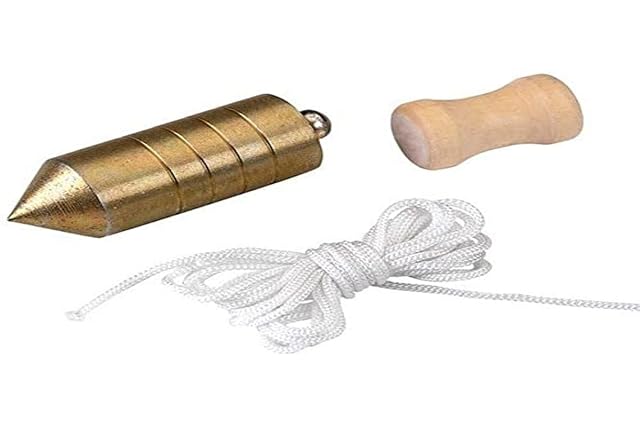
A plumb bob of 500 g (17.6 oz) in walnut and zinc-plated steel, with 5 m (16 ft) of nylon rope. Packaging dimensions of 4 × 8 × 25.5 cm (1.6 × 3.1 × 10 in) and a packed weight of 560 g (19.8 oz).
Gravity needs no calibration
Every other instrument here has an adjustment that can drift: a vial that shifts in its seat, a pendulum that sticks, a sensor that ages. A plumb bob reports vertical by hanging, and there is nothing in it to go out of true.
That is why it survives alongside self-leveling lasers, and why it is still the check when a laser plumb point and a spirit level disagree.
The technique
Hang it, let it stop by itself, and read it. Do not steady it with a hand. Over a long drop, shelter it from drafts or damp the point in water — both are older than any tool on this site and both still work.
Availability
Catalogued and unsold: the American Amazon shop lists the reference with nobody behind it.
Read from Keepa on the day this page was last revised; stock and price both move without notice.
What gets asked here
Why does weight matter on a plumb bob?
A heavy bob has more inertia relative to the air moving around it, so it settles faster and swings less in a draft. On a stairwell or an open frame, that is the difference between a usable vertical and waiting.
How should the bob be stopped?
Let it stop on its own, or damp it by dipping the point in a container of water. A bob touched to stop it is a bob you have just pushed off vertical.
Is a plumb bob still relevant with lasers?
Yes — over long drops, in stairwells, where there is no power, and as the check on a laser plumb point. It is the only instrument on this site that cannot go out of adjustment.
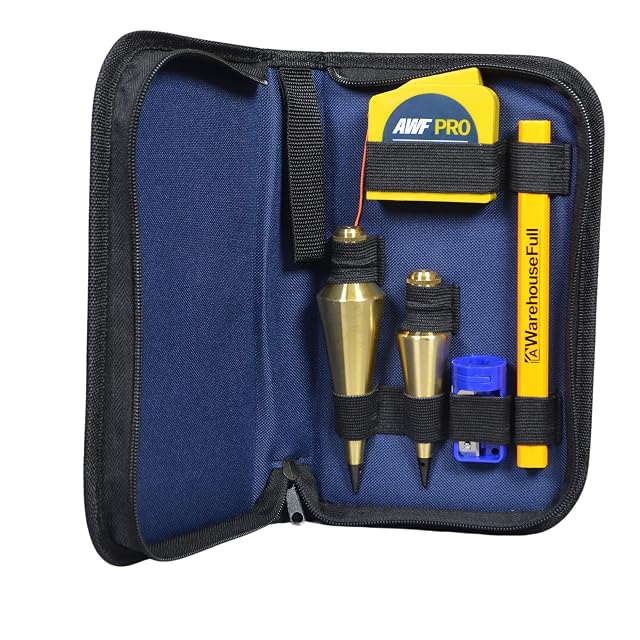
The only bobs here with spare points — which is the part of a plumb bob that actually wears out.
Supplied
An 8 oz bob, a 16 oz bob, a retractable line reel, two pencils, a pencil sharpener and a blue zipped carry case — stated. Two weights in one kit is unique on this shelf: a light bob settles slower but reaches further up a wall before it fouls, and a heavy one holds still in a draft
Material
SOLID BRASS, stated, precision made. It is the only brass on this shelf — the rest are steel, plated or chromed — and brass matters for a specific reason: it is denser than steel, so a brass bob of the same weight is smaller and swings in less air, and it does not rust at all rather than resisting rust
Functions
FOUR replaceable steel tips — two per bob, one of them hidden in the cap — with caps and tips interchangeable between the two sizes. Nobody else on this shelf sells a spare tip of any kind, and the tip is the part that goes: a point dropped onto concrete rolls over, and a rolled point puts the bob off center
Body and fittings
A reel with approximately 14 feet of bright orange BRAIDED nylon cord, RARE-EARTH magnets to attach it to steel or iron, and a fold-out bracket to hang it on a nail, screw or tack. A locking lever holds the cord; press again and the line self-retracts
Scale
The cord attaches by removing a screw-in cap, threading the cord through the center opening and knotting it — stated. Center threading is what keeps a bob hanging true, and a screw cap is what lets a worn cord be replaced rather than retied around a hook
Also stated
A specialty sharpener designed for cutting CARPENTER pencils, which is a different cone from a round pencil and is the reason an ordinary sharpener destroys a flat pencil. No settling time and no bob dimensions are published
Amazon reference
B074SW83JH
EAN
0855493007698
Four replaceable steel tips, unique on this shelf
Solid brass: denser than steel and it cannot rust
Fifty dollars, the most expensive thing on this shelf
Best for: Owning one kit for years, where a blunted point would otherwise end the tool
The only plumb bob on this shelf measured against a published specification — and the cheapest bob on it.
Also stated
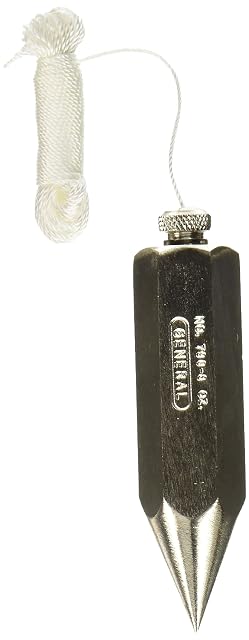
Conforms to government specification GGG-P-501e, stated — the US federal specification for plumb bobs, which fixes the form, the weight tolerance and the finish. It is the ONLY standard cited anywhere on this shelf and the only one in the American chantier for this site: every other bob here is sold on its material and its weight, with nothing against which either is checked
Stated dimension or range
8 oz, 4 inches long and 7/8 inches wide — the only bob DIMENSIONS published on this shelf. Length and width matter on a bob: a long thin bob hangs closer to a wall before it fouls, and a short wide one has more surface for a draft to push
Material
A hexagonal body of COLD-DRAWN steel, nickel plated to prevent rust. Cold-drawn rather than cast or turned from bar: the grain runs along the body, which is why a cold-drawn bob survives being dropped on its side. Hexagonal, stated, which also means it will not roll off a board
Body and fittings
A removable cord cap for easy cord replacement, sized for 3/32 inch cords. A named cord size is unusually practical: it means a replacement can be bought by specification rather than by trying it
Supplied
A 10-foot 3 mm (0.12 in) BRAIDED cord and the removable cap. Ten feet is the shortest line on this shelf — the retracting reels carry 14 and 14.5 feet and the mason's line reel carries 250 — but it is braided, which this shelf's introduction says resists the stretch that makes a twisted line sag differently at each setting
Measuring mode
No settling time is published, and this shelf's introduction says weight sets how quickly a bob settles. Eight ounces is the middle-light end of this shelf, which runs 5 to 21 oz; one maker here publishes six seconds for a ten-ounce bob
Amazon reference
B00004T7TI
EAN
0038728426154
The only published standard on this shelf: GGG-P-501e
The only published bob dimensions: 4 in by 7/8 in
Ten feet of cord, the shortest line here
Best for: A bob that has to be the right shape and weight, bought once and kept in a toolbox
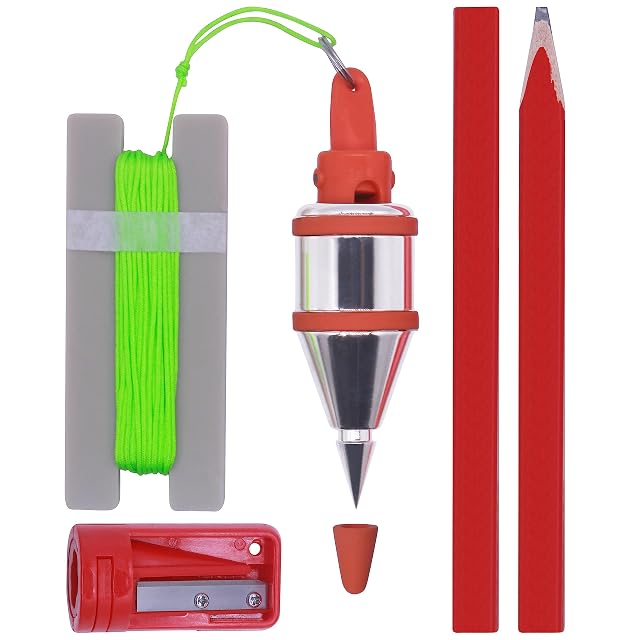
Sixteen feet of braided line, which is more than any other bob here carries — wound on a card rather than a reel.
Stated dimension or range
8 oz / 227 g, with 16 FT (5 m (16 ft)) of nylon braided line. Sixteen feet is the longest bob line on this shelf — the retracting reels carry 14 and 14.5 ft and a steel bob ships 10 ft — and on a stairwell or a two-story drop that difference is the whole job
Material
High-quality steel, stated corrosion-resistant, with a sharp point for calibration. NYLON BRAIDED line, stated — which this shelf's introduction says resists the stretch that makes a twisted line sag differently at each setting
Functions
A FAST Stabilizing DEVICE at the end of the bob, stated to speed up the stabilization of the line. No time is given — the Tajima bobs on this shelf publish six seconds — but the feature is the same idea: this shelf's introduction says weight sets how quickly a bob settles, and a damping device is the other way to get there without adding mass
Body and fittings
A safety cap over the point, stated to make it safer to use, and an anti-slip band at the waist of the bob to prevent it slipping off the line. The cap is the same answer to the same problem as the elastomer tip guard on another bob here: the point is what a plumb bob dies of
Supplied
The bob, a line board holding the 16 ft of braided line, TWO pencils and a sharpener. The line board is a card rather than a reel: the line is unwound by hand and rewound by hand, and the board can be held or weighted down to fix the top of the line, which is how HCCMLOVE describes using it
Reference and mounting
Nylon clips to adjust the line length for different heights, stated. No magnet, no pin and no hook: the top of the line is fixed by holding the board or weighting it, which is the simplest arrangement on this shelf and the least secure
Amazon reference
B0C86R3MNR
EAN
0765365646538
Sixteen feet of line, the longest bob cord on this shelf
Braided nylon, which resists stretch
A line board, not a reel: wound and unwound by hand
Best for: A tall drop on a budget, where sixteen feet of line matters more than a reel to wind it on
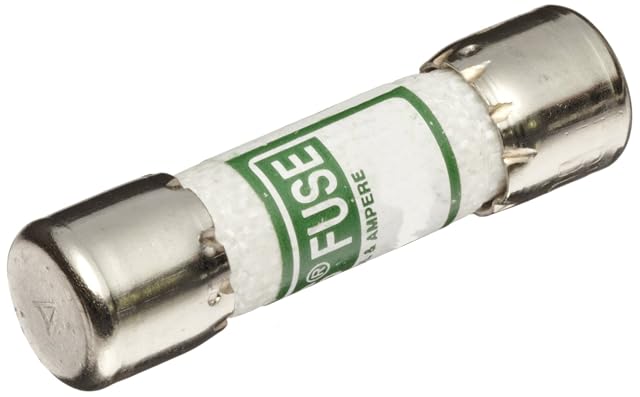
The Fluke part, five to a pack — and the only fuse on this shelf whose own page never states its size.
Current rating
11 A nominal, stated. This shelf's introduction asks for the current rating first among the electrical figures, and this is one of two things the page is clear about. It matches the YUNFOOK and differs from the Klein's 10 A, which is exactly the kind of difference this shelf's buying tip warns not to paper over
Voltage rating
1000 V, stated as "maximum voltage to ground: 1000V". That wording is more precise than the bare figure the other two give, and it is the right way to state it: what a fuse in a current input has to withstand is the potential between the input and earth
Breaking characteristic
Fast-acting, stated in the title. No breaking capacity in kiloamps is published, and neither of the other two American fuses on this shelf publishes one either
Stated dimension or range
NOT PUBLISHED. This shelf's introduction names dimensions as the FIRST of the four things a manufacturer specifies about this component, and the only dimensions on this page are the BLISTER's — 19.05 × 13.716 × 0.508 cm (7.5 × 5.4 × 0.2 in). The Klein and the YUNFOOK both state 10 × 38 mm (0.39 × 1.50 in); this page leaves a buyer to work it out from the part number
Body type
NOT PUBLISHED. Nothing on the page says ceramic or glass. The shelf's tag line is that a glass fuse in a meter specifying ceramic is not a substitute, and this is a 1000 V part — the energy level at which the distinction stops being academic
Supplied
FIVE fuses, $42.42, so $8.48 each. That sits between the YUNFOOK at $5.85 and the Klein at $15.99. A five-pack is the right quantity for a bench that blows them: the fuse in a current input is the component that goes when somebody probes a live circuit in the 10 A socket
Also stated
Country of origin: United States. The four bullets on this listing are generic catalog fields — "Product Type: Precision Measuring", "Package Dimensions", "Country Of Origin", "Package Quantity: 1" — rather than anything about the fuse. The whole specification is in the title and a two-line description
Amazon reference
B00937V94W
EAN
0009596904600
Eight forty-eight a fuse, five in the pack
The voltage stated properly, as potential to ground
No dimensions on the page — the hub asks for them first
Best for: A workshop running Fluke meters, where the part number in the manual is the specification and spares are kept by the handful
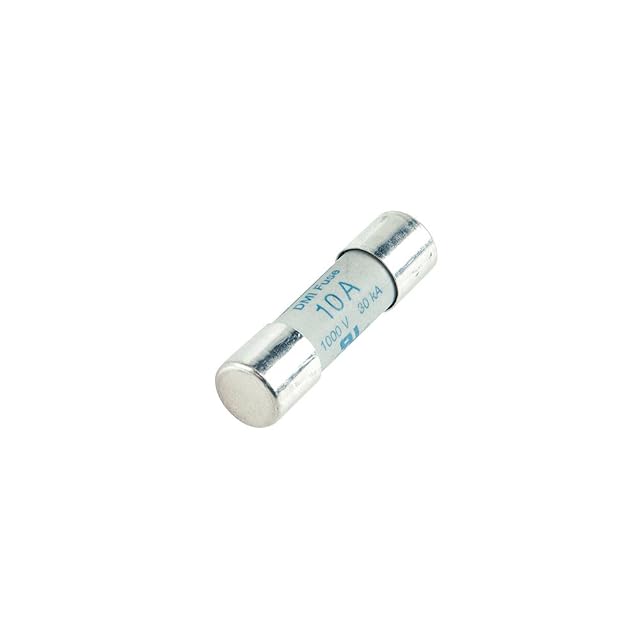
The only fuse here that states dimensions, current, voltage and body material — and the most expensive per piece by a wide margin.
Body type
FAST-ACTING CERAMIC, stated in so many words. This shelf's introduction says ceramic sand-filled bodies are specified where the meter must interrupt a high-energy fault and that a glass fuse of the same current rating does not do the same job. Of the three American fuses on this shelf, this is the ONLY one that puts its body material in writing
Stated dimension or range
10 × 38 mm (0.39 × 1.50 in), stated in the product title. That is the high-energy instrument format — markedly larger than the 5 × 20 mm (0.20 × 0.79 in) and 6.3 × 32 mm (0.25 × 1.26 in) bodies of the three fuses already published here
Current rating
10 A, stated. The two other American fuses on this shelf are both 11 A, so this is the only 10 A part of the three — and this shelf's introduction is explicit that you replace with the exact part the manual specifies, not with the fuse that fits
Voltage rating
1000 V, stated. No fuse previously published on this shelf is rated above 690 V. A 1000 V rating is what a CAT III or CAT IV current input needs, and it is the figure that most often differs between the right fuse and the one that fits the holder
Breaking characteristic
Fast-acting, stated. Klein adds that it "reduces the risk of internal arc flashes during operation" — which is the whole purpose this shelf's introduction describes: a fuse in a current input is a safety component before it is a consumable
Supplied
ONE fuse, at $15.99. That is the most expensive piece on this shelf by a long way: the YUNFOOK two-pack works out at $5.85 each and the Fluke five-pack at $8.48 each. Klein states compatibility with its MM600, MM700 and MM720 meters, and notes Cat. No. 69035 as a companion part
Also stated
Klein also claims "long-lasting performance" and "reliable and safe", which say nothing measurable. Two of the seven bullets on this listing are of that kind — and on a safety component, the four numbers matter and the adjectives do not
Amazon reference
B01JBMZ3B8
EAN
0092644690341
Says it is ceramic, which the other two never do
All four of the hub's numbers published
Fifteen ninety-nine for a single fuse
Best for: A Klein MM600, MM700 or MM720 whose current input has blown, where the manual names this part number
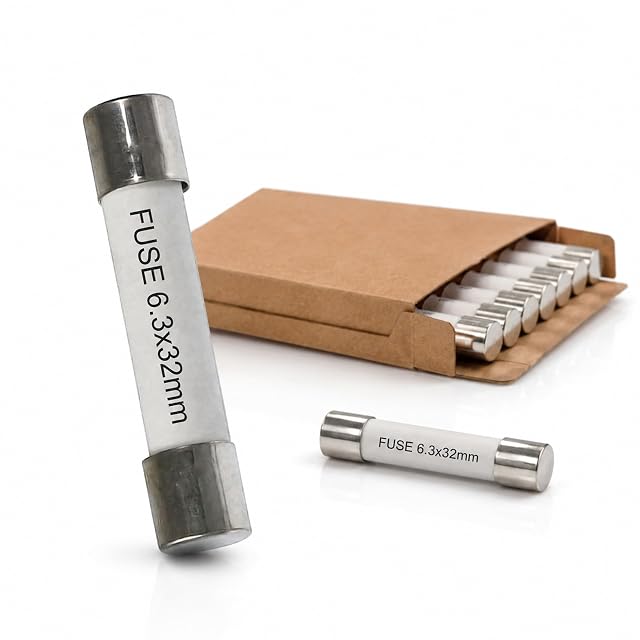
The instrument-grade format: 6.3 × 32 mm (0.25 × 1.26 in) at a rated 690 V, super fast-acting, which is what a properly specified meter current input takes.
Amazon reference
B07SQQXXP3 (identical on 5 markets)
EAN
4250569402852
Stated dimension or range
6.3 × 32 mm (0.25 × 1.26 in)
Fuse rating
500 mA · 690 V rated · super fast-acting (FF)
A 690 V rating, far above the 250 V of the general-purpose fuses here
The 6.3 × 32 mm (0.25 × 1.26 in) format used by instrument current inputs
One value only — 500 mA, which fits the low current range and not the 10 A input
Best for: The meter whose manual specifies exactly this — and it should be checked, not assumed.