Electrical testing: the order to buy the instruments in
Across ten electrical instruments on this site, two listings publish a complete measurement category. That is the specification these tools are judged on, and it is missing from most of the market. Here is the order to buy in, and what to check in each manual.
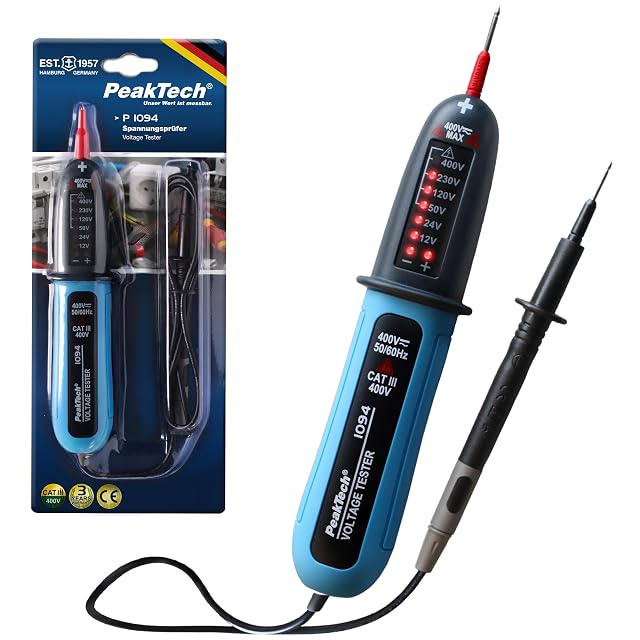
The PeakTech P 1094 states CAT III 400 V AC/DC, IP54, battery-free operation and an audible warning from 50 V. Battery-free matters: an instrument that draws its indication from the circuit under test has no state in which it appears dead because it is dead.
Second: the socket tester
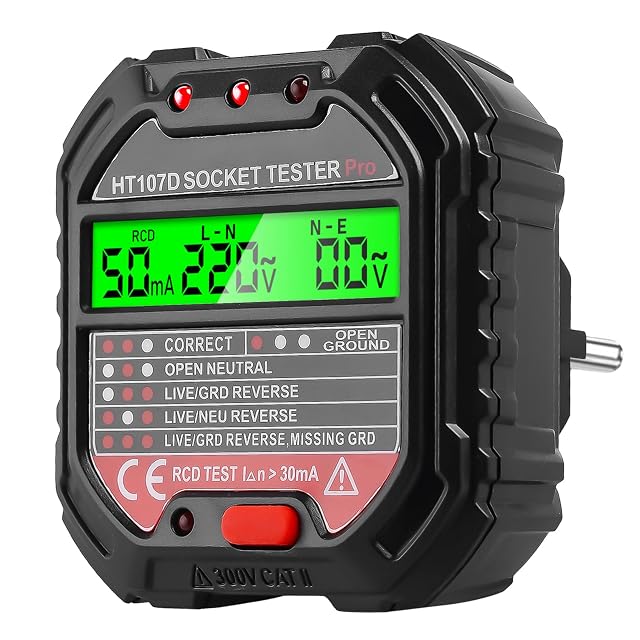
The GOMETY states CAT II 300 V — the correct category for socket-outlet work, and the only socket tester in its hub that publishes one. Six LEDs, a one-button RCD trip test and an LCD voltage display. Remember that no socket tester judges the quality of an earth.
Third: the multimeter
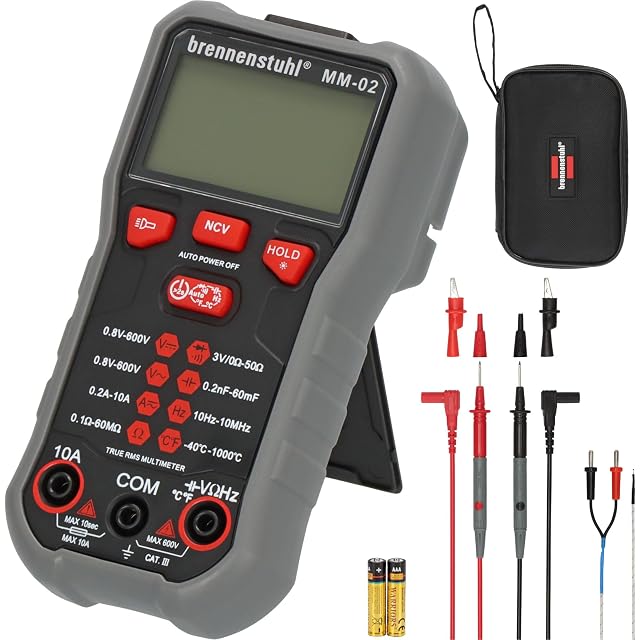
The Brennenstuhl brings true RMS, 6000 counts and the widest function list in its hub. It publishes no category, which is the same gap as almost every meter on this site — read the manual.
Fourth: the clamp
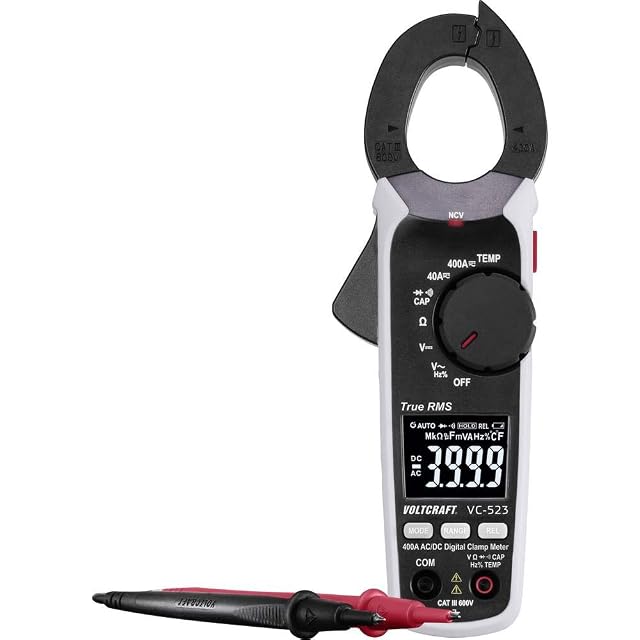
The Voltcraft VC-523 states CAT III 600 V AC/DC in full, with true RMS, eight functions and a built-in contactless detector. That complete rating is what distribution-board and control-cabinet work needs, and it is one of two on this site.
The thing to remember about all four
Prove your tester on a known live source before and after the measurement that matters. No specification substitutes for it.
Which instrument does your work demand?
You are a homeowner
This is a different world with legal and safety requirements, and most of it should not be attempted.
You are training
The kit follows the qualification, and the sequence of tests is what you are learning, not the instruments.
You want to understand a report
Knowing what each instrument measures helps you read what an electrician has written.
You want to work on your own installation
Understand which work is notifiable where you live before buying anything.
Picking by the measurement
Proving dead
A dedicated two-pole voltage tester and a proving unit. The first thing used on any job and the most important.
Continuity and insulation resistance
Where a multifunction tester earns its place, because these are the tests that certify an installation.
Loop impedance and RCD testing
Specialist functions with specialist procedures, on instruments made for the purpose.
Fault finding
Where a good multimeter and a clamp meter come back into their own, alongside experience.
The figures that settle accuracy accuracy
Safety category and certification
The first and last criterion. Instruments used on an installation must be rated for it, and using anything less is not a matter of preference.
Calibration
Test instruments used to certify work need periodic calibration. That is a service with a certificate, not a self-check.
Proving equipment
A voltage tester is only meaningful if it is proved on a known source before and after use. That means carrying a proving unit.
Whether the work is notifiable
In many jurisdictions certain electrical work must be carried out or certified by a competent person. That decides what you can legally do, whatever you own.
Leads, probes and their condition
The part of the system in your hands. Fused probes and intact insulation are what stands between a fault and an injury.
Which tolerance for which work
The task
The instrument
The caution
Proving dead
Two-pole tester and proving unit
Never a multimeter alone
Certifying an installation
Multifunction tester
Needs calibration
Measuring load current
Clamp meter
Rated for the circuit
Fault finding
Multimeter
Category rating still applies
The errors that cost you
Using a non-contact voltage detector to prove dead
They indicate the presence of voltage and can miss it entirely. Proving dead uses a two-pole tester checked on a known source before and after.
Working without knowing what is notifiable
Rules on who may carry out and certify electrical work vary by country and region. Owning the instruments does not make the work legal.
Assuming an instrument is still accurate
Test instruments used for certification need calibration on a schedule. An out-of-calibration instrument produces a certificate that means nothing.
Skipping the proving unit
A voltage tester that has failed reads dead on a live circuit. Proving it before and after is the entire safeguard.
By the trade you are in
The apprentice
Learns the sequence of tests first; the instruments follow the training rather than the other way round.
The working electrician
A calibrated multifunction tester, a proved two-pole tester, a clamp meter and a good multimeter.
The homeowner
A socket tester and a strong sense of where the boundary lies. Most of this work belongs to someone qualified.
Calibration and how long accuracy holds
Test instruments live in vans and get dropped, and their leads take the worst of it. Calibration drifts over time, fuses blow, and a proving unit's own battery fails quietly, which undermines the whole procedure it exists to support.
Keep calibration current for any instrument used to certify work.
Inspect leads and probes before every job, not periodically.
Check the proving unit works at the start of the day.
Replace fuses with the correct rated type only.
Safety
This is work that injures and kills people who take shortcuts.
Always prove a voltage tester on a known live source before and after testing a circuit is dead.
Isolate, lock off and label before working on any circuit.
Use instruments and leads rated for the installation, with no exceptions.
If the work is notifiable or beyond your competence, use a qualified electrician.
CAT II 300 V stated · six fault types · six LEDs · one-button RCD test
A socket tester stating CAT II 300 V — the only socket tester here that publishes a category — with six LED indications and a one-button RCD trip test.
Best for: The socket tester to buy if you want to know where the instrument is rated to be used.
True RMS · 6000 counts · 600 V · temperature, capacitance and frequency
A true-RMS meter with 6000-count resolution and a wide function list — voltage, current, resistance, temperature, diode, continuity, capacitance and frequency — with probe caps included.
Best for: Household and light installation work where waveforms are not clean and the reading has to be right.
CAT III 600 V AC/DC · True RMS · 4000 points · 8 functions · NCV
The only clamp meter in this hub that publishes a complete safety rating: CAT III 600 V AC/DC, with true-RMS, eight measuring functions and a non-contact voltage detector.
Best for: Distribution boards and control cabinets — the work a stated CAT III rating exists for.
It loads the circuit. A phantom voltage induced on a floating conductor collapses under that load, so a two-pole tester distinguishes a live conductor from an induced one. A contactless pen cannot, and it never claims to.
Is a higher CAT number always better?
No — a category describes where an instrument may be used, not how good it is. A socket tester rated CAT II 300 V is correctly rated for a socket outlet, and a higher number would not make it a better tool.
What should I read before the first use?
The manual, for the category and voltage, and for the fuse specification. Both are safety specifications and neither is reliably in the online listing.
What is the first instrument an electrician uses?
A two-pole voltage tester, together with a proving unit. Proving dead is the first step on any job and the one that protects you.
Why not use a non-contact voltage detector to prove dead?
They indicate voltage and can miss it entirely, for several ordinary reasons. They are useful for a first look, not for confirming a circuit is safe to work on.
Do test instruments need calibration?
Any instrument used to certify work does, on a schedule and with a certificate. An out-of-calibration instrument produces results that cannot be relied on.
Can I do my own electrical work?
Rules on what may be done and who must certify it vary by country and region. Check what is notifiable where you live before starting, not after.
What is a multifunction tester?
An instrument combining the tests used to certify an installation, such as continuity, insulation resistance, loop impedance and RCD testing.
Is a clamp meter useful?
For measuring current without breaking a circuit, very. It must still carry a safety category appropriate to what you are clamping around.
Targets, tripods and spares from the same aisle, at the price we noted. Check the thread matches the instrument you pick before ordering: it depends on the mount and the part number, which the listing states.
AUTOOL Multimeter Leads Kit · Test leads and probes — 68 pieces · silicone insulation · universal instrument fit · $62
Bionso 0001A · Test leads and probes — 25 pieces · FIVE tip sizes — 1.0, 2.0, 3.8 and 0.7 mm (0.03 in) plus hooks · a WRENCH to change them, the only tool on this shelf · 2 tip SHROUDS · silicone, double insulated · 43 in (109 cm) · 2 storage boxes · NO category and NO voltage published · $29.99 · $30
GP Extra Alkaline 9V · Instrument batteries — 9 V alkaline · eight-pack · G-TECH construction
Fluke 203406 · Multimeter fuses — 11 A · 1000 V to ground · fast-acting · FIVE to a pack, $8.48 each · dimensions NOT published · body material NOT published · $42
The one-line read
If the figure that matters is our rating → look at Voltcraft VC-523
The instruments above come from the catalog of this site. Specifications are the ones the manufacturer states and the ones on the Amazon listing; prices are the Keepa reading for the date below, and both change. Ranking uses declared specifications, stated strengths weighed against stated limits, and price. Nothing here has had its accuracy checked by us, and the page says as much.
Last checked on
Prices quoted in these summaries are dated readings. The live price is shown next to each product.
The tool we use ourselves
Chosen your tool? Now buy it at the right price.
Thermal cameras, line lasers and clamp meters swing by thirty dollars or more
across the
year, and the biggest "discounts" often land at prices the same model sold for six weeks
earlier.
UniverTrack tracks the real price history across retailers, spots fake
reductions, and alerts you when it is genuinely the moment to buy.
Real price historyBuy-now alertsAI buying assistant