Under forty dollars the range figure is nearly meaningless — the diode does not care whether the wall is at twenty meters or a hundred. What separates these three is whether the maker publishes an accuracy at all, and what it says.
Three meters under forty dollars, and the ranking follows the published figures.
First: the tightest published accuracy
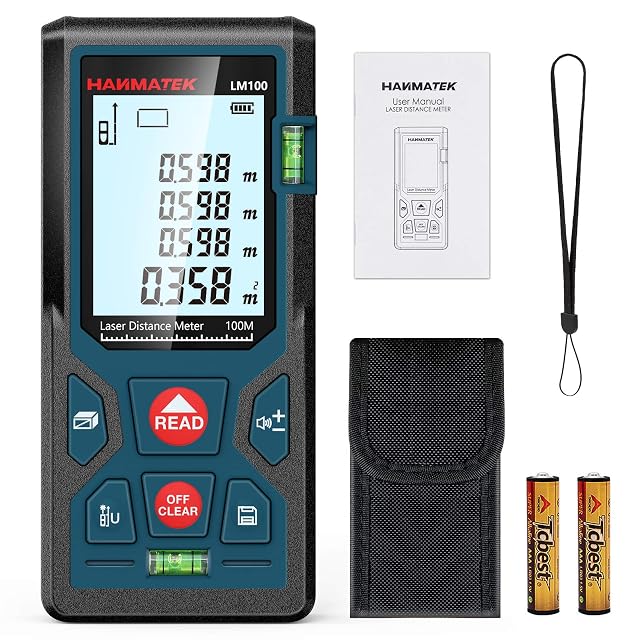
The HANMATEK states ± 1.5 mm (0.06 in) over 0.3 to 100 m (1 to 328 ft). That is the tightest figure in the whole hub, including meters at six times the price, and it comes with area, volume, continuous and three-point Pythagorean modes. IP54 for splash and dust.
Second: the honest cheapest
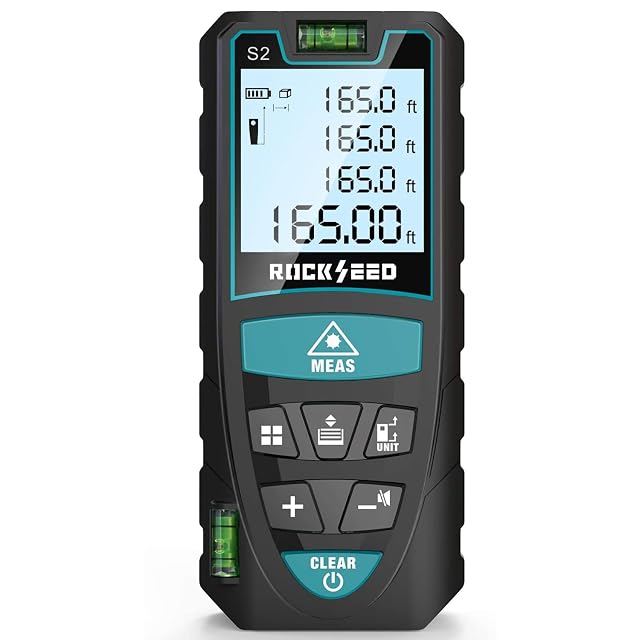
The RockSeed states ± 2 mm (0.08 in) over 0.2 to 50 m (0.7 to 164 ft) — looser, and published, which puts it ahead of everything in this price band that publishes nothing. Two bubble vials in the body let you square the tool to a wall before pressing, which removes the commonest beginner error.
Third: the one to hand to somebody else
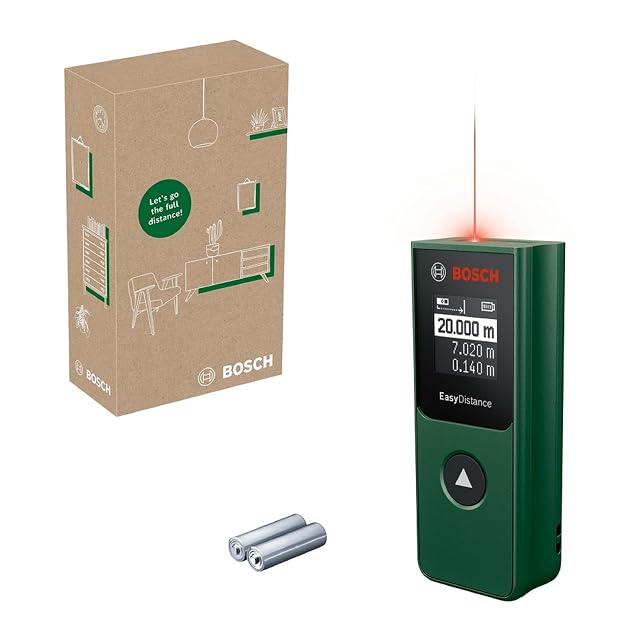
The Bosch EasyDistance 20 does one thing with one button and states ± 3 mm (0.12 in)/m over 20 m (66 ft). It cannot be left in the wrong mode, because it has no modes. As a working tool it is the weakest here; as a shared tool it is the only one that cannot produce a number that is not a distance.
What none of them has
An ingress rating above IP54, and a body that survives a site. That starts at the Bosch Professional GLM 40-31 at around sixty-four euros, which states IP 65 and a 1.5 m (5 ft) drop — and, oddly, does not state an accuracy at all.
Which instrument does your work demand?
You measure rooms alone
This is the tool's whole purpose, and even a basic one changes the job.
You measure outdoors
Range in daylight is the limitation, and a target plate is what makes long shots readable.
You need area and volume
Almost all of them calculate it, and it is worth checking the unit switches to what you use.
You measure short distances
A tape is still faster and often more accurate at close range.
Picking by the measurement
Room dimensions
The core use. One person, one button, and no tape sagging across a room.
Estimating materials
Area and volume functions, which save arithmetic and the errors that come with it.
Ceiling heights
Where a laser is dramatically easier than a ladder and a tape.
Outdoor distances
Where daylight limits the range, and where a target plate becomes necessary rather than optional.
The figures that settle accuracy accuracy
Range and where you measure from
Stated ranges assume good conditions and a good target. Outdoors in daylight the usable range is shorter, and that is normal rather than a fault.
The reference point
Whether it measures from the front or the back of the device. Getting this wrong is the commonest error with these tools.
Readability of the display
A backlit display is worth having in a dark corner or a loft, which is exactly where you use one.
Units and functions
Whether it switches to the units you use, and whether it does area, volume and continuous measurement. Beyond that, extra functions are rarely used.
What surface you are aiming at
Dark, glossy or textured surfaces reflect poorly. A white card held at the target solves this and costs nothing.
Which tolerance for which work
Your measurement
What matters
The limit
Inside a room
Almost anything works
Very few
Outdoors in daylight
Range and a target plate
Sunlight washes out the dot
Dark or glossy surfaces
A white card at the target
Poor reflection
Short distances
A tape
The laser's own reference offset
The errors that cost you
Forgetting which end it measures from
Front or back reference changes every reading by the length of the device. It is the commonest mistake and it is entirely avoidable.
Expecting the stated range outdoors
Range figures assume favorable conditions. In sunlight, on a dark surface, the usable distance is much shorter, and a target plate is the answer.
Measuring to a surface that is not flat
The laser measures to whatever it hits. A skirting board, a radiator or a curtain gives a shorter reading than the wall behind it.
Trusting a single reading
Take two from different positions. A disagreement usually means the beam hit something you did not intend.
By the trade you are in
The occasional user
A basic model with a clear display. It will do everything a domestic job asks of it.
The one measuring outdoors
Longer range and a target plate, accepting that daylight is the real constraint.
The estimator
Area, volume and a memory function, which turn a survey into a list rather than a page of arithmetic.
Calibration and how long accuracy holds
A laser meter is a sealed electronic instrument whose weaknesses are its lens, its battery and being dropped. A dirty lens scatters the beam and shortens the usable range, and a drop can shift the internal alignment without any external sign.
Keep the lens clean with a soft cloth; dust reduces range noticeably.
Remove batteries for long storage, since leaks destroy the electronics.
Check it against a tape occasionally over a known distance.
Recheck after any drop rather than assuming it survived.
Safety
It is a laser, and the beam is aimed by hand.
Never look into the beam or point it at anyone's eyes.
Be aware of reflective surfaces that can redirect the beam unexpectedly.
Keep it away from children, who will point it at each other.
Do not rely on it alone for anything structural; verify with a tape.
100 m (328 ft) range · ± 1.5 mm (0.06 in) stated · IP54
The tightest accuracy figure published in this hub — the maker states ± 1.5 mm (0.06 in) — paired with a 100 m (328 ft) range, at a third of the price of the Leica that matches that reach.
Best for: The best-published specification per euro in this hub, for someone who measures long distances and does not need a documented workflow.
50 m (164 ft) range · ± 2 mm (0.08 in) stated · IP54 · two bubble vials
The cheapest meter in this hub, and the only one under twenty-five euros that publishes an accuracy figure at all: the maker states ± 2 mm (0.08 in) over a 0.2 to 50 m (0.7 to 164 ft) range, with an IP54 rating and two bubble vials built into the body.
Best for: A first laser measure for indoor work, where the job is room dimensions rather than a wet site.
20 m (66 ft) range · ± 3 mm (0.12 in)/m stated · one-button operation
A deliberately minimal meter: one button, a 20 m (66 ft) range and a stated accuracy of ± 3 mm (0.12 in)/m. It is the shortest-range meter in this hub and the easiest to hand to somebody who has never used one.
Best for: Somebody who wants a room measured without learning a tool, and will never need the far end of a car park.
Rarely, indoors. A 20 m (66 ft) meter covers a room and a corridor; 50 m (164 ft) covers a house frontage. Beyond that the limiting factor outdoors is seeing the dot, not the electronics — which is what target plates exist for.
What does the reference edge do?
It sets where the measurement starts: the back of the housing, the front, or a fold-out stop. Most meters default to the back on power-up, and a measurement taken with the front pressed to a wall is then wrong by the length of the tool.
Do I need area and volume modes?
For estimating paint, flooring or plaster, yes — and they are the same multiplication you would do anyway, done without transcribing two numbers. The Bosch here deliberately has neither, and is easier to hand to somebody else because of it.
Is a laser measure accurate enough for building work?
For room dimensions and estimating, comfortably. The larger source of error is usually what the beam hits rather than the instrument itself.
Why does it read differently from my tape?
Most often the reference point: front or back of the device. Check which mode it is in, and remember it adds or removes the device's own length.
Why does it fail outdoors?
Daylight washes out the dot and dark surfaces reflect poorly. A target plate, even a white card, restores the reading over longer distances.
Do I still need a tape?
Yes. For short and awkward measurements a tape is faster, and it works when the battery is flat.
What surfaces cause problems?
Dark, glossy, transparent or textured ones, plus anything in front of the wall like a radiator or curtain. The laser measures to what it hits.
How do I check that it is right?
Measure a known distance with a good tape and compare, ideally in the same reference mode. Repeat after any drop.
Targets, tripods and spares from the same aisle, at the price we noted. Check the thread matches the instrument you pick before ordering: it depends on the mount and the part number, which the listing states.
GP Extra Alkaline 9V · Instrument batteries — 9 V alkaline · eight-pack · G-TECH construction
Bosch Professional 1608M0005C · Laser target plates — For laser distance meters · improved beam visibility · with stand
HOZO C-M02-A02 TargetMate · Laser target plates — TWENTY-NINE DOLLARS, the most expensive plate on this shelf — and the same maker's four-card set costs nineteen for four · magnetic AND washable, the only plate here that is both · stated specifically for the HOZO M-Cube 02 laser measure · NO tint color, NO scale, NO size · $29
Bosch 0601091A00 · Laser tripods — 122–295 cm (48 to 116.1 in) · aluminum · Quick Clamp height lock
VEVOR 27.36-68.11 inch · Laser tripods — 1/4"-20 thread · 695–1750 mm (27.4 to 68.9 in) · 0.5 mm aluminum · 360° rotation · $40
The one-line read
If the figure that matters is our rating → look at HANMATEK LM100
Pairings that settle the figures
Instrument against instrument, where we have already published the comparison.
The instruments above come from the catalog of this site. Specifications are the ones the manufacturer states and the ones on the Amazon listing; prices are the Keepa reading for the date below, and both change. Ranking uses declared specifications, stated strengths weighed against stated limits, and price. Nothing here has had its accuracy checked by us, and the page says as much.
Last checked on
Prices quoted in these summaries are dated readings. The live price is shown next to each product.
The tool we use ourselves
Chosen your tool? Now buy it at the right price.
Thermal cameras, line lasers and clamp meters swing by thirty dollars or more
across the
year, and the biggest "discounts" often land at prices the same model sold for six weeks
earlier.
UniverTrack tracks the real price history across retailers, spots fake
reductions, and alerts you when it is genuinely the moment to buy.
Real price historyBuy-now alertsAI buying assistant