Checking a wall for damp: what a meter can and cannot say
A moisture meter finds a difference. It does not find a cause, and it does not establish that a building has a problem — rising damp, a leaking pipe, condensation and splash-back all read the same. What it does, properly used, is tell you where to look.
Three meters, and the method matters more than any of them.
First: pins, for timber and a published figure
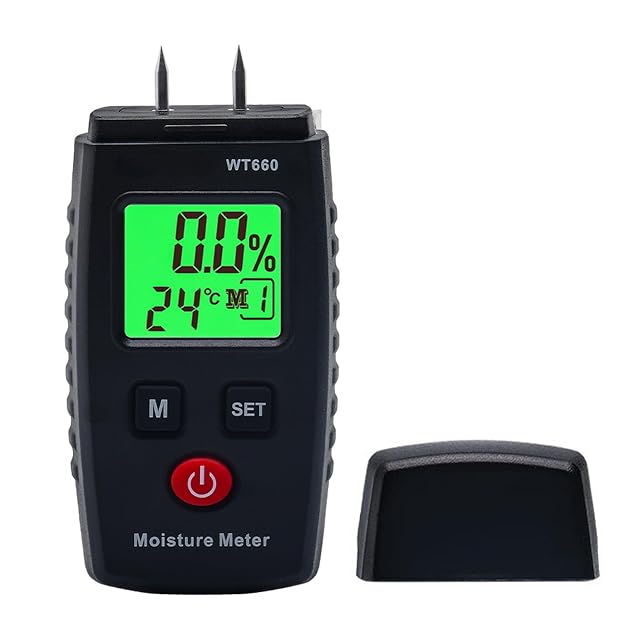
The GERUI publishes both its accuracy (± 2.0%) and its resolution (0.10%), and carries seven calibrated scales — four wood groups and three building materials. Resistance at a given moisture content depends on the material, so scales are a real compensation and this is the only meter in the hub with seven of them. It leaves two holes.
Second: a ball sensor, for finished surfaces
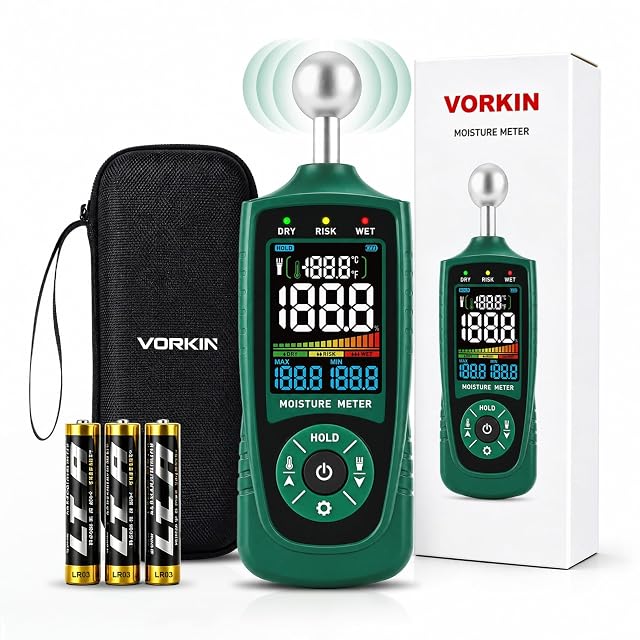
The VORKIN reads to a stated 40 mm (1.57 in) without pins, on a rounded probe that sits in corners and joints where a flat plate cannot make contact. It bands the reading DRY, MID or WET and has an adjustable alarm. It publishes no accuracy figure, which is the trade.
Third: the quick check with two honest ranges
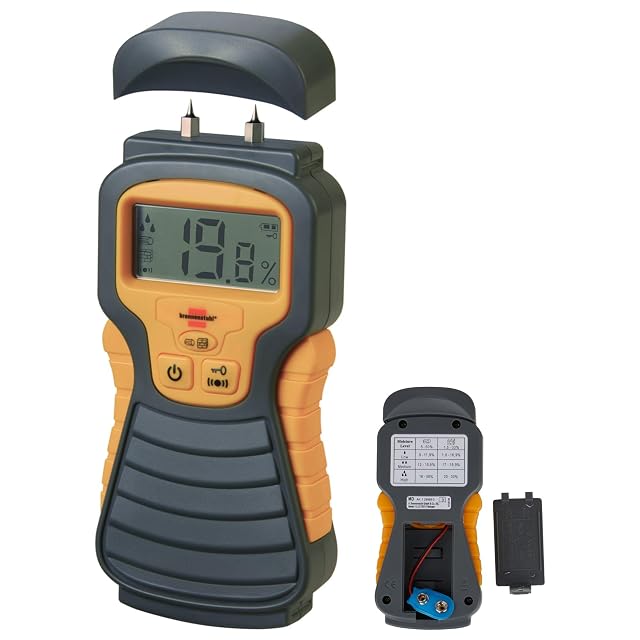
The Brennenstuhl states 5–50% for wood and 1.5–33% for building materials as separate ranges, and holds a reading taken where you cannot see the display. It measures at the surface, which it says plainly.
The sentence that belongs on every survey
A reading is a comparison. Take one in an area you believe is dry, record both, and treat a high reading as a place to investigate rather than as a conclusion.
Which instrument does your work demand?
You have a visible damp patch
A meter tells you where it is worst, not what is causing it. The cause is the diagnosis.
You are buying a house
A meter reading in a survey is an indicator, and treating it as a verdict is how unnecessary work gets sold.
You want to track drying
This is where a meter genuinely excels: the same spot measured over weeks tells a real story.
You have mold without obvious water
Condensation and ventilation are the likelier explanation, and a meter alone will not show it.
Picking by the measurement
Finding the wettest area
Comparative readings across a wall show where the problem is concentrated, which is genuinely useful.
Tracking drying
The strongest use: repeated readings at the same points over weeks show whether something is improving.
Checking timber
Where pin-type meters are on firmer ground, because wood moisture content is what they are designed to read.
Diagnosing a cause
Where a meter is weakest. Rising damp, penetrating damp and condensation can produce similar readings and need different remedies.
The figures that settle accuracy accuracy
Pin or pinless
Pin meters measure conductivity between two points and leave marks; pinless meters read a volume beneath the surface without damage. They answer slightly different questions.
What the scale actually means
On masonry, most meters show a relative index rather than a moisture percentage. Reading it as a percentage is the commonest misunderstanding.
What else conducts
Salts, foil-backed plasterboard, metal, and some paints all give high readings with no water present. This is why readings need interpretation.
Repeatability of position
For tracking drying, measuring the same spot each time matters more than the absolute number. Mark the points.
Whether you need a diagnosis or an indicator
A meter indicates. Diagnosing damp usually needs the building's history, the weather, the ventilation and sometimes a professional.
Which tolerance for which work
Your question
Can a meter answer it?
What you need instead
Where is it wettest?
Yes
Nothing
Is it drying?
Yes, over time
Marked measuring points
What is causing it?
No
History, inspection, sometimes a professional
Is it rising damp?
No
Proper investigation
The errors that cost you
Reading masonry values as a moisture percentage
Most meters give a relative index on masonry, not a percentage. Treating the number as a percentage leads to conclusions the instrument cannot support.
Ignoring salts and foil
Hygroscopic salts, foil-backed board and metal all read high with no water present. This is why a single high reading proves nothing on its own.
Diagnosing from a meter alone
Condensation, a leak and ground moisture can all read similar. The diagnosis comes from where, when and under what conditions the damp appears.
Not measuring the same spot when tracking
Drying is a trend at fixed points. Wandering across a wall each week produces noise rather than information.
By the trade you are in
The homeowner with a patch
Use the meter to find where it is worst, then look for the cause above and outside that point.
The one drying out after a leak
Marked points, weekly readings, and patience. This is the meter at its most useful.
The buyer
Treat any meter reading in a report as an indicator, and ask what evidence supports the diagnosis.
Calibration and how long accuracy holds
Moisture meters are simple and their weakness is their contacts. Pins corrode and bend, which changes conductivity, and a pinless meter's sensing pad reads wrong if it is not held flat against the surface.
Replace bent or corroded pins; they change the reading directly.
Check the meter against a known dry material at the start of a session.
Hold a pinless meter flat and still; angle changes the reading.
Remove the battery for long storage.
Safety
Damp and the work around it carry real hazards.
Never push pins into a wall without checking for cables and pipes first.
Treat significant mold growth as a health matter and ventilate before working near it.
Do not disturb old materials that may contain asbestos; if in doubt, stop and take advice.
Be careful of electrical fittings in a wall you suspect is wet.
Pin type · ± 2.0% stated · 0.10% resolution · 4 wood + 3 building scales
A pin meter publishing both its accuracy and its resolution — ± 2.0% and 0.10% — with seven calibrated scales split between four wood groups and three building materials.
Best for: Timber and firewood, where a pin reading at a known depth is exactly the right measurement.
A pinless meter with a ball sensor reading to a stated 40 mm (1.57 in) depth, showing DRY, MID or WET alongside a value, with an adjustable moisture alarm.
Best for: Surveying a finished wall or floor, where holes are not acceptable and depth matters.
Wood 5–50% · building materials 1.5–33% · hold · auto-off after 3 minutes
A handheld detector publishing two separate measuring ranges — 5 to 50% for wood and 1.5 to 33% for building materials — with a hold function for readings taken out of sight.
Best for: Quick checks on wood and masonry where the comparison between two spots is the answer.
Take a reference reading somewhere you believe is dry, then compare. The difference is the finding; an absolute number on its own establishes nothing, because the reading depends on the material, its density and what is behind it.
Pin or pinless?
Pins measure resistance between two points at a known depth — accurate, and they leave two holes. Pinless meters read a capacitive field over an area, leave no marks, and average whatever is in that volume including any metal. For timber, pins. For a finished wall, pinless.
Can a meter prove I have rising damp?
No. It shows a moisture difference. Establishing a cause, and anything that follows from it, belongs to someone qualified to assess the building.
Can a moisture meter tell me what is causing damp?
No. It shows where moisture is highest. The cause comes from where and when the damp appears, the building's history and often a proper inspection.
Why does my meter read high on a dry wall?
Salts, foil-backed plasterboard, metal and some paints all conduct. That is why a single high reading proves nothing without context.
Is the number a percentage?
On timber it usually is moisture content. On masonry most meters show a relative index instead, and reading it as a percentage is the common mistake.
How do I track whether a wall is drying?
Mark fixed points and measure the same ones weekly. The trend is what tells you something; a single reading does not.
Do I need a professional?
If the cause is not obvious, or if someone is proposing significant work on the basis of meter readings alone, an independent opinion is worth having.
Targets, tripods and spares from the same aisle, at the price we noted. Check the thread matches the instrument you pick before ordering: it depends on the mount and the part number, which the listing states.
GP Extra Alkaline 9V · Instrument batteries — 9 V alkaline · eight-pack · G-TECH construction
Fieldpiece ST4 · Temperature probes — TWO type K channels, T1 / T2 / T1−T2 · −58 to 2000 °F (−50 to 1300 °C), the widest span on this shelf · WRAP-TAB BEADED thermocouples supplied · TWO front-face CALIBRATION POTS, the only adjustable instrument here · LED for a disengaged probe · rubber boot · magnetic hanger case · NO accuracy figure · $119 · $119
Klein Tools 69140 · Temperature probes — Type K · a PIPE CLAMP, a style the hub intro does not name · pipes 1/4 to 1-3/8 in · −4 to 212 °F (−20 to 100 °C) — the NARROWEST range on this shelf · ±2% stated · 40 in (102 cm) flexible lead · banana plug adapter SOLD SEPARATELY (Cat. No. 69146) · $27
The instruments above come from the catalog of this site. Specifications are the ones the manufacturer states and the ones on the Amazon listing; prices are the Keepa reading for the date below, and both change. Ranking uses declared specifications, stated strengths weighed against stated limits, and price. Nothing here has had its accuracy checked by us, and the page says as much.
Last checked on
Prices quoted in these summaries are dated readings. The live price is shown next to each product.
The tool we use ourselves
Chosen your tool? Now buy it at the right price.
Thermal cameras, line lasers and clamp meters swing by thirty dollars or more
across the
year, and the biggest "discounts" often land at prices the same model sold for six weeks
earlier.
UniverTrack tracks the real price history across retailers, spots fake
reductions, and alerts you when it is genuinely the moment to buy.
Real price historyBuy-now alertsAI buying assistant