What the figures leave us with A complete rating, no battery and an audible threshold. The straightforward choice for domestic work.
A tester that states its rating in full, which is rarer than it should be.
What the manufacturer publishes
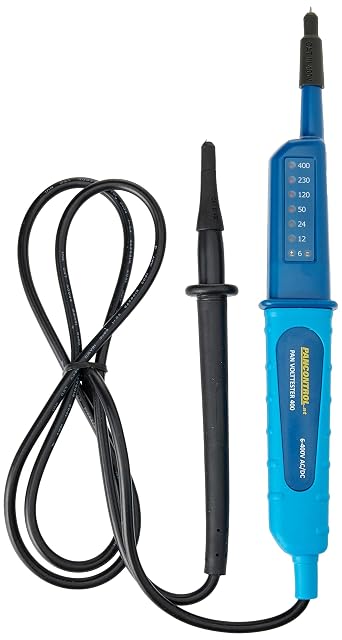
A robust two-pole tester stated as suited to professional use in electrical engineering, CAT III 400 V AC/DC, IP54. Battery-free operation, described as always ready to use. A clearly visible LED display and an acoustic warning signal from 50 V.
Battery-free is a specification, not an economy
Every battery-powered test instrument has a state in which it appears to work and does not. A two-pole tester with no cell has no such state: if it indicates, it is because current is flowing through it from the circuit. That is why this design has survived unchanged for decades alongside far more capable instruments.
Where 400 V stops
It covers single- and three-phase domestic and light commercial installations. It does not cover the 1000 V DC of a photovoltaic string or the higher ranges of industrial work — the BENNING in this hub goes to 1000 V AC and 1200 V DC for exactly those jobs.
Availability
No such listing: the American Amazon shop answers the reference with a search box rather than a page.
Read from Keepa on the day this page was last revised; stock and price both move without notice.
What it has, and what it lacks
Strengths
States the complete rating: CAT III 400 V AC/DC
Battery-free, so it is always ready — the failure mode of a battery tool removed entirely
IP54 stated against dust and splashing water
An audible warning from 50 V, the threshold at which voltage becomes dangerous
Compromises
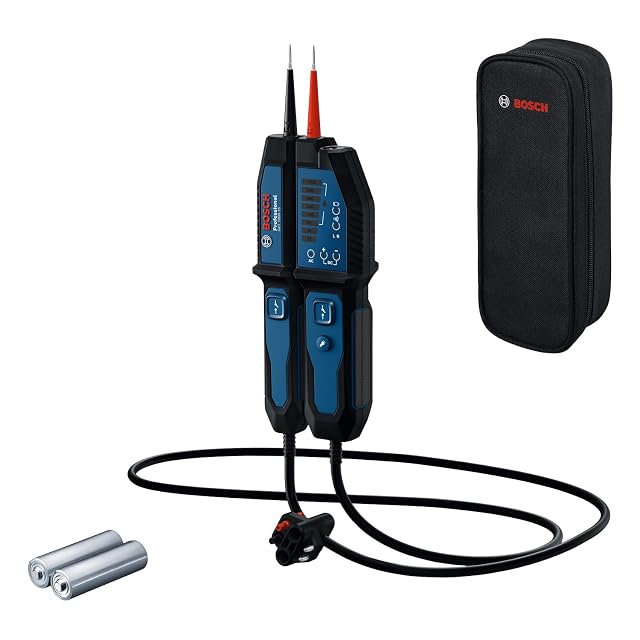
Four hundred volts, where the Bosch and BENNING here reach 1000 V
No self-test function
Not found on the British market
Specifications
Amazon reference
B0DY1W4X8M (identical on 5 markets)
EAN
4250569407413
Measurement category
CAT III 400 V AC/DC
Ingress protection
IP54
Power
battery-free
Functions
audible warning from 50 V
What gets asked here
How can it work without a battery?
A two-pole tester draws its indication current from the circuit it is testing. That is why it loads the circuit, and why it cannot be fooled by an induced phantom voltage — and it is also why it needs no cell.
Why does the alarm start at 50 V?
Fifty volts AC is the conventional threshold above which voltage is treated as hazardous. PeakTech states an audible signal from 50 V, which turns the instrument into something you can use without looking at it.
Is IP54 enough for site use?
It covers dust and splashing water, which is what a tester meets in a distribution board or a damp cellar. The Bosch in this hub states IP65, which is a step further.
Our score
8.0/ 10
A complete rating, no battery and an audible threshold. The straightforward choice for domestic work.
This one’s price among measuring instruments
A reference exists on these Amazon stores: France, Germany, Italy, Spain, United Kingdom. Listed is not the same as in stock — availability changes daily.
Details checked on August 31, 2026.
Who should pick this one, among measuring instruments
Domestic and light commercial installation work, with the rating printed where you can read it.
Amazon reports what buyers took in the month before this page was last checked: at least 100.
The figure is a floor, rounded by Amazon, and read through Keepa — it says what buyers picked, not what a maker claims.
Sources
Specifications: the manufacturer sheet for measuring instruments and the matching Amazon product page. Prices and availability: Keepa. Every figure on this page names its source.
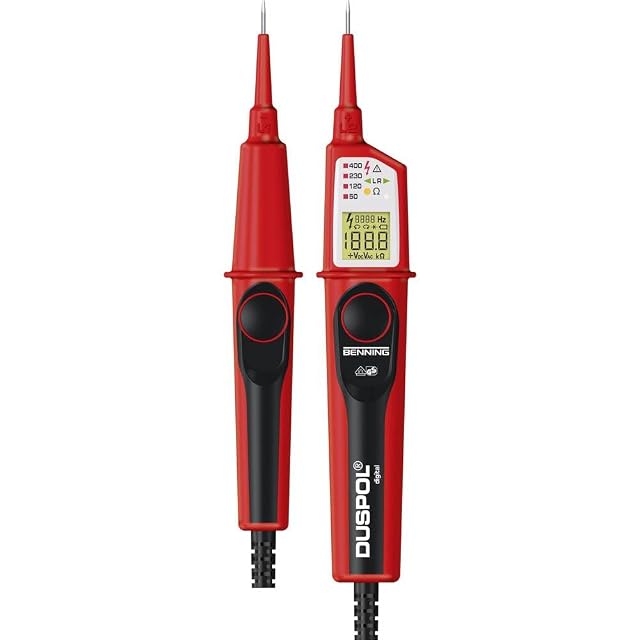
1–1000 V AC / 1200 V DC · True RMS · tested to DIN EN 61243-3, VDE 0682-401
The only tester here that names the standard it is approved to: DIN EN 61243-3 and VDE 0682-401:2015, with a 1–1000 V AC and 1200 V DC range and indication from 50 V even on flat batteries.
Best for: Photovoltaic, industrial and hybrid-vehicle work, where 1200 V DC is real and the approval matters.