What the figures leave us with Buy it for the self-test and the sealing. The unpublished category is the one thing that should not be missing at this price.
A tester specified around the way testers fail.
What the manufacturer publishes
An LED display indicating the voltage range between 12 and 1000 V. A self-test function, stated as increasing safety by verifying the integrity of the tool. A robust design certified to IP65 for dust and water resistance, stated for durability under difficult conditions.
The failure this design is aimed at
A voltage tester that has stopped working looks exactly like a circuit that is dead. That is the entire hazard of the instrument, and it is why the discipline of proving on a known live source exists. A self-test does part of that job on demand, without needing a live source to hand — which in practice means it actually gets done.
It does not replace the discipline. Prove live, test, prove live again.
What is missing at this price
No category and no voltage rating in the listing, where the twelve-euro Kopp states CAT III. That gap is documented rather than excused: read the specification sheet in the box before the first use.
Availability
Catalogued and unsold: the American Amazon shop lists the reference with nobody behind it.
Read from Keepa on the day this page was last revised; stock and price both move without notice.
What it has, and what it lacks
Strengths
A self-test function, stated as verifying the integrity of the tool — the answer to the one failure a tester cannot otherwise reveal
A 12 to 1000 V range, two and a half times the 400 V testers here
IP65 stated, the highest ingress rating in this hub
On sale across all six markets
Compromises
No measurement category published in the listing, unlike the three cheaper testers here
Four times the price of the PeakTech, which states its full rating
The self-test is not a substitute for proving on a known live source
Specifications
Amazon reference
B0F2N8S9R8 (identical on 6 markets)
EAN
4053423330083
Voltage measurement
12–1000 V
Functions
self-test function
Ingress protection
IP65
What gets asked here
What does the self-test actually check?
Bosch states it verifies the integrity of the tool. That addresses the scenario that makes a tester dangerous: one that has failed silently and now indicates nothing on a live circuit. It does not replace proving the tester on a known live source before and after the measurement that matters.
Why is there no CAT rating in the listing?
It is not stated. That is surprising on an instrument in this class and it is the same omission found across most of the electrical instruments on this site. The rating will be in the documentation supplied with the tool.
What does IP65 add over IP54?
Dust-tight rather than dust-protected, and resistant to water jets rather than splashing. For a tester used outdoors or in a wet plant room, that is a real difference.
Our score
7.4/ 10
Buy it for the self-test and the sealing. The unpublished category is the one thing that should not be missing at this price.
This one’s price among measuring instruments
A reference exists on these Amazon stores: France, Germany, Italy, Spain, United Kingdom, United States. Listed is not the same as in stock — availability changes daily.
Details checked on August 31, 2026.
Who should pick this one, among measuring instruments
Site work where the tester lives in a bag and where 1000 V is in scope.
What buyers actually choose
Amazon reports what buyers took in the month before this page was last checked: at least 200.
The figure is a floor, rounded by Amazon, and read through Keepa — it says what buyers picked, not what a maker claims.
Sources
Specifications: the manufacturer sheet for measuring instruments and the matching Amazon product page. Prices and availability: Keepa. Every figure on this page names its source.
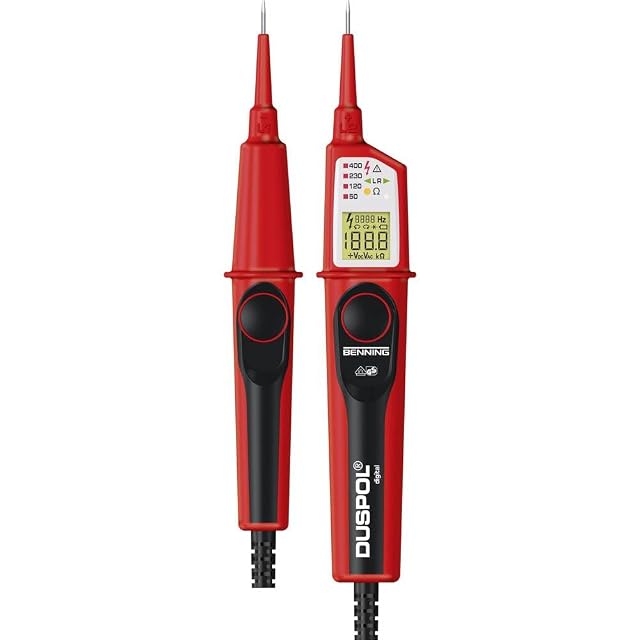
1–1000 V AC / 1200 V DC · True RMS · tested to DIN EN 61243-3, VDE 0682-401
The only tester here that names the standard it is approved to: DIN EN 61243-3 and VDE 0682-401:2015, with a 1–1000 V AC and 1200 V DC range and indication from 50 V even on flat batteries.
Best for: Photovoltaic, industrial and hybrid-vehicle work, where 1200 V DC is real and the approval matters.
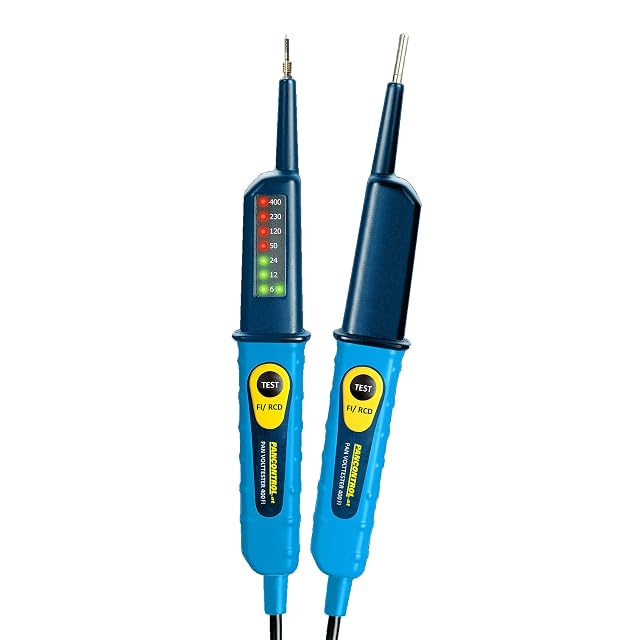
CAT III 400 V · IP64 · 8 LEDs 6–400 V · green under 24 V, red from 50 V
A two-pole tester with a color-coded LED scale — green for extra-low voltage up to 24 V, red for dangerous voltage from 50 V — stated as CAT III 400 V and IP64.
Best for: Anyone who wants the safe-or-not judgment made by the instrument rather than by reading a number.