Before you drill: the three tools worth twenty minutes
A detector reduces risk. It does not remove it, and no honest page about drilling says otherwise. What these three tools do together is turn a guess into an informed decision — and give you a way to check the answer before the drill goes in.
Three tools, and a procedure worth more than any of them.
The detector that publishes four depths
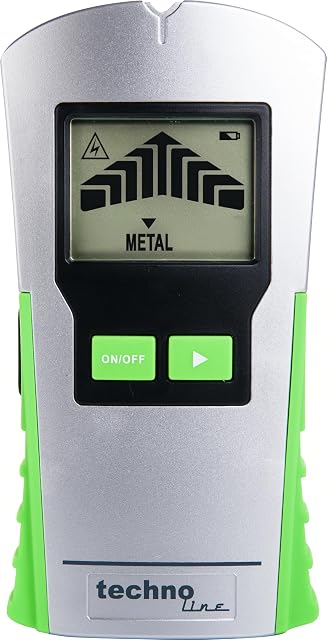
The Technoline states wood to 19 mm (0.75 in), metal to 30 mm (1.18 in), deep scan to 38 mm (1.50 in) and live cable to 50 mm (1.97 in) at 230 V. Four numbers rather than one, and the one that applies to a stud behind two layers of board is the 19 mm (0.75 in) — which is at or beyond the limit, and knowing that is what tells you when to stop trusting the tool.
The detector that finds the center
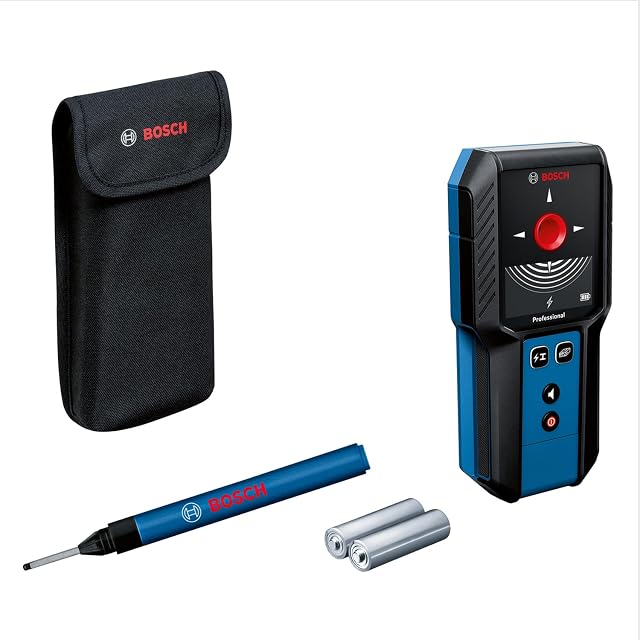
The Bosch GMS 120-27 identifies the material and rings the marking hole with a three-color LED: yellow approaching, red on the object. Marking through the hole removes the offset between where the tool indicates and where the pencil goes, and a center indication finds the middle of a stud in one pass rather than three.
The pen that checks the answer
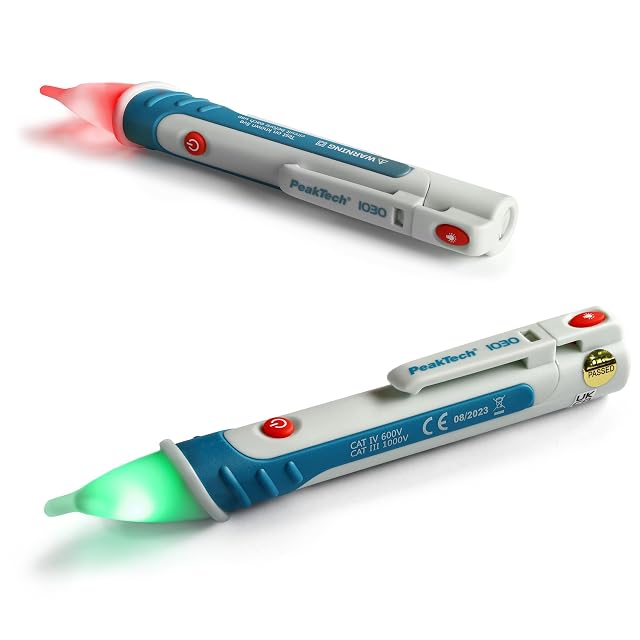
Before the drill, run a contactless detector along the line. It answers “there is probably voltage here”, never “this is safe” — but a pen that responds where the detector said nothing is a reason to stop and think.
The procedure
Calibrate on the wall. Scan in both directions, twice. Mark the edges and the center. Look at where the sockets and switches are, and assume the cable runs vertically or horizontally from them. Then drill shallow first.
Which instrument does your work demand?
You are hanging a picture
A basic stud detector is enough, and knowing where cables usually run matters just as much.
You are drilling into a kitchen or bathroom wall
Assume pipes and cables. A detector that finds both is the minimum.
You are drilling deep or into an unknown wall
A multi-mode detector, and the discipline to stop when a reading is ambiguous.
You cannot be sure
Isolate the circuit, or do not drill. No detector is a guarantee.
Picking by the measurement
Finding studs and joists
The commonest use, and one that a simple detector or careful tapping handles.
Avoiding cables
Where the stakes rise sharply. Live cable detection is the function that matters most and is the least reliable in awkward walls.
Avoiding pipes
Metal detection finds copper; plastic pipes are effectively invisible to most detectors, which is a real limitation.
Checking before a big cut
Where scanning a whole area rather than a single point is worth the extra minutes.
The figures that settle accuracy accuracy
What it can actually detect
Wood, metal and live cables are separate detection modes. A detector that finds studs does not necessarily find cables, and that distinction matters.
Plastic pipes
Most detectors cannot find an empty plastic pipe. This is the limitation that catches people, and no setting fixes it.
Calibration on the wall
Most detectors calibrate against the wall when switched on. Starting over a stud or a cable gives wrong results for the whole scan.
Depth capability
Detection depth is limited and varies with wall construction. Deep services in a thick wall may not register at all.
How it behaves on difficult walls
Foil-backed board, metal lath, wet plaster and dense masonry all confuse detectors. On these, the tool is an indicator rather than an answer.
Which tolerance for which work
What you want to avoid
Detector help
The gap
Studs and joists
Reliable
Little
Copper pipes
Usually found
Depth limits
Plastic pipes
Usually not found
A serious limitation
Live cables
Often found
Not if the circuit is off
The errors that cost you
Trusting a detector as a guarantee
Detectors indicate. They miss plastic pipes, they struggle on some wall constructions, and live cable detection depends on the circuit being energized.
Calibrating over the thing you are looking for
Most detectors zero themselves against the wall at switch-on. Starting on a stud or a cable makes it invisible for the whole scan.
Scanning one line and drilling
Scan across and down, and scan a wider area than the hole. Services do not always run where the rules of thumb say.
Forgetting the safe zones
Cables commonly run vertically and horizontally from sockets and switches. Knowing that is worth as much as any detector.
By the trade you are in
The picture hanger
A basic detector, an awareness of where cables run, and shallow fixings.
The kitchen fitter
A multi-mode detector and the assumption that both pipes and cables are present until proven otherwise.
Anyone unsure
Isolate the circuit at the consumer unit, and if there is any doubt about pipework, get advice before cutting.
Calibration and how long accuracy holds
Detectors are simple electronics whose accuracy depends on the battery and on the sensing face being flat against the wall. A weak battery gives erratic results long before the device stops working, which is the failure mode that matters.
Replace the battery when readings become erratic rather than when the device dies.
Keep the sensing face clean and undamaged.
Recalibrate on a clear area of wall whenever readings look inconsistent.
Test on a known feature, such as a socket back box, before relying on it.
Safety
This is the guide where the safety section is the point of the whole exercise.
Isolate the circuit at the consumer unit before drilling into a wall you are unsure about.
Assume cables run vertically and horizontally from every socket and switch.
Never assume a detector has found everything, especially plastic pipes.
If you hit something, stop immediately, do not pull the drill out under power, and get qualified help.
Wood 19 mm (0.75 in) · metal 30 mm (1.18 in) · deep 38 mm (1.50 in) · live cable 50 mm (1.97 in) at 230 V
The only detector here that publishes a depth for every material it claims: wood to 19 mm (0.75 in), metal to 30 mm (1.18 in), deep scan to 38 mm (1.50 in) and live cable to 50 mm (1.97 in) at 230 V.
Best for: Anyone who wants to know what the depth figure means before trusting it.
Metal, live cable and timber · three-color LED ring · center indication · IP54
A site-rated scanner that identifies which material it has found and rings the marking hole with a three-color LED — red on the object, yellow approaching, in an IP54 rubber housing.
Best for: Repeated drilling on site, where finding the center of the stud quickly matters more than reading a depth.
No. Damp plaster, foil-backed board, metal mesh and depth all change what the tool sees. Treat every reading as an indication, follow the manufacturer instructions, and assume a cable may be present where the wall makes one likely — above a socket, beside a switch, along a horizontal at ceiling height.
Why does depth matter per material?
Because the physics differs. A scanner sees wood, metal and a live cable by three different mechanisms at three different depths, and a single headline figure on the box is always the deepest of them. One detector in this hub publishes all four.
What does calibration on the wall do?
It zeroes the detector against the construction in front of it. Wall build-ups vary enormously, and a detector not calibrated on this wall is reading against an assumption.
Will a detector find everything in my wall?
No. Plastic pipes are usually invisible to them, depth is limited, and live cable detection depends on the circuit being energized. It indicates, it does not guarantee.
Why does my detector give different results each time?
Usually calibration: most zero themselves against the wall at switch-on. Starting over a stud or cable makes it invisible. A weak battery does the same.
Can it find plastic water pipes?
Almost never when empty, and unreliably when full. This is the limitation that causes the most damage, and no setting solves it.
Where do cables usually run?
Commonly vertically and horizontally from sockets and switches. Knowing that is as valuable as any detector, though it is a convention rather than a certainty.
Do I need to turn the power off?
If you are drilling into a wall you cannot be confident about, isolating the circuit removes the most serious risk entirely.
What if I drill into something?
Stop at once, do not withdraw a drill under power, isolate the supply, and get qualified help. Water and electricity both need proper repair.
Targets, tripods and spares from the same aisle, at the price we noted. Check the thread matches the instrument you pick before ordering: it depends on the mount and the part number, which the listing states.
GP Extra Alkaline 9V · Instrument batteries — 9 V alkaline · eight-pack · G-TECH construction
Hultafors 650100U Dry Marker HDM · Marking pencils — ROLL STOP ON BOTH the pencil AND the holster, the only one here that treats both · a DRAIN HOLE in the holster base to lead dirt and moisture away from the pen, published by nobody else · sharpener in the holster, accessible without releasing the pencil · the dispenser doubles as a blade snapper and fits SRP knife handles · easy to change lead · $16
Klein Tools 80189 Skribes · Marking pencils — 2.8 mm (0.11 in) lead · TEN replacement leads in a carry case, the largest lead count on this shelf · a TRIANGULAR barrel so it cannot roll off a beam — the flat pencil's one virtue, kept in a mechanical body · built-in sharpener · stated for OSB, wood, concrete and metal · "assorted color" leads, with no color named · $15
Bionso 0001A · Test leads and probes — 25 pieces · FIVE tip sizes — 1.0, 2.0, 3.8 and 0.7 mm (0.03 in) plus hooks · a WRENCH to change them, the only tool on this shelf · 2 tip SHROUDS · silicone, double insulated · 43 in (109 cm) · 2 storage boxes · NO category and NO voltage published · $29.99 · $30
Eiranoly E-67-001 · Test leads and probes — CAT II 1000 V 20 A — a LOWER category than everything else rated on this shelf · −58 to 392 °F (−50 to 200 °C), the ONLY operating temperature range published here · double-insulated SILICONE · 40.5 in (103 cm) · gold-plated ultra-sharp probes · 2 clips, 4 caps · a "4.2 mm (0.17 in)" banana plug, where the standard is 4 mm (0.16 in) · $6.79 · $7
The instruments above come from the catalog of this site. Specifications are the ones the manufacturer states and the ones on the Amazon listing; prices are the Keepa reading for the date below, and both change. Ranking uses declared specifications, stated strengths weighed against stated limits, and price. Nothing here has had its accuracy checked by us, and the page says as much.
Last checked on
Prices quoted in these summaries are dated readings. The live price is shown next to each product.
The tool we use ourselves
Chosen your tool? Now buy it at the right price.
Thermal cameras, line lasers and clamp meters swing by thirty dollars or more
across the
year, and the biggest "discounts" often land at prices the same model sold for six weeks
earlier.
UniverTrack tracks the real price history across retailers, spots fake
reductions, and alerts you when it is genuinely the moment to buy.
Real price historyBuy-now alertsAI buying assistant