Skip to content

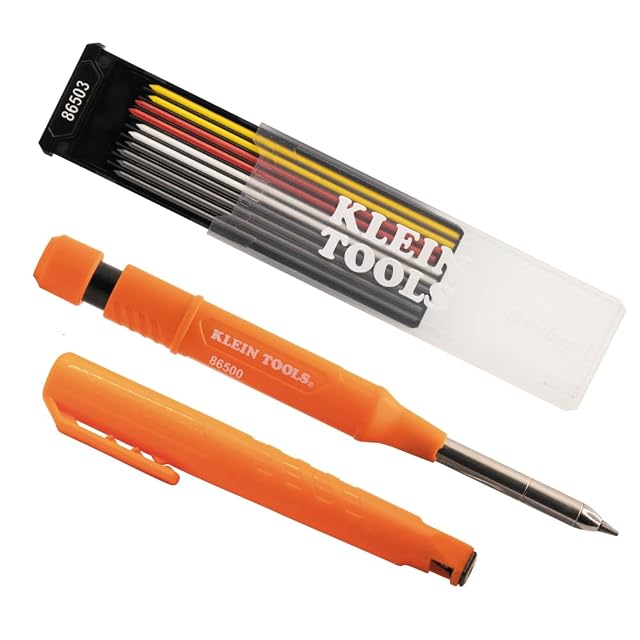
Klein Tools Mechanical carpenter pencil, 2.8 mm (0.11 in), 10 leads

A triangular body does what a flat pencil does — it stays on the beam — and the ten leads come in a case.

Klein Tools Skribes mechanical carpenter pencil with triangular barrel

Klein Tools Mechanical carpenter pencil, 2.8 mm (0.11 in), 10 leads

A triangular body does what a flat pencil does — it stays on the beam — and the ten leads come in a case.

Body and fittings
A TRIANGULAR-shaped barrel, stated to prevent the tool rolling away. This shelf's introduction says a flat carpenter pencil does not roll off a beam and that this is one of its two virtues; a triangle keeps that property in a mechanical body, which a round barrel does not. It is one of two anti-roll designs on this shelf
Supplied
A TEN-PACK of assorted color replacement leads in a carrying case — Klein cat. no. 86503 — alongside the marking tool itself, cat. no. 86501. Ten is the largest lead count on this shelf, where the others ship four, six or seven, and a case rather than a loose sleeve is what stops 2.8 mm (0.11 in) leads snapping in a bag
Functions
A 2.8 mm (0.11 in) lead, stated to create long-lasting marks, with a built-in sharpener to keep it sharp for precision marking. Two point eight millimeters is the common mechanical carpenter lead and one of two diameters published on this shelf
Also stated
Tough enough for OSB, wood, concrete and metal, stated. OSB is the useful one on that list: a chipped, resinous, uneven face is where a soft lead skates and a hard one gouges, and it is the surface a framing pencil actually meets
Material
Not published. No barrel material, no tip dimensions and no lead HARDNESS appears — and the leads are described only as assorted color, with not one color named. This shelf's introduction says graphite disappears on dark stone where white or red shows; this listing gives you ten leads and no way to know which is which before opening the case
Reference and mounting
Two Klein catalog numbers inside one product reference: the 80189 kit is the 86501 marking tool plus the 86503 lead pack. No belt clip is stated, where two markers on this shelf publish one
Amazon reference
B0F9HBC845
EAN
0092644801891
  • A triangular barrel: it stays where you put it
  • Ten replacement leads, the most on this shelf
  • "Assorted color" leads, with no color named

Best for: A pencil that will be put down on a joist forty times a day and still be there

≈ $15
Check price on Amazon
Specifications

Body and fittings
A TRIANGULAR-shaped barrel, stated to prevent the tool rolling away. This shelf's introduction says a flat carpenter pencil does not roll off a beam and that this is one of its two virtues; a triangle keeps that property in a mechanical body, which a round barrel does not. It is one of two anti-roll designs on this shelf
Supplied
A TEN-PACK of assorted color replacement leads in a carrying case — Klein cat. no. 86503 — alongside the marking tool itself, cat. no. 86501. Ten is the largest lead count on this shelf, where the others ship four, six or seven, and a case rather than a loose sleeve is what stops 2.8 mm (0.11 in) leads snapping in a bag
Functions
A 2.8 mm (0.11 in) lead, stated to create long-lasting marks, with a built-in sharpener to keep it sharp for precision marking. Two point eight millimeters is the common mechanical carpenter lead and one of two diameters published on this shelf
Also stated
Tough enough for OSB, wood, concrete and metal, stated. OSB is the useful one on that list: a chipped, resinous, uneven face is where a soft lead skates and a hard one gouges, and it is the surface a framing pencil actually meets
Material
Not published. No barrel material, no tip dimensions and no lead HARDNESS appears — and the leads are described only as assorted color, with not one color named. This shelf's introduction says graphite disappears on dark stone where white or red shows; this listing gives you ten leads and no way to know which is which before opening the case
Reference and mounting
Two Klein catalog numbers inside one product reference: the 80189 kit is the 86501 marking tool plus the 86503 lead pack. No belt clip is stated, where two markers on this shelf publish one
Amazon reference
B0F9HBC845
EAN
0092644801891

What the maker puts in writing

  • 2.8 mm (0.11 in) lead, creates long-lasting marks · built-in sharpener
  • “ANTI-ROLL DESIGN: Triangular-shaped barrel prevents marking tool from rolling away”
  • 10-pack assorted color replacement leads, stored in a carrying case
  • Tough enough to write on jobsite surfaces including OSB, wood, concrete and metal
  • Kit: cat. no. 86501 marking tool plus cat. no. 86503 replacement multi-color leads

No lead hardness. No lead colors named. No tip dimensions. No barrel material.

A triangle stays on the beam

Which is the flat pencil’s one virtue, kept.

This shelf’s introduction: a flat carpenter pencil does not roll off a beam and lays a wide, visible line on rough timber.

All five markers on this shelf are mechanical rather than flat. Most of them are round, and round rolls.

A triangle sits on a face and stays there.

For a framer putting a pencil down on a joist forty times a day, that is the difference between one pencil and three.

One other marker here solves it differently: a roll stop on both the pencil and its holster.

Ten leads, and no colors named

Which is the gap.

The listing says a 10-pack of assorted color replacement leads. It names none of them.

The marker beside it on this shelf writes out graphite for wood, metal and drywall, yellow and red for stone, ceramic and concrete — because the introduction above says the color is what decides which surfaces take a mark.

Ten leads is generous. Finding out what they are when the case is opened is a poor way to discover that none of them is white.

OSB, which is the honest surface to name

Not wood. OSB.

A chipped, resinous, uneven face is where a soft lead skates and a hard one gouges.

It is also the surface a framing pencil actually meets, several hundred times a day — and the only listing on this shelf to name it.

And a case for the leads

Which sounds like packaging until a 2.8 mm (0.11 in) lead snaps in a tool bag.

Ten loose leads in a sleeve become six leads and four halves.

Klein ships them in a carrying case.

Availability

On sale at around 15 € on the American Amazon store at the time of checking.

Prices and availability are what Keepa reported on the date this page was updated; both move.

Prices quoted in this text were read on 8 October 2026. The live price is at the top of the page.

What gets asked here

Does a triangular barrel really matter?

On a beam, yes, and it is the one virtue of the flat carpenter pencil this shelf has otherwise lost. This shelf's introduction says a flat pencil does not roll off a beam and lays a wide line on rough timber — and all five markers here are mechanical rather than flat, so most of them are round and will roll. A triangle sits on a face and stays. For a framer putting a pencil down on a joist forty times a day that is the difference between one pencil and three. One other marker on this shelf solves it differently, with a roll stop on both the pencil and its holster.

What colors are the ten leads?

Klein does not say, which is the gap on an otherwise practical kit. The listing states a 10-pack of assorted color replacement leads and names none of them, where the marker beside it on this shelf writes out graphite for wood, metal and drywall and yellow and red for stone, ceramic and concrete. This shelf's introduction says the color decides which surfaces take a mark. Ten leads is generous and you will find out what they are when the case is opened — which is a poor way to discover that none of them is white.

Is 2.8 mm (0.11 in) the right lead size?

It is the standard for this kind of tool and the reason refills are easy to find. Two point eight millimeters is thick enough to survive being pushed into a drilled hole and sharpened to a point, and thin enough to mark a line you can cut to — which this shelf's buying tip says is the real question: a wide carpenter line is a millimeter or more and far too coarse for a hole you mean to place precisely. Two of the five markers on this shelf publish 2.8 mm (0.11 in) and the others publish no diameter at all, so a refill for them is a guess.

All marking pencils