Target plates
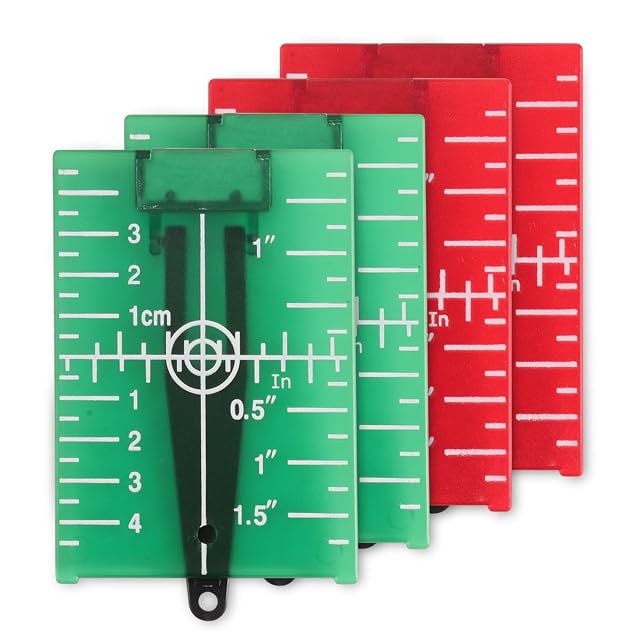
SMTOER Target plates, 2 green and 2 red, 10 × 7 cm (3.9 × 2.8 in)
The only box on this shelf that answers the tint question by containing both answers — and the only plate that tells you how big it is.
Specifications
- Supplied
- Two RED and two GREEN plates in one package, stated. It is the only set on this shelf that covers both diode colors — this shelf's introduction says the tint must match the diode and calls it the one specification people get wrong, and this box removes the decision. It also gives two plates per color, which is what transferring a line across a room actually takes
- Stated dimension or range
- 10 × 7 cm (4 × 2.8 in), 30 g each, with a slim profile for a pocket or toolkit. It is the ONLY published size on this shelf — this shelf's introduction lists size as one of five comparisons and at least six of the ten plates here leave it to the photograph
- Scale
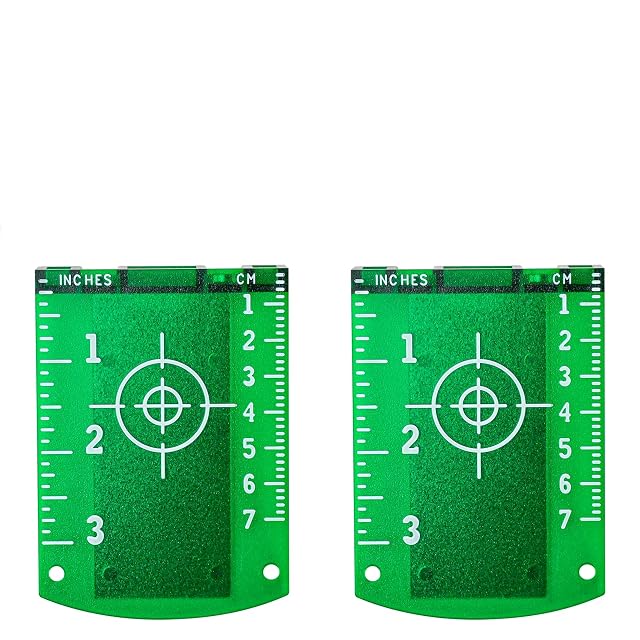
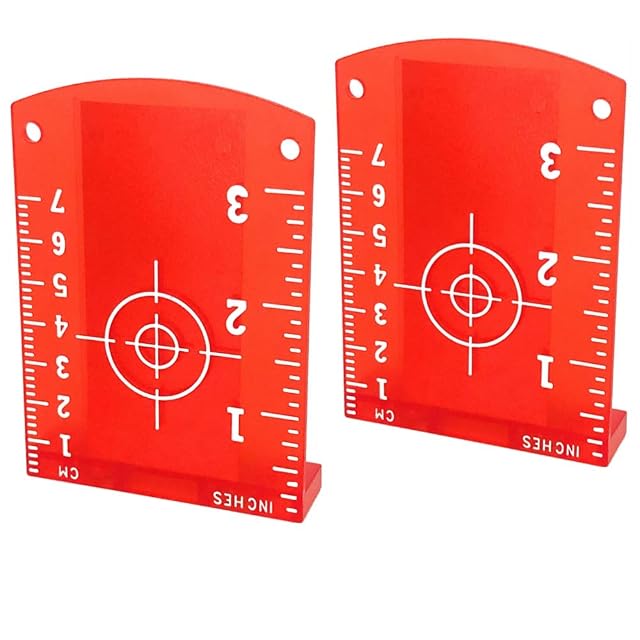
- Front-facing BULLSEYE patterns with dual-unit scales in inches and centimeters, stated to enable accurate measurements. A bullseye rather than a cross: concentric rings give a center that can be judged from any angle, where a cross has to be read square on
- Functions
- A reflective backing stated to enhance laser spot recognition in direct sunlight or low light. No brightness gain figure is published, where one maker on this shelf states 1.3×
- Material
- Durable ABS plastic, stated, with a magnetic base for metal surfaces. ABS is named, which four plates on this shelf do not do — a rigid plate stays flat where a card curls
- Reference and mounting
- A magnetic base for attachment to metal surfaces, and the title states a stand. No hook hole is published, and two plates on this shelf publish three fixing routes
- Amazon reference
- B0FNMYRHF9
- EAN
- 0712110938646
What the maker puts in writing
- 2 red and 2 green laser target plates in the package
- “Each lightweight target (30g) measures 10 x 7 cm (3.9 × 2.8 in) (4 x 2.8 inches) with a slim profile”
- Front-facing bullseye patterns with dual-unit scales (inches/centimeters)
- Reflective backing to enhance laser spot recognition in direct sunlight or low-light
- Durable ABS plastic · magnetic base for metal surfaces
- Compatible with alignment lasers, cross-line lasers, rotary lasers and laser measurers
No brightness gain figure. No hook hole. Nothing about the magnets.
Both answers in one box
Which no other listing on this shelf offers.
This shelf’s introduction: the tint is matched to the diode, a red plate does very
little for a green line, and that is the one specification people get wrong.
Two red and two green removes the decision.
And two plates per color is what transferring a line across a room actually
takes — a datum at one wall, a check at the other, nothing moved in between.
The only plate that says how big it is
Ten by seven centimeters. Thirty grams.
A target plate is read at a distance and carried in a pocket, and those pull
opposite ways.
Ten by seven is about the size of a phone: obvious at twenty meters, and it still
goes in a shirt pocket with the laser.
At least six of the ten plates on this shelf publish no size at all, which leaves you
judging from a photograph of somebody’s hand. This shelf’s introduction lists size as
one of five comparisons.
A bullseye reads off-square
Which a cross does not.
A printed cross is read by seeing whether the line lies along it. That works
standing in front of the plate and gets ambiguous from an angle.
Concentric rings stay concentric however you look at them.
On a plate clipped to a stud and read from twenty meters down a room, that is the
difference. And it makes a POINT laser — a distance meter dot rather than a line —
easy to center, which a cross does not.
ABS, which four plates here do not name
A rigid plate stays flat. A card curls.
A curled plate reads a line slightly off, and the error is the curl.
What SMTOER does not publish is a brightness gain. One maker on this shelf states
1.3×; this says reflective backing and stops.
Availability
On sale at around 32 € on the American Amazon store at the time of checking.
Prices and availability are what Keepa reported on the date this page was updated; both move.
Prices quoted in this text were read on 8 October 2026. The live price is at the top of the page.