A marking crayon specified for the condition that defeats everything else.
What the manufacturer publishes
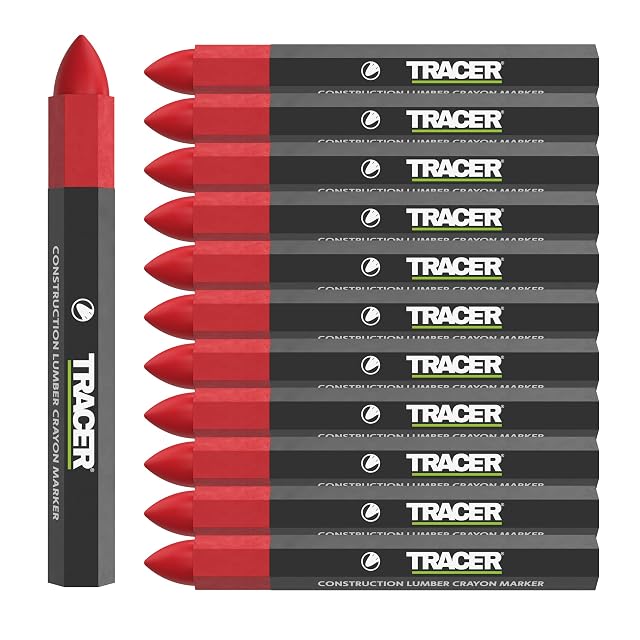
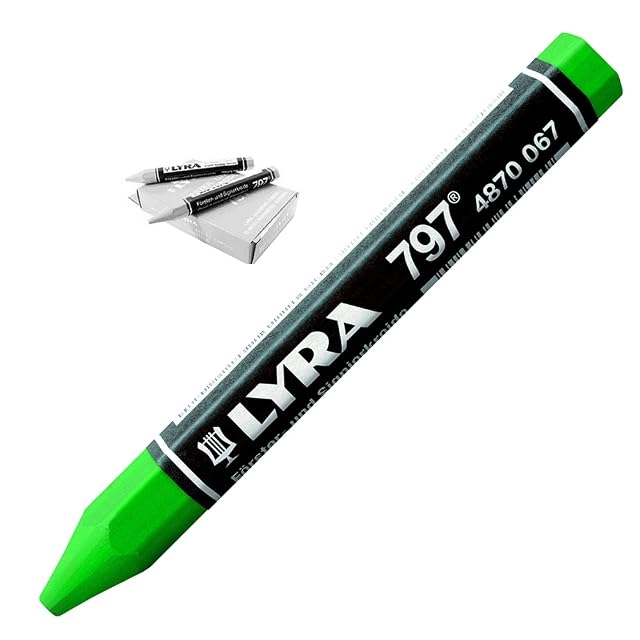
Marking crayons stated as ideal for construction sites, forestry and the trades. Specially developed to adhere on damp as well as dry surfaces. A robust, wide wax tip of 3 to 6 mm (0.12 to 0.24 in) delivering precise marks.
Wet is the hard case
Every marking method assumes a dry surface. Graphite needs texture to grip; chalk needs somewhere to sit. On wet timber, wet concrete or a rained-on steel section, both give up — and those are exactly the surfaces that need marking, because that is where the work is.
Wax bonds to a wet surface. It is the reason the forestry industry uses it and the reason it belongs in an outdoor kit.
The trade-off, plainly
What sticks to wet timber also sticks to a finished floor. Use wax where the mark is meant to last, and keep a temporary chalk for anything that will be seen afterwards.
Availability
Read on the day this page was built: $17 at the American Amazon shop.
Read from Keepa on the day this page was last revised; stock and price both move without notice.
Prices quoted in this text were read on 31 August 2026. The live price is at the top of the page.
What gets asked here
Wax or chalk — what is the difference?
Chalk sits in the surface and brushes off; wax bonds to it and does not. Wax is the choice when the mark has to survive rain, handling or time, and the wrong choice when it has to disappear.
Does it really work on wet timber?
That is the stated property, and it is the reason forestry uses wax crayons. A pencil on wet timber leaves nothing at all, and chalk washes off before the log is moved.
How precise is a 3 to 6 mm (0.12 to 0.24 in) tip?
Not very, deliberately. This is a mark to be seen from ten meters, not a cut line. For that, the deep-hole markers in the marking pencils hub are the right tool.
Two ounces of chalk at twenty dollars, with neither the color nor the grade published — the two things this shelf says decide everything.
Also stated
NO Color and NO GRADE. This shelf's introduction opens on it: chalk comes in two grades and choosing wrongly is not recoverable — temporary brushes off, permanent survives weather and also survives being wrong on a finished wall. This listing states neither, and the buying tip says the color is what normally tells you
Stated dimension or range
Two bottles of one ounce each, at twenty dollars thirty-seven — about ten dollars nineteen an ounce. The other bottle on this shelf is eight ounces for two dollars ninety-eight, or thirty-seven cents an ounce: this is twenty-seven times the price per ounce of powder
Functions
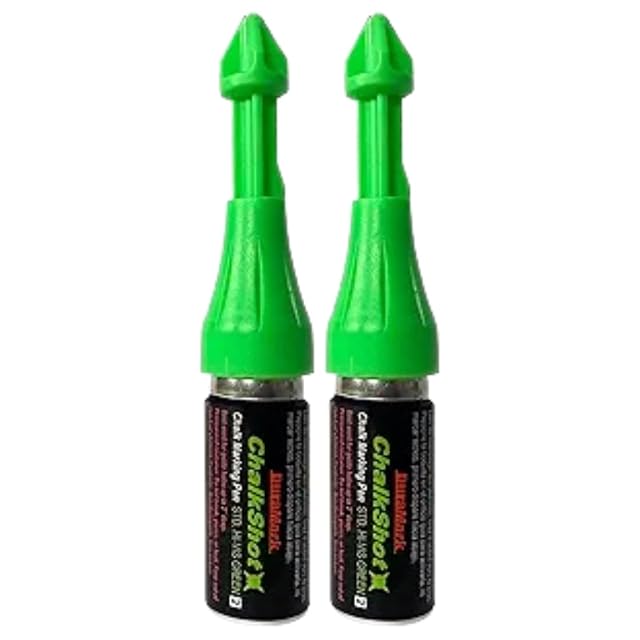
Intended for use with construction MARKERS and marking pen systems rather than a chalk reel — deep-hole marker pens, an Ox pencil, Pica pencil systems and a Tracer TrueShot chalk marker are all named. That is the real distinction on this shelf: a one-ounce bottle with a narrow neck fills a marker cartridge, where an eight-ounce bottle is sized for a reel
Supplied
Two 1 oz containers, stated as a practical multipack and as a gift-ready set. The fifth of five bullets is the gift suggestion
Material
A formula stated optimized for consistent flow and visibility. No fineness figure, no grain size and no material description appears — and fineness is one of the five things this shelf's introduction compares
Reference and mounting
Recorded under the brand "Generic" with the reference US TAPE - DURAMRK - 76700. US Tape is a real layout-tool maker and DuraMark its chalk line; the Generic brand field is a marketplace artefact rather than the product
Amazon reference
B0GV694V9Q
EAN
0840512248763
Sized for a marker cartridge rather than a reel
Compatible systems named: Ox, Pica of the marking pencils shelf, Tracer TrueShot, deep-hole pens
No color stated at all
Best for: Refilling a deep-hole chalk marker, once the color has been confirmed with the seller
Blue chalk sold as water-resistant and fade-resistant, which is the opposite of what the color convention promises.
Stated dimension or range
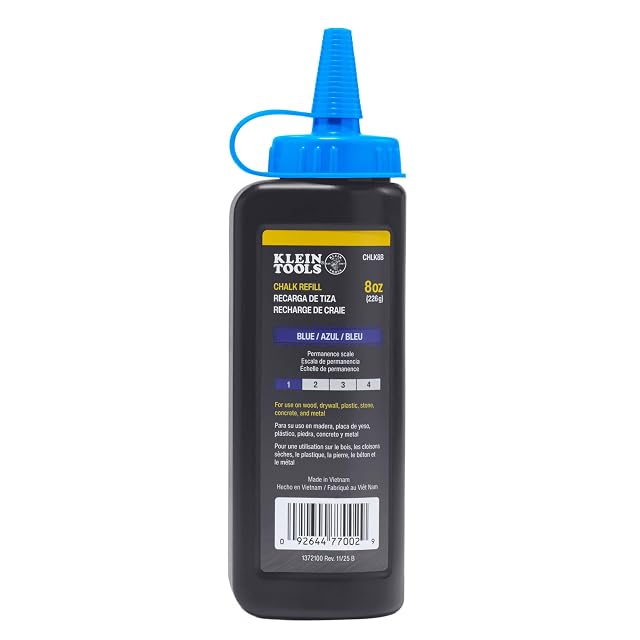
Eight ounces, at two dollars ninety-eight — about 37 cents an ounce. The other bottle on this shelf is two ounces for twenty dollars thirty-seven, which is ten dollars nineteen an ounce: the same shelf, the same powder, a factor of twenty-seven
Material
Ultra-fine powdered chalk, stated to dispense smoothly and give an even coating with enhanced color payoff. Fineness is one of the five things this shelf's introduction compares, and it decides how cleanly the line lays: a coarse chalk leaves a fuzzy band, a fine one a crisp edge
Also stated
SEMI-PERMANENT, fade-resistant under direct sunlight and water-resistant, "measuring in at 1 on the permanence scale" — all of that on BLUE chalk. This shelf's buying tip says to use blue indoors as a default and keep red for outdoors, because on most brands the color tells you which grade is in the bottle. This bottle is blue and sold as surviving sun and water
Supplied
A fine-tipped nozzle stated to slot into chalk reel openings, minimizing spills. Klein says it can be used with ALL chalk reels — which on a shelf where one reel maker ties its tool to its own branded chalk is worth having in writing
Functions
Stated high-visibility on drywall, concrete, stone, wood and plastic. Plastic is the unusual one on that list and it goes with the water resistance: a chalk that will not bleed is a chalk that marks a membrane or a pipe
Reference and mounting
The product reference recorded for this listing is T5169GKLE while the title and the description both read CHLK8B. Two codes for one bottle, and CHLK8B is the one that matches the 8-ounce blue product
Amazon reference
B0H382HFS2
EAN
0092644770029
Thirty-seven cents an ounce, the cheapest chalk here by far
Eight ounces, which fills a reel many times
Blue chalk sold as semi-permanent, against the color convention
Best for: Lines on concrete, stone or plastic that must survive a damp week — not for a finished wall
The only marker here that tells you both how long its tip is and which lead color works on dark stone.
Stated dimension or range
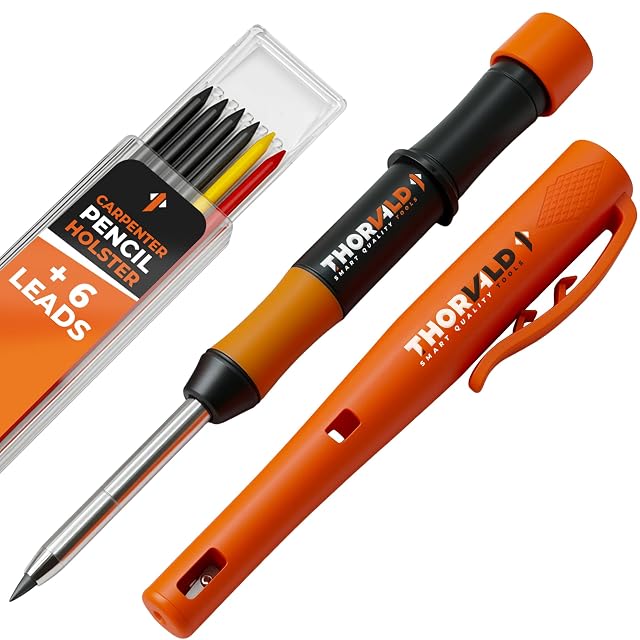
A long narrow tip of 6 mm (0.24 in) DIAMETER and 45 mm (1.77 in) LENGTH, stated, for marking deep holes, gaps, tight corners, hinges and fittings. It is the ONLY tip dimension published on this shelf — one other marker says extra-long needle-nose and gives no figure — and both numbers matter: the diameter decides which hole it enters and the length decides how far down it reaches
Supplied
SIX leads: four graphite plus one yellow and one red — and THORVALD is the only maker here to say what each color is for. Graphite for wood, metal, drywall and light surfaces; yellow and red for stone, ceramic, concrete and dark materials. This shelf's introduction says graphite disappears on dark stone where white or red shows, and this is the listing that acts on it
Body and fittings
A protective holster with an integrated sharpener and a quick-clip attachment, stated for one-hand access on a ladder or overhead. The holster is where the sharpener lives, which means it cannot be lost separately — and the clip is what keeps the marker off the floor
Material
A soft-touch grip stated to hold firmly with dusty, sweaty or wet hands, in a heavy-duty holster and body stated to resist drops, dust, moisture and impact. A high-visibility orange body, stated — which on a site floor is the difference between finding it and buying another
Functions
Mechanical lead advance. No lead HARDNESS is published — no HB, no 2B, nothing — and neither is a lead diameter, where two markers on this shelf state 2.8 mm (0.11 in). This shelf's introduction says lead hardness and color decide which surfaces take a mark; this listing answers the color half completely and the hardness half not at all
Also stated
Named for plumbers, trim installers, cabinet makers, metalworkers and finish carpentry, and separately for electricians, framers, roofers and HVAC. Every tool inspected before shipping, stated
Amazon reference
B0G7G86R3D
EAN
3760394610069
The only published tip dimensions here: 6 mm (0.24 in) by 45 mm (1.77 in)
Six leads, with the color-to-surface match written out
No lead hardness published
Best for: Marking through a hinge recess or a fixing hole on concrete, where graphite shows nothing
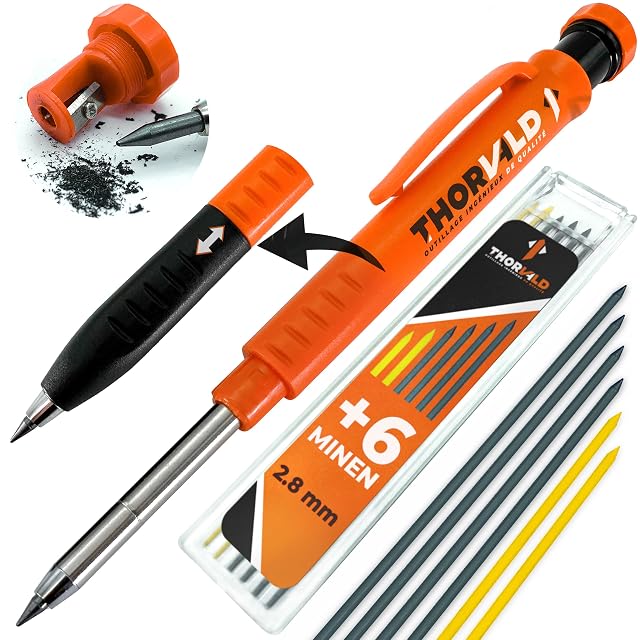
A marker built to reach through a drilled hole or into a recess — a 6 mm (0.24 in) tip on a 43 mm (1.69 in) reach, which no flat carpenter pencil can do.
Amazon reference
B0BD8J7K6F (identical on 6 markets)
EAN
3760312570567
Stated dimension or range
6 mm (0.24 in) tip · 43 mm (1.69 in) reach
Marking medium
seven leads
Body and fittings
integrated sharpener and clip
A 6 mm (0.24 in) tip on a stated 43 mm (1.69 in) reach, so it marks through a hole or into a recess
Seven leads supplied, with an integrated sharpener and a clip
A narrow lead breaks more readily than a carpenter pencil's
Best for: Marking through an existing hole — the job a flat pencil physically cannot reach.