Skip to content

THORVALD Deep-hole marker with holster, 45 mm (1.77 in) tip

The only marker here that tells you both how long its tip is and which lead color works on dark stone.

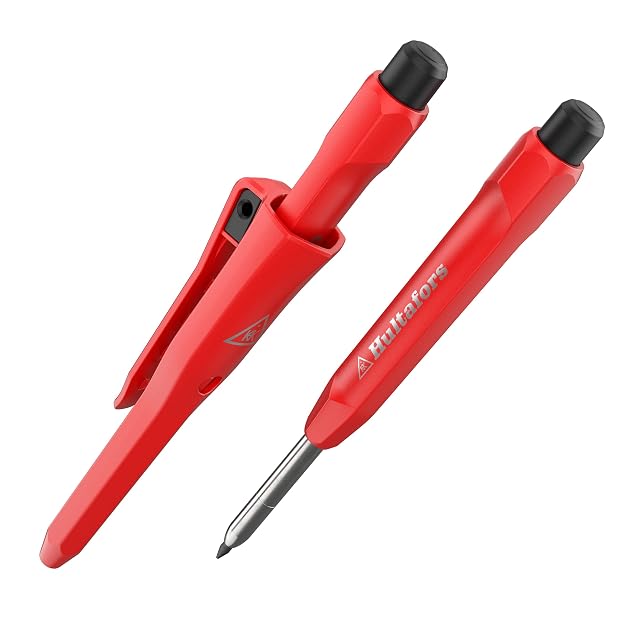
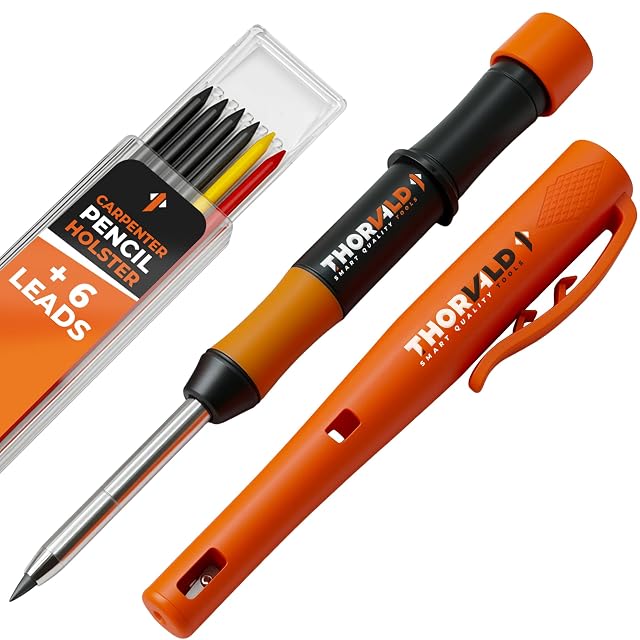
THORVALD orange mechanical deep-hole marker in its holster

THORVALD Deep-hole marker with holster, 45 mm (1.77 in) tip

The only marker here that tells you both how long its tip is and which lead color works on dark stone.

Stated dimension or range
A long narrow tip of 6 mm (0.24 in) DIAMETER and 45 mm (1.77 in) LENGTH, stated, for marking deep holes, gaps, tight corners, hinges and fittings. It is the ONLY tip dimension published on this shelf — one other marker says extra-long needle-nose and gives no figure — and both numbers matter: the diameter decides which hole it enters and the length decides how far down it reaches
Supplied
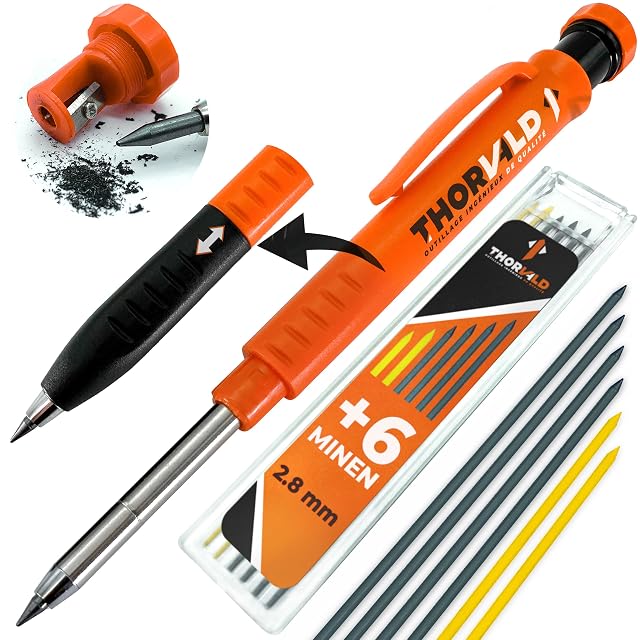
SIX leads: four graphite plus one yellow and one red — and THORVALD is the only maker here to say what each color is for. Graphite for wood, metal, drywall and light surfaces; yellow and red for stone, ceramic, concrete and dark materials. This shelf's introduction says graphite disappears on dark stone where white or red shows, and this is the listing that acts on it
Body and fittings
A protective holster with an integrated sharpener and a quick-clip attachment, stated for one-hand access on a ladder or overhead. The holster is where the sharpener lives, which means it cannot be lost separately — and the clip is what keeps the marker off the floor
Material
A soft-touch grip stated to hold firmly with dusty, sweaty or wet hands, in a heavy-duty holster and body stated to resist drops, dust, moisture and impact. A high-visibility orange body, stated — which on a site floor is the difference between finding it and buying another
Functions
Mechanical lead advance. No lead HARDNESS is published — no HB, no 2B, nothing — and neither is a lead diameter, where two markers on this shelf state 2.8 mm (0.11 in). This shelf's introduction says lead hardness and color decide which surfaces take a mark; this listing answers the color half completely and the hardness half not at all
Also stated
Named for plumbers, trim installers, cabinet makers, metalworkers and finish carpentry, and separately for electricians, framers, roofers and HVAC. Every tool inspected before shipping, stated
Amazon reference
B0G7G86R3D
EAN
3760394610069
  • The only published tip dimensions here: 6 mm (0.24 in) by 45 mm (1.77 in)
  • Six leads, with the color-to-surface match written out
  • No lead hardness published

Best for: Marking through a hinge recess or a fixing hole on concrete, where graphite shows nothing

≈ $10
Check price on Amazon
Specifications

Stated dimension or range
A long narrow tip of 6 mm (0.24 in) DIAMETER and 45 mm (1.77 in) LENGTH, stated, for marking deep holes, gaps, tight corners, hinges and fittings. It is the ONLY tip dimension published on this shelf — one other marker says extra-long needle-nose and gives no figure — and both numbers matter: the diameter decides which hole it enters and the length decides how far down it reaches
Supplied
SIX leads: four graphite plus one yellow and one red — and THORVALD is the only maker here to say what each color is for. Graphite for wood, metal, drywall and light surfaces; yellow and red for stone, ceramic, concrete and dark materials. This shelf's introduction says graphite disappears on dark stone where white or red shows, and this is the listing that acts on it
Body and fittings
A protective holster with an integrated sharpener and a quick-clip attachment, stated for one-hand access on a ladder or overhead. The holster is where the sharpener lives, which means it cannot be lost separately — and the clip is what keeps the marker off the floor
Material
A soft-touch grip stated to hold firmly with dusty, sweaty or wet hands, in a heavy-duty holster and body stated to resist drops, dust, moisture and impact. A high-visibility orange body, stated — which on a site floor is the difference between finding it and buying another
Functions
Mechanical lead advance. No lead HARDNESS is published — no HB, no 2B, nothing — and neither is a lead diameter, where two markers on this shelf state 2.8 mm (0.11 in). This shelf's introduction says lead hardness and color decide which surfaces take a mark; this listing answers the color half completely and the hardness half not at all
Also stated
Named for plumbers, trim installers, cabinet makers, metalworkers and finish carpentry, and separately for electricians, framers, roofers and HVAC. Every tool inspected before shipping, stated
Amazon reference
B0G7G86R3D
EAN
3760394610069

What the maker puts in writing

  • “The long, narrow tip (6 mm (0.24 in) diameter, 45 mm (1.77 in) length) lets you mark deep holes, gaps, tight corners, hinges and fittings”
  • 6 leads included: 4 graphite + yellow + red. “Graphite leads for wood, metal, drywall, and light surfaces + yellow and red leads for stone, ceramic, concrete, and dark materials.”
  • A protective holster with an integrated sharpener and quick-clip attachment
  • Soft-touch grip engineered to hold firmly with dusty, sweaty or wet hands
  • Heavy-duty holster and body resist drops, dust, moisture and impact · high-visibility orange

No lead hardness. No lead diameter.

Two tip numbers, which nobody else gives

And they answer two different questions.

Six millimeters of DIAMETER decides which hole the tip enters. A fixing hole for an 8 mm (0.31 in) plug takes it. A 5 mm (0.20 in) pilot does not.

Forty-five millimeters of LENGTH decides how far past the face of the material it reaches — which is what marking through a hinge recess, a joist hanger or a cabinet back actually needs.

One other marker on this shelf says extra-long needle-nose and publishes no figure. The only way to know is to try it on the hole.

Which color on which surface

Written out, and only here.

Graphite for wood, metal, drywall and light surfaces. Yellow and red for stone, ceramic, concrete and dark materials.

The reason is contrast, not hardness. A graphite mark is a dark grey line — invisible on grey concrete, dark slate or a black steel section. A yellow or red pigment lead shows on all three.

This shelf’s introduction says exactly this: graphite disappears on dark stone, where white or red shows.

Another marker on this shelf ships ten assorted-color leads and names none of them.

A holster, because the tip is thin

A bare marker clipped to a pocket has its tip against your chest.

It snaps the lead the first time you kneel.

A holster protects the tip and gives the sharpener somewhere to live that cannot be lost on its own.

The cost is bulk on a belt already carrying a tape and a knife.

And no hardness, like everything here

This shelf’s introduction: lead hardness AND color decide which surfaces take a mark.

Five markers on this shelf. Zero published hardnesses — no HB, no 2B, nothing.

This listing answers the color half completely and the hardness half not at all.

Availability

On sale at around 10 € on the American Amazon store at the time of checking.

Prices and availability are what Keepa reported on the date this page was updated; both move.

Prices quoted in this text were read on 8 October 2026. The live price is at the top of the page.

What gets asked here

Why do both tip dimensions matter?

Because they answer two different questions and only this listing answers either. The DIAMETER — 6 mm (0.24 in) — decides which hole the tip will enter: a fixing hole for an 8 mm (0.31 in) plug takes it, a 5 mm (0.20 in) pilot does not. The LENGTH — 45 mm (1.77 in) — decides how far past the face of the material it can reach, which is what marking through a hinge recess, a joist hanger or a cabinet back actually needs. One other marker here says extra-long needle-nose and publishes no figure at all, so the only way to know is to try it on the hole.

Which lead for which surface?

THORVALD writes it out, which nobody else on this shelf does: graphite for wood, metal, drywall and light surfaces; yellow and red for stone, ceramic, concrete and dark materials. The reason is contrast rather than hardness — a graphite mark is a dark grey line, which is invisible on grey concrete, dark slate or a black steel section, and a yellow or red pigment lead shows on all three. This shelf's introduction says exactly this. Another marker here ships ten assorted-color leads and names none of the colors.

Is a holster better than a clip?

For a mechanical marker with an exposed thin tip, yes. A bare marker clipped to a pocket has its tip against your chest and snaps the lead the first time you kneel; a holster protects the tip and gives the sharpener somewhere to live that cannot be lost separately. The cost is bulk on a belt already carrying a tape and a knife. One other marker on this shelf also uses a holster and adds a drainage hole in its base to let moisture out; this one states a quick clip for one-hand access instead.

All marking pencils