Target plates
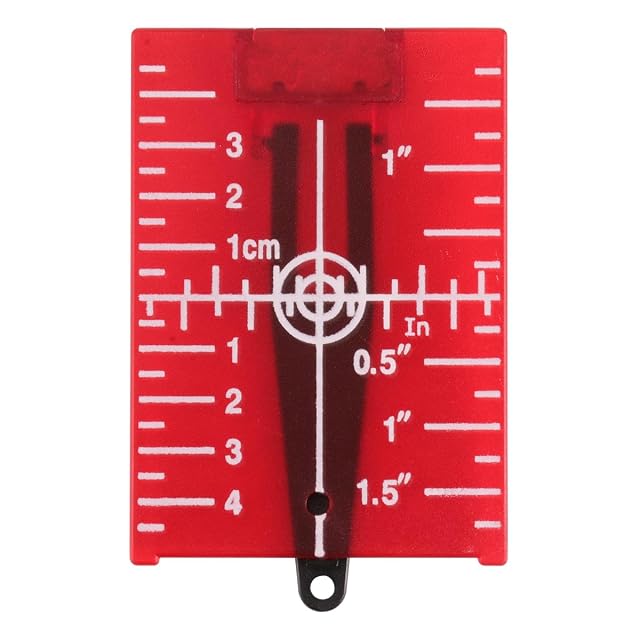
MOETER Red laser target plate, 1.3× film, floor stand
The only plate here with a numbered brightness gain — on a red plate whose own listing says it suits green lasers as well.
Specifications
- Functions
- A special reflective target film stated to increase the brightness of RED laser lines or points by 1.3 times in long-distance or bright sunlight conditions. One point three is the ONLY numbered gain on this shelf — the other plates say reflective backing, or high-contrast, and leave you to judge
- Scale
- Center-zero scales in BOTH inches and centimeters, stated easy to read. Center zero is the detail that matters: a target plate is used to transfer a line, and a scale reading outward from the middle gives the offset directly in either direction without arithmetic
- Reference and mounting
- Three fixings, stated: strong magnets for metal studs, a hole for hook mounting, and a fold-out back stand to stand it upright on a floor. Three routes is the most on this shelf, and the floor stand is what makes a plate usable where there is no steel and nothing to hang it on
- Also stated
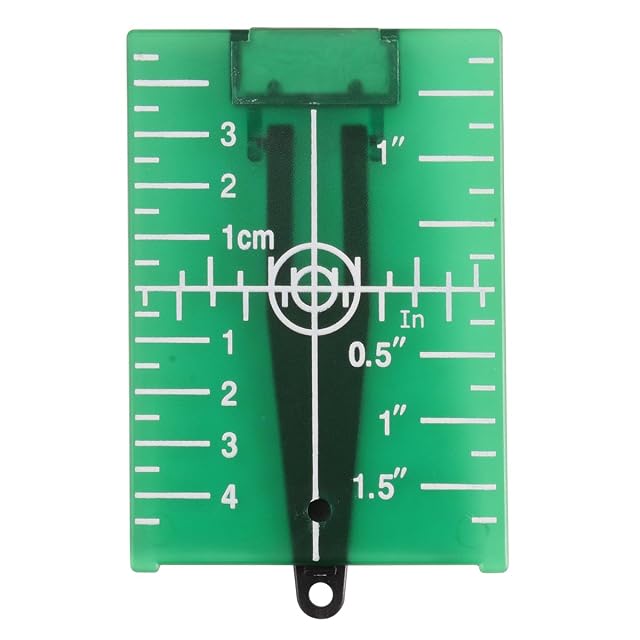
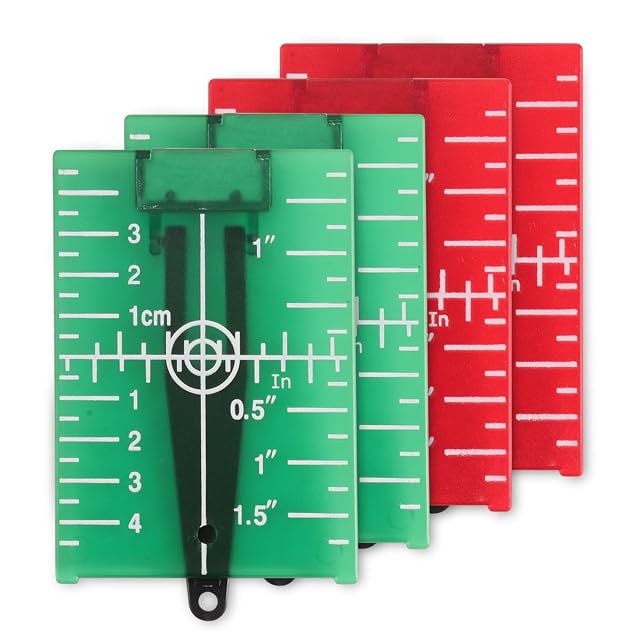
- The fourth bullet reads: "compatible with both red and green beam laser levels". This shelf's introduction says a red plate does very little for a green line and calls that the one specification people get wrong, and the buying tip warns that listings frequently show both plates lit by the same beam. This is a RED plate, sold beside the maker's own GREEN plate at the same price — the two exist precisely because the tints are not interchangeable
- Material
- Lightweight and rugged, stated, compact enough for a toolkit. No dimensions and no weight appear, where one plate on this shelf publishes 10 × 7 cm (3.9 × 2.8 in) and 30 g (1.1 oz)
- Supplied
- The plate. The parcel weighs 27 g (1 oz), which is consistent with a single card rather than a pair — two plates on this shelf ship in multiples
- Amazon reference
- B0DCFL4DXX
- EAN
- 0711271802087
What the maker puts in writing
- “Increasing their brightness by 1.3 times in long-distance or bright sunlight conditions” — for RED laser lines or points
- Easy-to-read scales with center zero in both inches and centimeters
- Three fixings: strong magnets for metal studs, a hole for hook mounting, a fold-out back stand for floors
- Bullet 4: “It is compatible with both red and green beam laser levels”
- Lightweight yet rugged, compact enough for a toolkit
No dimensions. No weight. No count.
Its own fourth bullet contradicts the shelf
And the shelf is right.
A tinted plate works by absorbing everything EXCEPT the wavelength of the beam.
The beam comes back, the surroundings go dark.
Which is why a red plate makes a red line jump out and does very little for
green.
This shelf’s introduction calls that the one specification people get wrong. The
buying tip warns that listings frequently show both plates lit by the same beam.
And MOETER sells a GREEN plate, the LT02G, at the same price — the two exist
precisely because the tints are not interchangeable.
Buy the one that matches the diode.
One point three, and no method
The only number on this shelf.
Thirty per cent more apparent brightness, and no distance, no lighting condition
and no instrument stated.
Take it as a relative claim.
What is not in doubt is the mechanism: a reflective tinted film returns more of
the beam to the eye than painted plaster or dark brick does. On a long run in
daylight, that is a visible line against a guessed one.
The other six plates here claim the same effect with no figure at all.
Zero in the middle
Which is the difference between a transfer tool and a ruler.
You set the plate so the laser crosses it, then measure from the line to the mark
you actually want. Above, or below.
Center zero gives that offset directly, in either direction.
A scale starting at one edge means subtracting the center value every time, in a
notebook, in the rain.
And three ways to fix it
Magnets, a hook hole, a fold-out stand.
Magnets are the fastest and need steel. A hook hole needs something to hang on.
The fold-out stand is the one that works on a bare floor in an empty room — which
is where a laser gets used most, and where a magnet does nothing at all.
Availability
On sale at around 9 € on the American Amazon store at the time of checking.
Prices and availability are what Keepa reported on the date this page was updated; both move.
Prices quoted in this text were read on 8 October 2026. The live price is at the top of the page.