It stands up on its own, which is what a tape cannot do · review
Meister Beech folding rule, 3 m (10 ft) review
Three meters of beech in fifteen segments, marked to EC class III, with extra-large tens figures for reading at arm's length and a double scale along both edges.
What the figures leave us with The straightforward 3 m (10 ft) rule. Legible, class-marked, and priced so that losing it is annoying rather than expensive.
The plain three-meter rule, done properly and not stretched into anything else.
What the manufacturer publishes
Length 3 m (10 ft), 15 segments, EC accuracy class III, beech, white. Metric graduation in black on both faces, with extra-large tens figures for quick reading, and a marked double scale along the edges. Joints described as stable and latching exactly at 90°. Meister states it is made in the EU.
The tens figures are the feature
A rule is read at whatever distance your arm reaches, often in bad light, often at an angle. What fails first is not seeing the millimeter marks — it is losing track of which decimetre you are in, and writing down 1.42 for 1.52. Large tens figures fix the error that actually happens.
Ninety degrees, and what it buys
Joints that latch cleanly at right angles turn the rule into a rough square: fold two segments into an L, hold it into a corner, and you can see whether the corner is square without carrying a square. It is not a precision check — it is the check that stops you cutting the wrong angle.
Availability
Catalogued and unsold: the American Amazon shop lists the reference with nobody behind it.
Read from Keepa on the day this page was last revised; stock and price both move without notice.
What it has, and what it lacks
Strengths
Three meters, the useful length for building work, against two on the Stanley
EC accuracy class III stated, with the material named as beech
Extra-large tens figures, which is what makes a rule readable held out at arm's length
Metric graduation in black on both sides, and a double scale along the edges
Fifteen joints that Meister states lock exactly at 90°
Compromises
No angle scale, unlike the PRESCH and Stabila
Joint material not stated — the Stanley names brass, this one does not
Fifteen segments make a longer folded package than a 2 m (7 ft) rule
Specifications
Amazon reference
B00F4WBYDG (identical on 6 markets)
EAN
4004846442006
Stated dimension or range
3 m (10 ft) beech
Display count
15 segments
EC accuracy class
EC class III
Scale
extra-large tens
What gets asked here
Why does 3 m (10 ft) matter over 2 m (7 ft)?
Ceiling heights, door openings and most single spans in building work sit between 2 and 3 m (10 ft). A 2 m (7 ft) rule needs two placements and an addition for all of them, and an addition is where the mistake goes.
What does "locking exactly at 90°" mean?
Meister states the joints latch precisely at right angles. That lets the rule be used as a square for rough work — folded to an L and held into a corner.
Is the joint material stated?
No. Meister states 15 joints described as stable, and beech as the material of the rule itself, but does not name the joint metal. Stanley states brass for its rule.
Our score
8.2/ 10
The straightforward 3 m (10 ft) rule. Legible, class-marked, and priced so that losing it is annoying rather than expensive.
This one’s price among measuring instruments
A reference exists on these Amazon stores: France, Germany, Italy, Spain, United Kingdom, United States. Listed is not the same as in stock — availability changes daily.
Details checked on August 31, 2026.
Who should pick this one, among measuring instruments
The default building-site rule: three meters, legible, and cheap enough to replace without thinking.
Accessories stated to fit this instrument
Listed because the accessory names this instrument itself.
Amazon reports what buyers took in the month before this page was last checked: at least 100.
The figure is a floor, rounded by Amazon, and read through Keepa — it says what buyers picked, not what a maker claims.
Sources
Specifications: the manufacturer sheet for measuring instruments and the matching Amazon product page. Prices and availability: Keepa. Every figure on this page names its source.
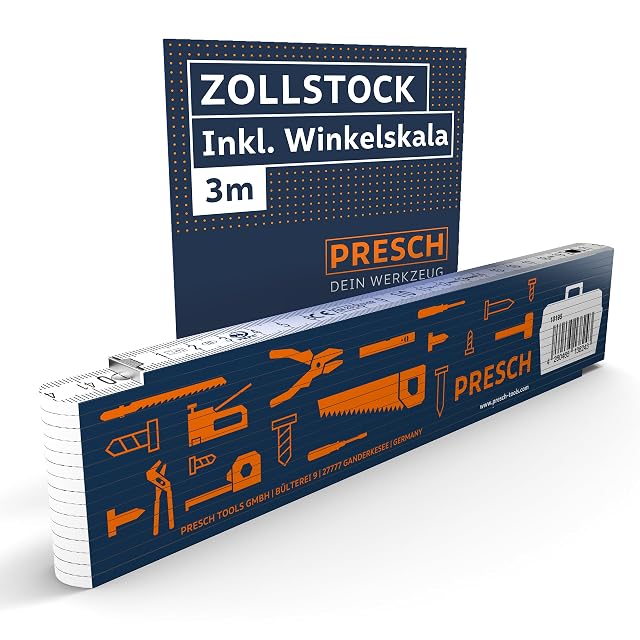
3 m (10 ft) beech · EC class III · integrated angle scale
A 3 m (10 ft) beech rule with an angle scale printed into the joints, so it marks and sets angles as well as lengths — the one function a plain rule cannot do at all.
Best for: Roofing, joinery and anything where the question is what angle, not just how long.
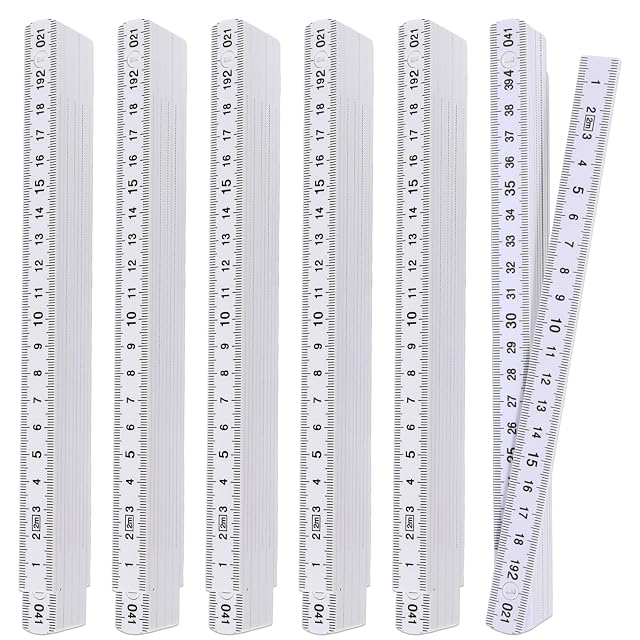
Five rules · 2 m (7 ft) each · ABS joints, PC body · folds to 230 mm (9.06 in)
Five 2 m (7 ft) plastic rules in one pack: a PC body on ABS connectors, ten segments folding to 230 mm (9.06 in), in white with a black scale. The set to buy when rules keep disappearing.
Best for: A workshop, a van and a shed each keeping their own rule, at the price of one wooden one.
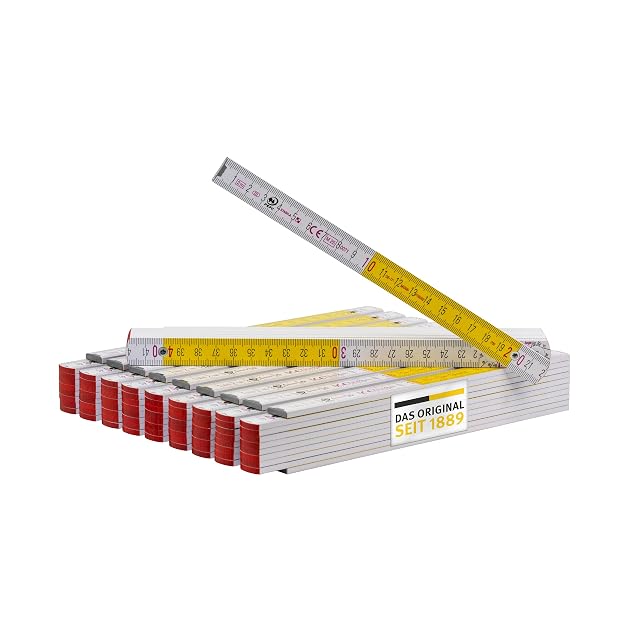
The most expensive rule here, and the only one specified as a marking tool: glass-fiber reinforced polyamide joints, a scribing function with a continuous straight edge when unfolded, PEFC beech and a quick-read scale.
Best for: Someone who marks against their rule all day and wants one that stays straight while doing it.