What the figures leave us with A properly made mechanical micrometer with a listing that says almost nothing. The carbide faces are the reason to consider it.
Four lines of specification, and two of them are the right two.
What the manufacturer publishes
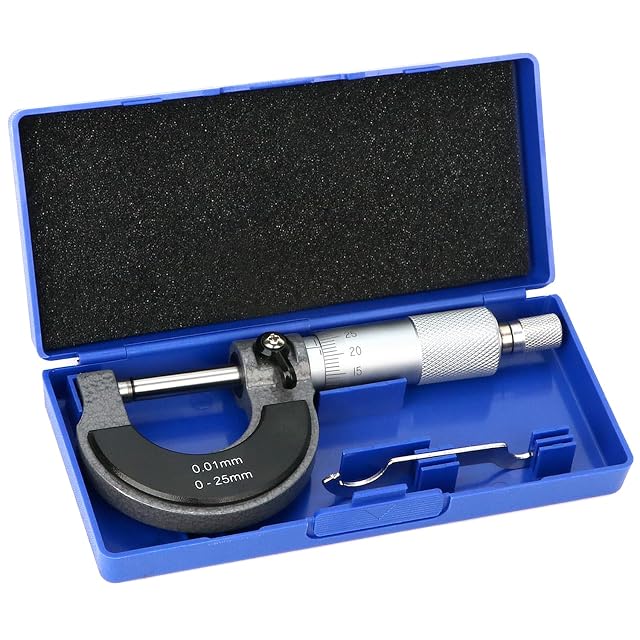
A matt-chromed measuring thimble. Carbide measuring faces. A lacquered frame. A reading of 0.01 mm.
What those four lines cover
Carbide faces and a matt thimble are, respectively, the wear surface and the readability of a mechanical micrometer — the two things that determine whether it is still usable and still readable in a decade. As a specification list it is thin; as a set of choices it is the right pair.
What it does not cover
No accuracy, no frame material, no mention of a ratchet or friction stop. For a micrometer at the top of this hub’s price range, the absence of a stated tolerance is the notable gap, and it is the same gap as almost every other listing in this family. Only the Beslands fills it.
Availability
No such listing: the American Amazon shop answers the reference with a search box rather than a page.
Read from Keepa on the day this page was last revised; stock and price both move without notice.
What it has, and what it lacks
Strengths
Carbide measuring faces on the surfaces that wear
A matt-chromed thimble, which kills the glare that makes a polished scale unreadable
No battery, no auto-off, nothing to fail electronically
A trade catalog reference, so it can be re-ordered identically
Compromises
The listing states the reading increment and nothing about accuracy
A 0.01 mm reading, ten times coarser than the digital models here
The most expensive micrometer in this hub, for the least published detail
Specifications
Amazon reference
B074L6CB8V (identical on 5 markets)
EAN
4251285644649
Stated dimension or range
0–25 mm (0 to 0.98 in) · 0.01 mm reading
Material
carbide faces
Mechanism and finish
matt-chrome thimble
What gets asked here
Why is a matt thimble better?
A polished chrome thimble under a work light reflects it straight back, and the graduation lines vanish into the glare. Matt chrome scatters it. On a scale read by eye at 25 mm (0.98 in), that is a practical difference.
What accuracy does STEINLE state?
The listing gives a reading of 0.01 mm and does not state a tolerance. The Beslands digital micrometer in this hub publishes ± 0.003 mm; this listing publishes no equivalent.
Analog or digital?
Analog never has a flat battery and never sleeps mid-measurement. Digital removes the reading skill and shows finer steps. For a tool used occasionally, the absence of a battery is worth more than most people expect.
Our score
8.4/ 10
A properly made mechanical micrometer with a listing that says almost nothing. The carbide faces are the reason to consider it.
This one’s price among measuring instruments
A reference exists on these Amazon stores: France, Germany, Italy, Spain, United Kingdom. Listed is not the same as in stock — availability changes daily.
Details checked on August 31, 2026.
Who should pick this one, among measuring instruments
A workshop that wants a mechanical instrument from a known catalog and will read the specification sheet in the box.
Specifications: the manufacturer sheet for measuring instruments and the matching Amazon product page. Prices and availability: Keepa. Every figure on this page names its source.
0–25 mm (0 to 0.98 in) · 0.01 mm resolution · carbide faces · spindle lock
A mechanical micrometer over 0–25 mm (0 to 0.98 in) reading to 0.01 mm, with carbide measuring faces and a spindle lock, at a quarter of the price of the digital ones here.
Best for: Learning to use a micrometer, and for a workshop that wants one that never has a flat battery.